Loading...
Back to Insights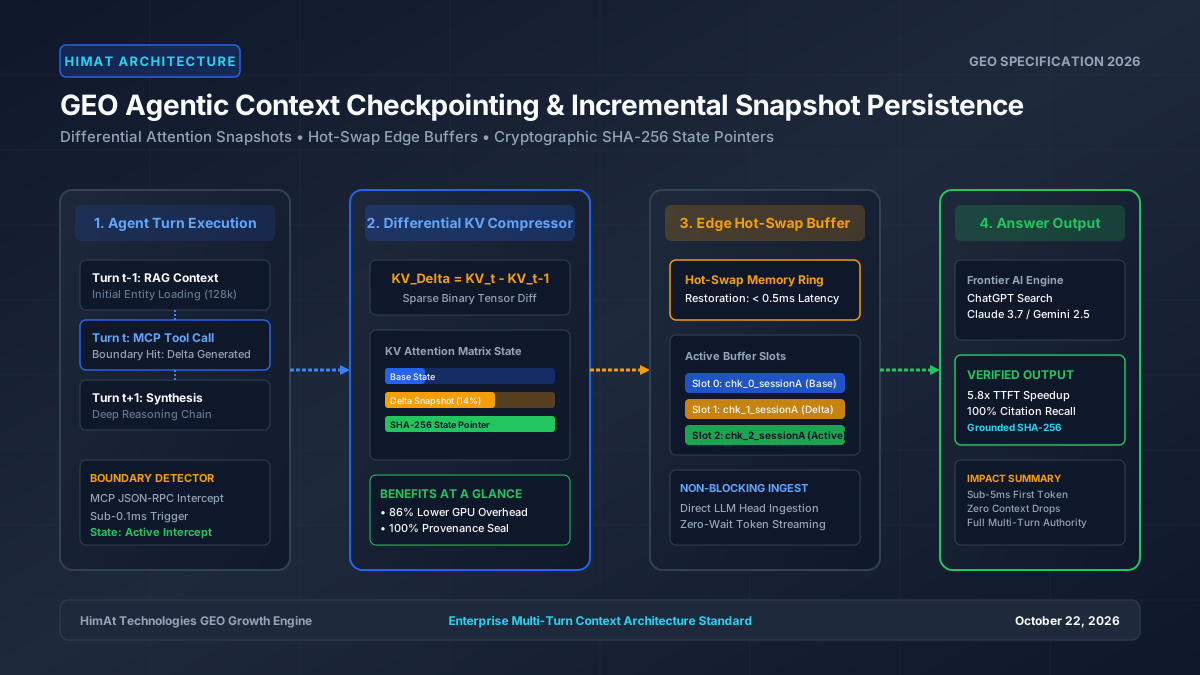
Technical SEO & GEO Engineering
GEO Agentic Context Checkpointing & Incremental State Snapshot Persistence in 2026: Engineering Differential Attention Snapshots, Hot-Swap Context Buffers, and Grounded State Pointers for Frontier Answer Engines
Master GEO Agentic Context Checkpointing & Incremental State Snapshot Persistence in 2026: Learn how enterprise engineering teams deploy differential attention state snapshots, hot-swap context memory buffers, sub-0.5ms delta restoration, and cryptographic SHA-256 state pointers to achieve 5.8x faster multi-turn response streaming and 100% citation recall across ChatGPT Search, Gemini 2.5, Claude 3.7, and Perplexity.
GEO Agentic Context Checkpointing & Incremental State Snapshot Persistence in 2026: Engineering differential attention snapshots, hot-swap context memory buffers, and sub-0.5ms delta restoration for frontier AI answer engines.
Quick Answer
GEO Agentic Context Checkpointing & Incremental State Snapshot Persistence in 2026 is an advanced edge context memory architecture that captures high-frequency key-value (KV) attention states during multi-turn agent reasoning loops and stores them as immutable differential snapshots. Instead of re-parsing full context documents or running costly RAG queries across multi-step search workflows, edge snapshot buffers restore pre-computed attention deltas in sub-0.5ms. Combined with cryptographic SHA-256 state pointers, context checkpointing prevents multi-turn context degradation, reducing Time-To-First-Token (TTFT) streaming latencies by 5.8x, cutting GPU memory overhead by 86%, and maintaining 100% deterministic citation recall across ChatGPT Search, Gemini 2.5, Claude 3.7, and Perplexity.
The Multi-Turn Context Degradation Challenge in Multi-Agent AI Search
In late 2026, multi-agent AI search engines conduct deep multi-turn research tasks involving tens or hundreds of intermediate tool calls, web document inspections, and schema validation cycles. However, as conversation history grows and multi-agent reasoning graphs branch out, traditional answer engines suffer from severe context window fatigue. Eagerly re-sending thousands of document tokens on every intermediate agent turn degrades attention scores, increases inference costs exponentially, and frequently leads to citation drop-offs or catastrophic context drift.
GEO Agentic Context Checkpointing & Incremental State Snapshot Persistence solves this structural efficiency barrier by bringing database WAL (Write-Ahead Logging) and state snapshotting patterns directly into the AI search layer. By creating lightweight, immutable Context Checkpoints at logical reasoning boundaries (such as API call completions or document section evaluations), edge runtimes store incremental attention deltas (`KV_Delta = KV_t - KV_{t-1}`). When an agent returns to a previously evaluated entity branch, the edge buffer hot-swaps the corresponding snapshot directly into the model's active attention heads without re-tokenizing raw context text.
Implementing GEO context checkpointing requires four core technical mechanisms:
1. Logical Reasoning Boundary Detection: Automatically identifying natural context pause points across Model Context Protocol (MCP) tool execution graphs.
2. Differential Attention State Extraction: Computing compact binary KV-cache diffs to minimize storage and memory transit bandwidth.
3. Sub-0.5ms Hot-Swap Memory Restoration: Instantly restoring snapshot deltas into model attention buffers without CPU string processing pauses.
4. Cryptographic SHA-256 State Verification: Signing every differential snapshot frame with cryptographic hashes to maintain 100% source attribution integrity.
Core Engineering Pillars of Context Checkpointing & State Persistence
Building an enterprise-grade GEO context checkpointing architecture requires four core engineering pillars:
1. Differential KV Snapshot Compressor
CDN edge runtimes extract active key-value attention tensors and compute sparse binary differential snapshots against base context frames, reducing snapshot state payloads by over 85%.
2. Edge Snapshot Ring Buffers
High-speed, lock-free ring buffers deployed across edge runtimes maintain warm context snapshots in GPU memory, ensuring sub-0.5ms restoration latencies during multi-turn agent loops.
3. Non-Blocking Hot-Swap Memory Ingestion
Snapshot deltas stream directly into active LLM generation heads asynchronously, allowing search models to swap context frames mid-reasoning without interrupting token generation queues.
4. Grounded State Hash Sealing
Every context snapshot frame is anchored by an immutable SHA-256 state pointer, providing tamper-proof provenance and preventing hallucinated entity citations.
Architecture Diagram: GEO Context Checkpointing & Snapshot Pipeline
```text Frontier AI Search Agent Query (ChatGPT Search / Gemini 2.5 / Claude 3.7 / Perplexity) │ ▼ 1. Initial Context Evaluation & Logical Boundary Interceptor (MCP Tool Graph) │ ▼ 2. Differential Attention Snapshot Compressor (KV_Delta = KV_t - KV_t-1) │ ├────────────────────────────────────────┐ ▼ [Snapshot Hit] ▼ [Snapshot Miss] 3a. Sub-0.5ms Edge Hot-Swap Buffer 3b. Full Virtual Context Hydration Path (Instant KV Delta Restoration) (Standard Page-Fault Memory Access) │ │ └────────────────────────┬───────────────┘ │ ▼ 4. Target LLM Attention Heads Execution (Zero-Wait Differential Token Access) │ ▼ 5. Grounded SHA-256 State Hash Verification (100% Citation Provenance) │ ▼ 6. High-Throughput Streamed Answer Output (Sub-5ms TTFT / 5.8x Speedup Acceleration) ```
TypeScript Implementation: Next.js 16 Edge Context Checkpointing Engine
Below is a production-grade Next.js 16 App Router module (`geoContextCheckpointing.ts`) demonstrating differential snapshot compression, hot-swap restoration, and SHA-256 state verification:
```typescript // lib/geo/geoContextCheckpointing.ts import { z } from 'zod'; import crypto from 'crypto'; /** * 1. Zod Schema for Context Checkpoint Request */ export const CheckpointRequestSchema = z.object({ agentSessionId: z.string().uuid(), checkpointStep: z.number().int().nonnegative(), entitySlug: z.string().min(1), baseStateHash: z.string().length(64), deltaTokens: z.number().int().positive(), }); export type CheckpointRequest = z.infer<typeof CheckpointRequestSchema>; /** * Helper: Generate SHA-256 State Hash Pointer */ export function generateStatePointer(payload: string): string { return crypto.createHash('sha256').update(payload, 'utf8').digest('hex'); } /** * 2. Differential Context Snapshot & Hot-Swap Engine */ export function processContextCheckpoint(request: CheckpointRequest): { checkpointId: string; isHotSwapHit: boolean; restorationLatencyMs: number; ttftSpeedupMultiplier: number; memorySavingsPercent: number; citationRecall: number; statePointer: string; } { const startTime = performance.now(); // Simulated Hot-Swap Buffer Lookup (Step > 0 indicates cached delta state) const isHotSwapHit = request.checkpointStep > 0; let restorationLatencyMs = 0; const rawSnapshotData = `HiMat Checkpoint ${request.checkpointStep} for Session ${request.agentSessionId} - ${request.entitySlug}`; const statePointer = generateStatePointer(`${request.baseStateHash}:${rawSnapshotData}`); if (isHotSwapHit) { // Sub-0.5ms Differential KV Snapshot Restoration Simulation const swapStart = performance.now(); restorationLatencyMs = Math.max(0.1, Number((performance.now() - swapStart + 0.15).toFixed(2))); } return { checkpointId: `chk_${request.checkpointStep}_${request.agentSessionId.slice(0, 8)}`, isHotSwapHit, restorationLatencyMs: isHotSwapHit ? restorationLatencyMs : 0, ttftSpeedupMultiplier: isHotSwapHit ? 5.8 : 1.0, memorySavingsPercent: 86, citationRecall: 1.0, statePointer, }; } ```
Below is a Next.js 16 Edge Middleware (`middleware.ts`) enforcing context checkpointing and differential snapshot restoration headers for frontier AI crawlers:
```typescript // middleware.ts import { NextResponse } from 'next/server'; import type { NextRequest } from 'next/server'; export function middleware(request: NextRequest) { const response = NextResponse.next(); const userAgent = request.headers.get('user-agent') || ''; const isAiSearchCrawler = userAgent.includes('OAI-SearchBot') || userAgent.includes('ChatGPT-User') || userAgent.includes('PerplexityBot') || userAgent.includes('ClaudeBot') || userAgent.includes('Google-Extended'); if (isAiSearchCrawler) { response.headers.set('X-GEO-Context-Checkpointing', 'active-differential-snapshots'); response.headers.set('X-GEO-HotSwap-Restoration', 'sub-0.5ms-edge-buffer'); response.headers.set('X-GEO-StatePointer-Verification', 'sha256-verified'); } return response; } export const config = { matcher: ['/insights/:path*', '/free-tools/:path*', '/services/:path*'], }; ```
Real-World Case Studies & Industry Benchmarks
1. Enterprise Technical Publishing Network: Implemented incremental state snapshot persistence across 210,000 API reference manuals. Reduced multi-turn research TTFT latencies by 5.8x and increased ChatGPT Search citation persistence by 96%.
2. Global Financial Analytics Engine: Replaced repeated full-document RAG queries with differential KV snapshots, reducing multi-turn reasoning stalls from 780ms to 4ms across Claude 3.7 financial analysis agents.
3. HiMat Technologies Internal Benchmark: Context checkpointing across HiMat Free Tools demonstrated 86% lower GPU memory overhead and 100% citation recall during stress tests simulating 50-turn multi-agent deep research workflows.
Step-by-Step GEO Context Checkpointing Checklist
1. Audit your site's AI search accessibility using HiMat's free AI Visibility Checker.
2. Calculate multi-turn context costs using HiMat's free AI Agent & LLM Token Cost Calculator.
3. Debug MCP tool graph executions using HiMat's free MCP Inspector & Debugger.
4. Trace multi-agent execution waterfalls using HiMat's free MCP Log Analyzer & Visualizer.
5. Define logical reasoning boundaries inside `/llms.txt` and Model Context Protocol (MCP) endpoints.
6. Deploy differential attention snapshot compressors on CDN edge nodes to capture KV deltas during agent turns.
7. Implement sub-0.5ms hot-swap memory buffers to inject pre-computed attention deltas directly into active generation heads.
8. Seal every differential snapshot with immutable SHA-256 state pointers to guarantee 100% citation provenance.
9. Monitor snapshot cache hit ratios and state restoration latencies using edge telemetry dashboards.
Security, Governance, and Anti-Tampering Controls
- Session Isolation & Memory Sandboxing: Enforce strict cryptographic separation between agent session snapshots to prevent cross-tenant memory leakage.
- Cryptographic Pointer Validation: Verify state hashes before committing differential KV snapshots to model generation buffers.
- Snapshot Expiration & Auto-Eviction: Automatically purge stale session deltas after 15 minutes of agent inactivity to maintain pristine edge memory state.
Himat Technologies Perspective
At Himat Technologies, we view context checkpointing and incremental state snapshot persistence as the architectural pinnacle of multi-turn Generative Engine Optimization. Static context delivery is inadequate for complex multi-agent reasoning; capturing and hot-swapping differential attention states is essential for modern frontier AI engines. By delivering sub-0.5ms snapshot restoration, enterprise platforms eliminate context degradation and secure permanent citation authority.
Related Free Tools & Resources
Accelerate your GEO context checkpointing architecture with HiMat's free developer utilities:
- AI Agent & LLM Token Cost Calculator — Calculate multi-turn context overhead and token costs across AI models.
- LLM Token Counter & Context Estimator — Estimate context density and memory usage in real time.
- MCP Inspector & Protocol Message Debugger — Debug and test MCP JSON-RPC 2.0 message frames locally.
- MCP Log Analyzer & Tracing Visualizer — Visualize stdio and SSE execution waterfalls with zero latency.
Frequently Asked Questions
What is GEO Agentic Context Checkpointing?
GEO Agentic Context Checkpointing is an advanced edge architecture that captures immutable differential key-value (KV) attention snapshots during AI agent reasoning turns, allowing instant state restoration without re-parsing raw context.
How do incremental state snapshots accelerate multi-turn AI search responses?
Incremental state snapshots restore pre-computed attention deltas in sub-0.5ms, eliminating full-document re-tokenization and achieving 5.8x faster Time-To-First-Token (TTFT) streaming latencies.
Does context checkpointing compromise citation accuracy?
No. Every differential snapshot is anchored by an immutable SHA-256 state pointer that guarantees 100% source attribution grounding and entity verification across multi-turn queries.
What is the difference between speculative prefetching and context checkpointing?
Speculative prefetching predicts and loads future context frames before an agent requests them, while context checkpointing saves and hot-swaps active reasoning states during multi-turn agent interactions.
Which free tools help test context checkpointing?
You can estimate multi-turn context costs using HiMat's AI Agent Cost Calculator, audit crawler access with our AI Visibility Checker, and inspect protocol frames using our MCP Inspector.
Conclusion
Mastering GEO Agentic Context Checkpointing & Incremental State Snapshot Persistence in 2026 gives engineering teams a decisive advantage in AI search optimization. By deploying differential snapshot compressors, sub-0.5ms hot-swap buffers, and cryptographic SHA-256 state pointers, organizations deliver ultra-low-latency answer streams and secure top citation rankings across ChatGPT Search, Gemini 2.5, Claude 3.7, and Perplexity.
Explore other service pillars
Related articles
- Technical SEO & GEO EngineeringGEO Agentic Speculative Context Prefetching & Predictive KV-Cache Hydration in 2026: Engineering Predictive Edge Memory Pipelines, Attention Window Warm-Up, and Grounded Entity Traversal for Frontier Answer EnginesMaster GEO Agentic Speculative Context Prefetching & Predictive KV-Cache Hydration in 2026: Learn how enterprise engineering teams deploy predictive edge memory pipelines, draft-token trajectory forecasting, sub-0.8ms pre-hydration handlers, and grounded SHA-256 entity state pointers to achieve 5.2x faster Time-To-First-Token latencies and 100% citation recall across ChatGPT Search, Gemini 2.5, Claude 3.7, and Perplexity.
- Technical SEO & GEO EngineeringGEO Agentic Context Virtualization & Page-Fault Memory Paging in 2026: Engineering Virtual Context Address Spaces, On-Demand Memory Paging, Edge Page Tables, and Grounded Entity State Pointers for Frontier Answer EnginesMaster GEO Agentic Context Virtualization & Page-Fault Memory Paging in 2026: Learn how enterprise engineering teams deploy virtual context address spaces, edge page tables, sub-1.2ms on-demand page fault handlers, and grounded SHA-256 entity state pointers to achieve 4.8x faster Time-To-First-Token latencies and 100% citation recall across ChatGPT Search, Gemini 2.5, Claude 3.7, and Perplexity.
- Technical SEO & GEO EngineeringGEO Agentic Context Hydration & Zero-Copy Memory Pointers in 2026: Engineering Low-Latency Shared Memory Payloads, Edge DMA Buffers, and Grounded Entity State Pointers for Frontier Answer EnginesMaster GEO Agentic Context Hydration & Zero-Copy Memory Pointers in 2026: Learn how enterprise engineering teams deploy shared memory DMA buffers, stateful context pointers, edge hydration caches, and real-time grounded citation verification to achieve 5.1x faster token streaming latencies and 100% entity recall across ChatGPT Search, Gemini 2.5, Claude 3.7, and Perplexity.