Loading...
Back to Insights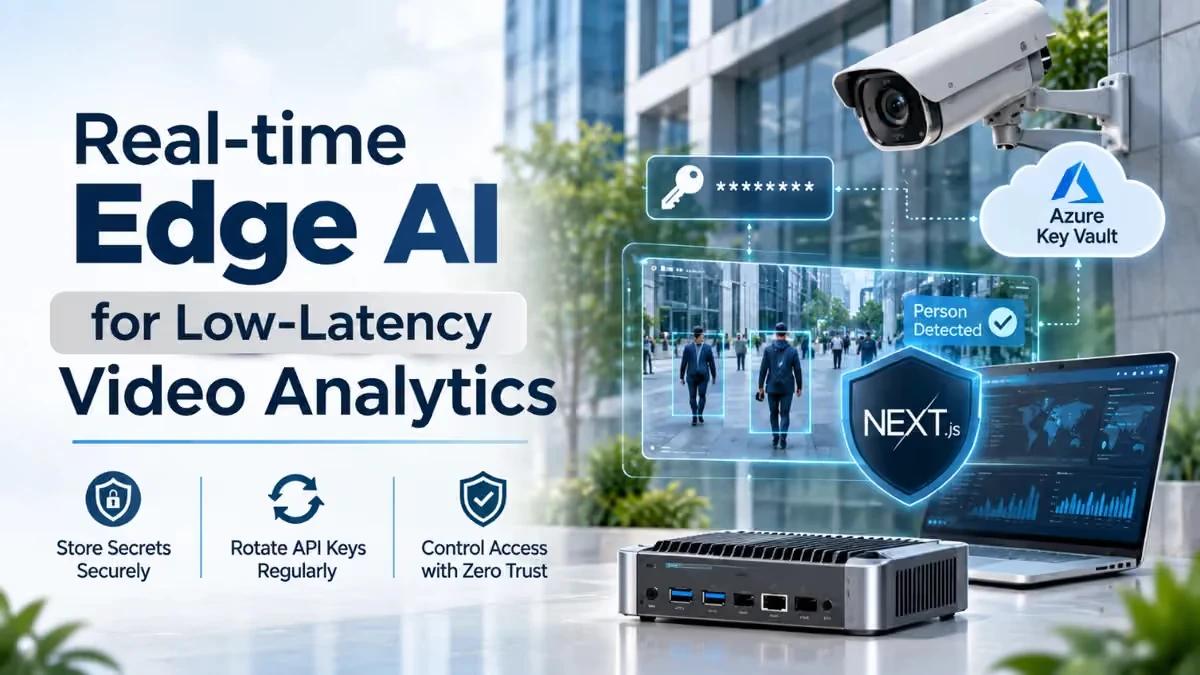
Artificial Intelligence and Edge Computing
Real Time Edge AI for Low Latency Video Analytics
A practical architecture for running video inference near the camera, measuring delays, and sending useful, privacy conscious events to cloud services.
A privacy conscious edge pipeline keeps frame processing close to the camera and forwards only the events an application needs.
Quick Answer
For low-latency video analytics, ingest a camera stream on a nearby edge device, decode frames with a bounded queue, run a model using a runtime supported by that device, and publish small, authenticated events instead of continuously uploading raw video. Measure latency from the frame's capture time to the resulting event, not just the model's inference duration. Keep the system's purpose narrow, avoid identifying people, limit access and retention, and verify local requirements for video surveillance before deployment.
A practical pipeline is: camera or stream source → decode and preprocess → inference → thresholding and event deduplication → authenticated event transport → dashboard or alert. NVIDIA describes DeepStream as a GStreamer-based toolkit for video analytics that can ingest camera, file and RTSP sources; ONNX Runtime provides a Node.js binding for supported environments. Hardware, codec, model shape and runtime support must be checked together rather than assumed from a model file alone. NVIDIA DeepStream overview · ONNX Runtime Node.js guide.
What edge processing changes
A conventional cloud pipeline sends video to a remote service before inference. An edge pipeline runs some or all frame analysis near the camera, then forwards the result needed by another system. That can reduce the amount of video crossing a network and remove a round trip from an alert path, but it does not automatically guarantee a particular latency, lower total cost, privacy compliance or uninterrupted service.
Edge processing also moves operational work onto devices: model packaging, hardware compatibility, secure provisioning, thermal limits, health reporting, patching and recovery when a camera or network is unavailable. Decide which responsibilities stay on the device and which belong in a central control plane before choosing the model runtime.
Reference architecture
Stream intake
Receive camera frames and reconnect when a stream stops. Keep access credentials out of logs and source files.
Frame preparation
Convert each frame to the model's required size, layout, and color format. Limit queued frames to prevent delays.
Model inference
Run detection or classification on hardware and software that support the model.
Event handling
Filter repeated results and send only the details needed for a product decision. Treat model scores as estimates.
Event delivery
Send updates through an authenticated, encrypted connection. A Next JS dashboard can display events while inference stays near the camera.
Runtime selection
GStreamer provides tools for media processing, buffering, and recovery. DeepStream can suit supported NVIDIA devices, but it is not a universal choice. Test the device maker's decoder, accelerator, inference software, and operating system together.
Build a bounded frame pipeline
Favor recent frames when live activity matters. Set a measured limit for queued work and decide whether overload drops older frames or reduces sampling. Track dropped frames and frame age. Buffering can absorb network changes, but it also adds delay.
Separate stream work from web requests
Run video decoding and inference as managed services with clear health checks. Keep request handlers focused on user access and event delivery. Let the edge device publish approved events to a service, then let the Next JS dashboard retrieve or subscribe to them.
Run a model with ONNX Runtime on a supported Node JS device
Check runtime and device support before choosing a model runner. Prepare each frame to match the model's required codec, dimensions, color order, normalization, labels, and output format.
Validate model inputs and results
Use the documented model dimensions. Test results against labelled frames, including poor lighting and blocked views. Compare results with a reviewed reference before enabling alerts.
Set a latency target before tuning
Measure the time from frame capture to event delivery. Track receiving, decoding, preparation, inference, result handling, queueing, and delivery separately. Review averages and percentile timings alongside dropped frames, reconnects, temperature, memory, and accelerator use.
Define a measurable target
If an event must arrive within 200 milliseconds, measure that full interval on the expected number of streams and under realistic network conditions. Define the start and end points, and account for clock differences between devices.
Events arrive late
Measure decoding time, inference time, and total time from capture to event.
Delay grows over time
Check queue size, age of the oldest frame, and dropped frame count.
Some cameras lag
Compare stream format, network variation, reconnects, and device use.
Alerts arrive after inference
Check result handling, message delivery, and dashboard updates.
Tune one stage at a time
Choose a model suited to the task. Change image size only after checking accuracy. Remove work that does not affect decisions, and discard stale frames deliberately. Test heat limits and simultaneous streams because a short demonstration is not a capacity test.
Publish only necessary events
Send a count or area alert instead of video, face images, identity details, or ongoing person tracking. Keep event data limited to what the product needs.
Describe the event fields
A useful event identifies its format, event, camera, event type, area, count, observation time, and model version. Sample identifiers are examples only.
Protect event delivery
Set access rules for each device or site. Encrypt delivery, check incoming event fields, and handle retries without repeating actions. MQTT defines message delivery behavior, not the total time from capture to alert.
Store video only when needed
If video evidence is required, create a separate process with its own access rules, retention period, encryption, and audit history. Do not enable recording by default.
Design privacy and security into the deployment
Document the purpose of each analytic, what is processed, who can view results, whether any video leaves the site, and how long each data type is retained. Prefer aggregate counts or zone events over identifying or tracking individuals. Restrict camera credentials to the edge service, encrypt device-to-service traffic, isolate devices from general-purpose networks, sign and verify model updates, and keep a rollback path for a faulty release.
Video surveillance rules differ by jurisdiction and use case. Before installation, get the appropriate privacy and legal review, provide required notices, and define a process for access requests and incidents. The UK Information Commissioner's Office publishes CCTV and video-surveillance guidance and a checklist; organizations operating elsewhere should consult their own regulator and applicable law. ICO CCTV and video-surveillance guidance.
Operate and evaluate the edge fleet
Treat each deployed camera and inference worker as a managed production service. Track device identity, software and model versions, last successful frame, last event, stream reconnects, queue depth, resource pressure and update status. Alert on stale telemetry or a failed pipeline rather than interpreting silence as a zero count. Use staged rollouts, signed artifacts, explicit compatibility checks and a tested rollback before updating the full fleet.
Build a fixed evaluation set from representative, lawfully collected footage or appropriately licensed test data. Label the outcome needed by the product, measure false positives and false negatives at the operating threshold, and review performance across lighting, camera placement and weather conditions. Re-evaluate after changing the model, camera, codec, inference provider or preprocessing. A model's confidence value is not a calibrated probability unless calibration has been established for the deployment data.
For broader system design, see HiMat's Edge AI service, the edge computing and web performance guide, AI inference cost engineering, and real-time WebRTC architecture in Next.js. These cover adjacent topics; none substitutes for validating the target camera and device.
Frequently asked questions
Does edge AI always make video analytics faster?
No. Local inference can avoid some network round trips, but decode, model execution, queues, device load and event delivery still contribute latency. Benchmark capture-to-event behavior on the deployment hardware and network.
Do I need an NVIDIA Jetson device?
Not necessarily. Choose hardware based on the camera count, model, codec, power, environment and runtime support you need. NVIDIA DeepStream is one option for supported NVIDIA platforms; compare it with runtimes and accelerators supported by your chosen device.
Can I run ONNX models from Node.js?
ONNX Runtime publishes a Node.js binding and documents supported platforms and execution providers. Confirm that your target architecture and accelerator are supported, then validate model input/output handling on the device.
Should the edge device upload every frame?
Only if the product and its reviewed privacy requirements require that data flow. For many analytics tasks, an aggregate or event is sufficient. Minimize data, access and retention; do not send footage to the cloud by default.
Is MQTT a guarantee of sub-200 ms alerts?
No. MQTT defines message delivery behavior; it does not bound camera capture, decode, inference, broker or consumer latency. Measure the complete path and configure the transport for the reliability and security requirements of the application.
What should happen when the camera or network goes offline?
Define observable states such as `camera_offline`, `inference_unavailable` and `event_delivery_delayed`. Monitor last-frame and last-event times, retry with bounded backoff, and decide whether the edge node buffers only compact events or drops them. Never present missing data as a confirmed zero.
Conclusion
A useful edge analytics system is more than a model that runs near a camera. It is a bounded stream pipeline, a compatible runtime, an end-to-end latency budget, an event contract and a device lifecycle that can be monitored and updated safely. Start with one camera and a narrow, non-identifying use case; measure accuracy and capture-to-event latency under realistic load; then expand only when the operational and privacy controls work as intended.
Explore other service pillars
Related articles
- AI & TechnologyEdge Computing: Moving Application Logic Closer to the UserHow edge functions and edge databases are bringing sub-millisecond latency to modern web applications.
- AI Engineering & SaaS ArchitectureAI Inference Cost Engineering in 2026: Model Routing, Prompt Caching, Semantic Caching, and Spend BudgetsAI applications can become expensive long before traffic looks large. This engineering guide explains how to control inference spend with model routing, prompt caching, semantic caching, request budgets, rate limits, and cost-per-task metrics without sacrificing product quality.
- AI & Engineering ArchitectureOpenAI Realtime WebRTC API in Next.js 16: Architecting Low-Latency Voice AI Agents & Streaming Session Security in 2026A comprehensive technical architecture guide for full-stack engineering teams implementing OpenAI Realtime WebRTC API, Next.js 16 App Router Route Handlers, ephemeral session security, and client-side developer tooling for conversational voice AI agents.