Loading...
Back to Insights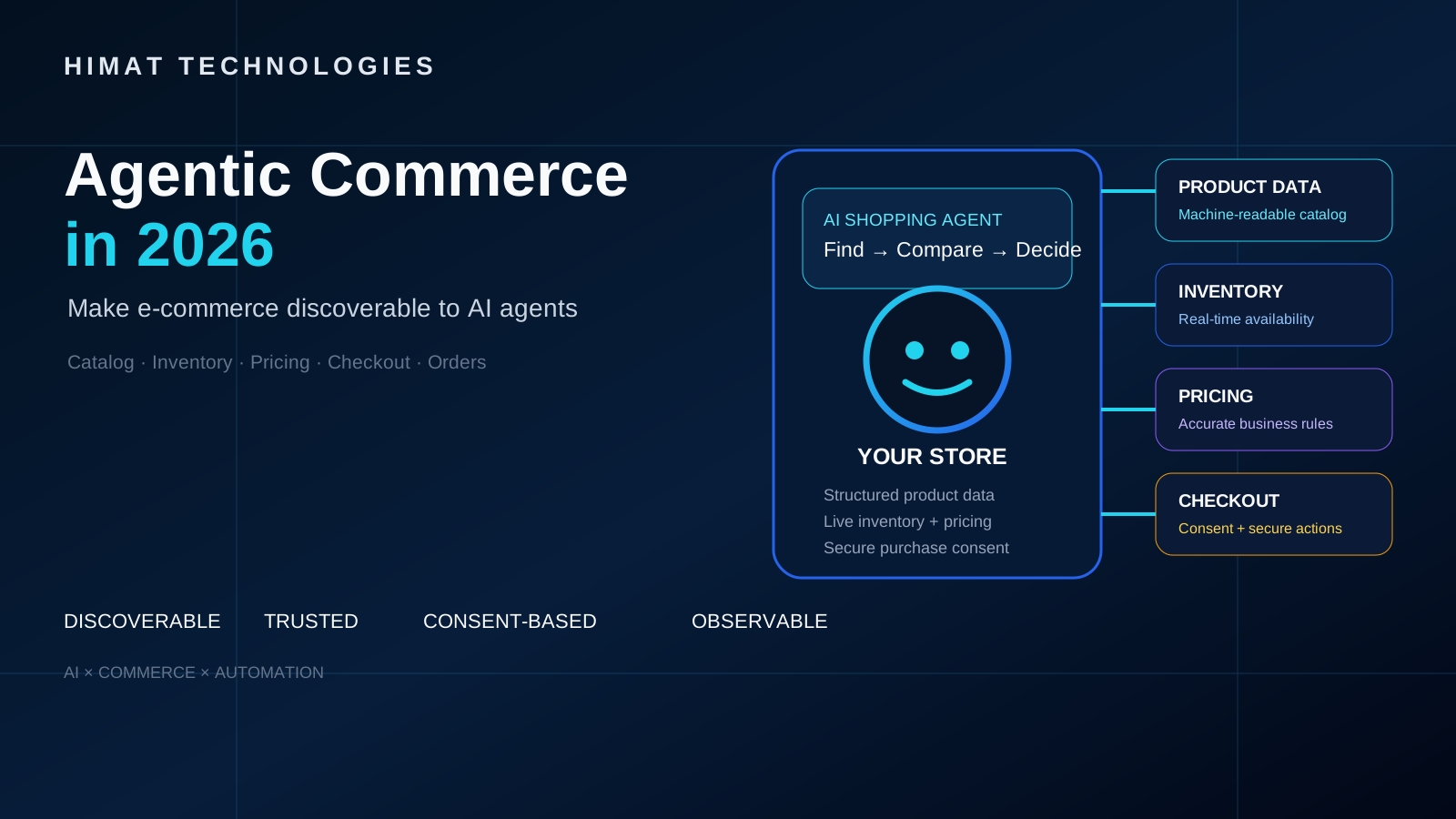
AI, E-Commerce & Automation
Agentic Commerce in 2026: How to Make an E-Commerce Store Discoverable to AI Agents
AI agents are becoming a new interface for product discovery and purchasing. This engineering guide explains how e-commerce teams can expose structured catalog data, live inventory, pricing, checkout actions, webhooks, identity, and consent so agents can interact safely.
An agent-ready commerce architecture connecting AI discovery to product data, inventory, pricing, checkout and order events.
Quick Answer
Agentic commerce is the shift from people using a website or app as the primary shopping interface toward AI agents helping users discover products, compare options, check availability, and—when explicitly authorized—complete transactions. For an e-commerce business, the engineering challenge is not simply adding a chatbot. The store needs machine-readable product data, reliable APIs or agent tools, live inventory and pricing, secure checkout actions, identity and consent controls, and event-driven order updates.
The trend is moving from experiments toward production infrastructure. Mastercard announced Agent Connect in September 2026 to help merchants expose products to AI ecosystems and support agent-powered shopping while maintaining control over business rules and customer relationships. Algolia also announced a production MCP server for live commerce data, emphasizing the need for agents to access catalogs, pricing, inventory, merchandising rules, and business context.
What Changes When AI Becomes the Shopping Interface?
Traditional e-commerce assumes a human can visually interpret a product page. A shopping agent needs structured facts: what a product is, which variants exist, what each variant costs, whether it is available, what shipping rules apply, and which actions it is allowed to perform.
The product page remains important, but it is no longer the only interface. Your catalog becomes an information layer that can be consumed by search engines, applications, internal services, and AI agents.
A practical mental model is: human UI + machine API + agent action layer + event layer + trust layer.
1. Make Your Product Catalog Machine-Readable
Start with a normalized product model. An agent should not have to infer essential business facts from marketing prose.
At minimum, expose stable identifiers, product names, descriptions, categories, variants, attributes, current prices, currencies, availability, images, shipping constraints, return policies, and important eligibility rules.
Prefer explicit fields over ambiguous natural language. Expose price, currency, available quantity, and estimated delivery days as structured values instead of asking an agent to extract them from a paragraph.
Keep the same product IDs across your website, commerce backend, analytics platform, and agent-facing API. Stable identity prevents an agent from confusing a product variant with its parent product.
2. Give Agents Search and Discovery Actions
Agents need actions that map to real shopping tasks. Useful capabilities include search products, filter by structured attributes, compare products, retrieve product details, check inventory, calculate shipping, and retrieve compatible accessories.
Do not expose one enormous endpoint that tries to do everything. Smaller, well-defined actions make validation, authorization, observability, and testing easier.
A good search action should accept structured filters and return product candidates with stable IDs, current evidence, and enough attributes for the application to explain why each result matched.
3. Separate Discovery From Purchase
One of the most important architectural boundaries is the difference between read operations and side effects.
Searching a catalog is usually low risk. Creating an order is not. Adding an item to a cart may have limited consequences, while charging a payment method has financial consequences.
Use different permissions and approval requirements for these actions. A sensible progression is read operations such as product search and inventory; prepare operations such as cart creation and checkout preview; commit operations such as order creation and payment authorization; and high-impact operations such as refunds or account changes.
The agent should never receive broad credentials simply because it needs to perform one purchase-related operation.
4. Make Consent Explicit
A conversational statement such as 'find me a good laptop' should not automatically become permission to purchase one.
Design an explicit consent boundary. The application should show the customer what is being purchased, the merchant, price, taxes or fees where known, shipping destination, and the action being authorized before a financial commitment occurs.
For recurring or high-value actions, require stronger confirmation according to the business risk model.
Banks and payment organizations are also raising concerns about AI shopping agents, including fraud, sensitive financial data, transparency, and consumer recourse. These concerns make explicit consent and clear responsibility boundaries important parts of commerce architecture.
5. Treat Inventory and Pricing as Live Data
An agent recommendation becomes dangerous when the information it uses is stale.
Do not rely on a static product document for inventory or price when the final action depends on current values. Give the agent a fresh inventory and pricing check immediately before checkout.
A robust flow is: search catalog → select candidate → check current price → check inventory → calculate shipping and tax → create checkout preview → obtain customer approval → commit order.
The checkout service should revalidate critical fields server-side. Never trust an agent-provided price, product ID, discount, quantity limit, or shipping amount simply because the agent obtained it from an earlier API call.
6. Use Idempotent Purchase Actions
Agents retry. Networks timeout. Tool calls can be repeated. A purchase endpoint therefore needs stronger protection than an ordinary read API.
Use idempotency keys for actions such as creating orders or initiating payment. If the same authorized request is retried, the backend should return the existing result instead of creating a duplicate order.
Also design explicit states for order creation: pending, authorized, confirmed, failed, cancelled, and refunded. This makes recovery and reconciliation much easier.
7. Add Webhooks for the Agent's World
Agents often need to react to events after the original interaction ends.
Examples include order confirmed, payment failed, shipment dispatched, delivery delayed, refund issued, or inventory changed.
Use signed webhooks or another authenticated event channel. Include event IDs so consumers can deduplicate messages, and include timestamps and resource IDs so downstream systems can reconcile state.
This turns commerce from a request-response integration into an event-driven system that agents can monitor safely.
8. Build an Agent Identity and Permission Layer
Do not treat an AI agent as an anonymous API client.
Give agent sessions explicit identities and scopes. A customer-authorized shopping agent might be allowed to search products, read saved preferences, create a checkout preview, and request an order—but not modify account security settings or issue refunds without additional authorization.
Useful controls include short-lived tokens, tenant isolation, resource-level authorization, rate limits, action allowlists, audit logs, and human approval for sensitive operations.
9. Make Your Commerce System Observable
An agent transaction has more moving parts than a normal web checkout. Record the agent session, action name, authorization scope, product IDs, pricing version, inventory check, tool latency, result status, idempotency key, approval event, and final order ID.
Do not store unnecessary secrets or sensitive payment data in telemetry.
Observability should answer practical questions: What did the agent request? What data did it see? Which action did it call? Was the action authorized? Did the price change? Was approval obtained? Did the order succeed?
10. Design for Agent Failure
Agents can misunderstand requests, select an unsuitable product, call a tool with invalid arguments, or encounter incomplete information.
Your backend should assume that the agent can fail. Validate every input, enforce business rules server-side, constrain quantities, cap transaction values where appropriate, and return structured errors that tell the application how to recover.
A safe agent should be able to say that it cannot complete an action rather than inventing a successful outcome.
Agentic Commerce Architecture
A practical architecture can be organized into five layers: the experience layer for web, mobile, chat, and voice; the agent interface layer for search, product details, inventory, pricing, cart, checkout, and order status; the commerce domain layer for catalog, inventory, pricing, promotions, payments, orders, shipping, and accounts; the trust layer for identity, authorization, consent, approval, fraud controls, rate limits, and audit logs; and the event and observability layer for webhooks, traces, metrics, reconciliation, alerts, and analytics.
This separation prevents the AI layer from becoming a privileged shortcut into the commerce database.
How MCP Fits Into Agentic Commerce
MCP can provide a standardized way for compatible AI clients to discover and invoke capabilities. For commerce, the useful abstraction is not 'give the model database access.' It is 'expose narrowly defined, validated business actions.'
A merchant could expose product search, product detail, inventory lookup, shipping estimate, and checkout-preview tools while keeping payment execution behind a stronger application-controlled approval flow.
The architectural principle is the same whether you use MCP, REST APIs, GraphQL, or another protocol: protocol exposure does not replace authorization.
SEO and AI Discoverability Are Converging
Traditional SEO asks whether search engines can crawl and understand your product pages. Agentic commerce adds another question: can an AI system reliably understand the product, its current state, and the actions available around it?
That means structured content, stable identifiers, clean product attributes, accessible policies, accurate availability, and machine-readable APIs increasingly complement traditional SEO work.
The goal is not to optimize for one AI provider. Build a clean information and action layer that can serve multiple clients.
A 30-Day Agent-Ready Commerce Plan
Week 1: Normalize the catalog
Audit product IDs, variants, attributes, pricing, inventory, images, policies, and data freshness. Remove ambiguous fields and define canonical schemas.
Week 2: Expose safe read actions
Implement product search, product detail, inventory lookup, and shipping estimation with authentication, validation, rate limits, and structured responses.
Week 3: Add checkout preparation
Create cart and checkout-preview actions. Add server-side revalidation, idempotency, audit events, and explicit customer consent.
Week 4: Add events and observability
Implement signed webhooks, order-state events, traces, dashboards, failure alerts, and reconciliation workflows. Test adversarial prompts and repeated tool calls before allowing higher-impact actions.
What E-Commerce Teams Should Measure
Track agent-originated product discovery sessions, product-detail requests, search-to-product conversion, checkout-preview completion, human approval rate, tool error and retry rate, price or inventory mismatch rate, duplicate-action prevention, agent-assisted order conversion, revenue and margin by agent-originated journey, and customer support contacts generated by agent transactions.
These measurements help distinguish genuine commerce value from additional API traffic.
HiMat Perspective
At HiMat Technologies, agentic commerce is best treated as an extension of sound e-commerce engineering—not as a chatbot bolted onto an existing storefront.
The foundation is a reliable catalog, clean APIs, secure business actions, current inventory and pricing, explicit consent, event-driven workflows, and observable backend systems. AI agents can then become another controlled interface to the commerce platform.
For businesses preparing their e-commerce stack for AI-driven discovery and automation, the opportunity is to build the underlying system once and make it usable across web, mobile, internal automation, and compatible AI clients.
Frequently Asked Questions
What is agentic commerce?
Agentic commerce is commerce in which AI agents help users discover, compare, and potentially purchase products or services on their behalf under defined permissions and customer authorization.
Do I need MCP to make my store agent-ready?
No. REST, GraphQL, existing commerce APIs, webhooks, and other interfaces can all support agent workflows. MCP is one standardized option for exposing capabilities to compatible AI clients.
Should an AI agent be allowed to make purchases automatically?
That depends on the business risk model and customer authorization. A safer architecture separates discovery from financial commitment and uses explicit consent and server-side validation before high-impact actions.
How do I prevent duplicate orders?
Use idempotency keys, explicit order states, server-side transaction controls, and reconciliation. Assume that agents and networks can retry operations.
How can an e-commerce store become discoverable to AI agents?
Expose structured product data, reliable search and product-detail actions, current inventory and pricing, accessible policies, and well-defined capabilities with clear authorization boundaries.
Conclusion
Agentic commerce changes the e-commerce engineering target from 'build a website people can use' to 'build a commerce system that people and authorized software agents can use safely.'
The most important work is underneath the interface: structured data, stable APIs, scoped actions, live pricing and inventory, idempotent transactions, explicit consent, event-driven updates, and strong observability.
Businesses that build these foundations can support new AI shopping interfaces without rebuilding their commerce platform for every new agent or model.
Previous Article
GEO Engineering in 2026: How to Optimize Next.js and React Applications for AI Search Retrieval and CitationsNext Article
AI Inference Cost Engineering in 2026: Model Routing, Prompt Caching, Semantic Caching, and Spend BudgetsExplore other service pillars
Related articles
- AI & Engineering ArchitectureAI Agent Observability in 2026: How to Control, Evaluate, and Monitor Production AgentsProduction AI agents need more than model quality. This engineering guide explains traces, tool-call monitoring, evaluations, human approval gates, cost controls, and operational guardrails for reliable agentic systems.
- AI & Engineering ArchitectureAutonomous AI Agent Security Guardrails in 2026: Hardening Next.js 16 Web Applications, Stateless MCP Gateways & OAuth 2.0 / JWT Auth HeadersA complete architectural security guide for engineering teams deploying autonomous AI agents in 2026: hardening Next.js 16 App Router Server Actions, enforcing zero-trust Stateless MCP OAuth 2.0 / JWT auth headers, sandboxing agent execution, and inspecting payloads with client-side developer tools.
- AI & Engineering ArchitectureModel Context Protocol (MCP) Enterprise Security & Governance in 2026: Architecting Secure Tool Access for Autonomous AI AgentsA comprehensive 2026 engineering guide to securing Model Context Protocol (MCP) client-server architectures, implementing zero-trust tool proxies, mitigating indirect prompt injection, and managing dynamic JWT authorization scopes for production AI agents.