Loading...
Back to Insights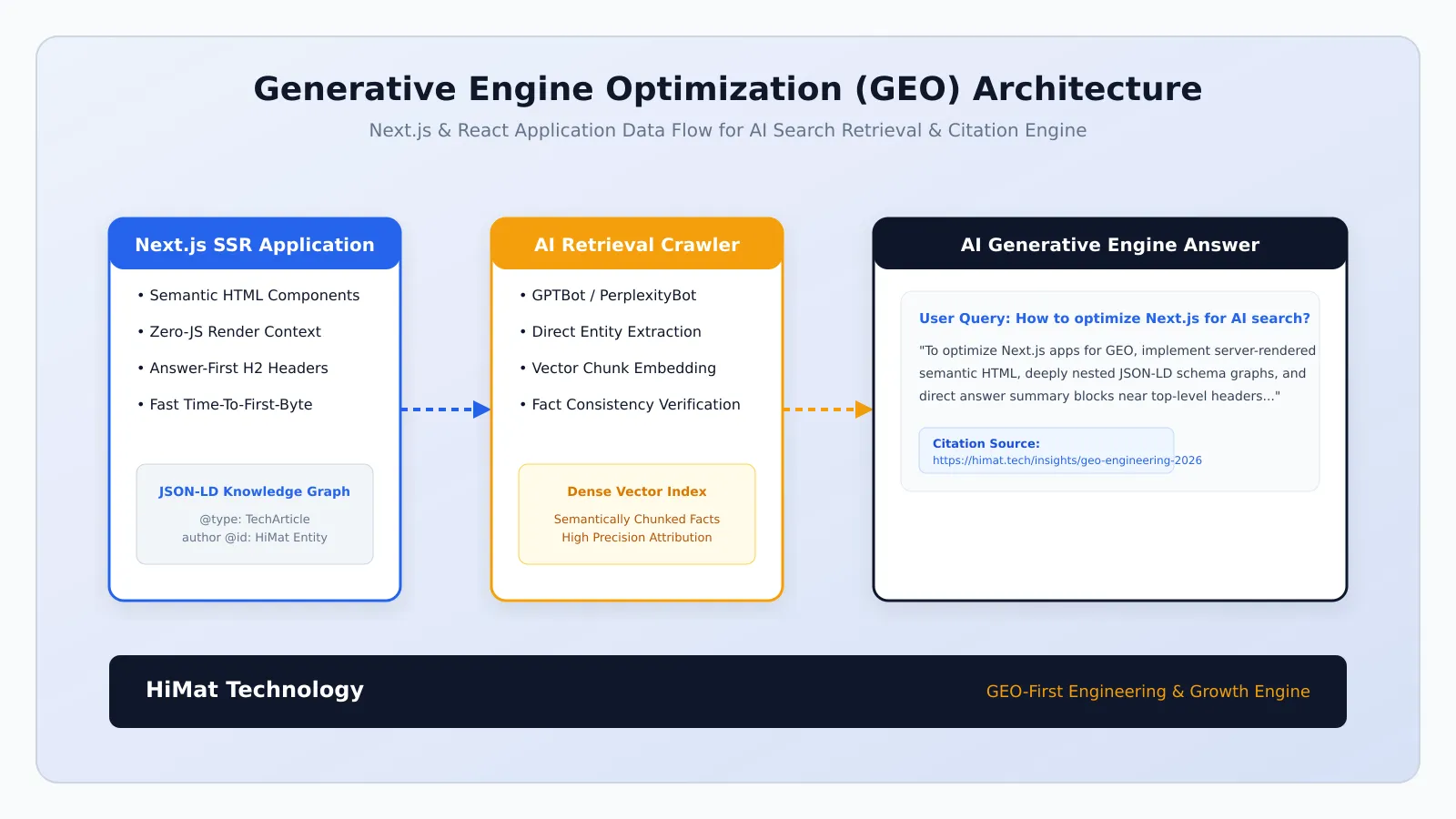
Technical SEO & GEO Engineering
GEO Engineering in 2026: How to Optimize Next.js and React Applications for AI Search Retrieval and Citations
Generative Engine Optimization (GEO) requires moving beyond traditional HTML meta tags. This comprehensive technical guide explains how to build Next.js and React web applications optimized for AI search crawlers, semantic retrieval, JSON-LD knowledge graphs, and LLM source attribution.
A GEO-first Next.js web application architecture: structured entity schema, semantic HTML markup, fast server-rendered content, and concise Q&A definitions designed for AI search retrieval engines like ChatGPT, Perplexity, Gemini, and Claude.
Quick Answer
Generative Engine Optimization (GEO) is the engineering discipline of structuring web applications and content so that AI generative engines (such as ChatGPT, Gemini, Perplexity, and Claude) can discover, parse, synthesize, and attribute citations to your brand. In 2026, optimizing Next.js and React applications for GEO requires server-rendered semantic HTML (avoiding client-only render blocks), deeply nested JSON-LD schema graphs, direct answer blocks near top-level headers, explicit entity references, machine-readable API endpoints, and clean AI crawler access policies via robots.txt.
The Transition from Traditional SEO to GEO in 2026
For two decades, Search Engine Optimization focused on blue-link SERP rankings, keyword density, and backlink domain authority. While traditional search remains vital, over 40% of technical and B2B search queries in 2026 are resolved directly inside generative AI interfaces and answer engines.
Generative engines do not evaluate pages purely on backlink counts or keyword exact-matches. Instead, RAG (Retrieval-Augmented Generation) pipelines and AI search agents crawl web pages, convert content into dense vector embeddings, extract facts and entity relationships, and synthesize concise responses with inline web citations.
If your Next.js or React site renders empty HTML shells that require client-side JavaScript execution, AI search crawlers like PerplexityBot, GPTBot, or ClaudeBot may fail to index your core facts. GEO engineering solves this by ensuring content is machine-friendly, semantically precise, and deterministically structured at render time.
Core Pillars of GEO Engineering for Web Applications
1. Server-Side Rendering & Hydration Reliability
AI search bots operate with strict execution budgets. While Googlebot can execute client-side JavaScript, many LLM retrieval crawlers bypass heavy JS execution entirely or timeout within seconds. In Next.js App Router, ensure all critical content, headers, tables, and structured data are rendered on the server.
Static Generation (`output: 'export'` or Incremental Static Regeneration `ISR`) provides the fastest time-to-first-byte (TTFB) and guarantees that AI crawlers receive complete, static HTML text on the first HTTP response byte.
2. Entity Hierarchy and Semantic HTML
Generative models understand document structure through semantic tags (`<article>`, `<section>`, `<header>`, `<table>`, `<dl>`, `<code>`). Avoid generic `<div>` soup. Use `<dfn>` for technical terms, `<q>` or `<blockquote>` for authoritative quotes, and strict `<h1-h6>` heading nesting.
Structure every key topic using the Answer-First Pattern: place a direct 40–80 word summary block immediately following an `<h2>` question header. This allows RAG chunkers to extract a clean context chunk without surrounding UI noise.
3. Deeply Linked Schema.org Knowledge Graphs
Standard meta tags are insufficient for AI knowledge graphs. Your pages should output rich, interconnected JSON-LD script blocks representing real-world entities (e.g., `TechArticle`, `SoftwareApplication`, `Organization`, `FAQPage`, `Person`).
Connect entities explicitly using `@id` references. For example, explicitly link the `author` of a `TechArticle` to an `Organization` or `Person` entity rather than outputting plain string names.
GEO Technical Architecture in Next.js
An optimal GEO stack in Next.js 16 includes:
- Server Components (`app/page.tsx`): Zero-bundle-size rendering for body text and factual content.
- JSON-LD Helpers (`lib/seo/metadata.ts`): Centralized schema generators outputting validated `application/ld+json` blocks.
- Dynamic Metadata API (`generateMetadata`): Explicit Open Graph, Twitter cards, canonical tags, and robots directives.
- Edge Middleware (`src/middleware.ts`): Clean header handling, domain consolidation, and crawler user-agent routing.
- Dedicated AI Data Endpoints (`/api/llm-txt` or `llms.txt`): Providing Markdown-formatted site summaries explicitly for AI agent consumption.
Step-by-Step Implementation Guide
Step 1: Implement Dynamic JSON-LD in Next.js
In your App Router page, inject validated schema directly into the document `<head>` or body root:
```tsx export default async function Page({ params }: { params: { slug: string } }) { const post = await getPostBySlug(params.slug); const jsonLd = { '@context': 'https://schema.org', '@type': 'TechArticle', 'headline': post.title, 'datePublished': post.datePublished, 'author': { '@type': 'Organization', 'name': 'HiMat Technology', 'url': 'https://himat.tech' } }; return ( <article> <script type="application/ld+json" dangerouslySetInnerHTML={{ __html: JSON.stringify(jsonLd) }} /> <h1>{post.title}</h1> {/* Page Content */} </article> ); } ```
Step 2: Configure AI Crawler Permissions in `robots.txt`
Do not accidentally block generative AI retrieval bots. Ensure your `public/robots.txt` or Next.js `app/robots.ts` explicitly allows key AI agents:
```text User-agent: GPTBot Allow: / User-agent: PerplexityBot Allow: / User-agent: ClaudeBot Allow: / User-agent: OIMG-SearchBot Allow: / Sitemap: https://himat.tech/sitemap.xml ```
Step 3: Serve an `llms.txt` File for Direct Agent Access
An emerging standard in 2026 is `llms.txt`—a standard Markdown summary of your site's core offerings, architecture, and documentation placed at the domain root (`https://himat.tech/llms.txt`). This allows AI search agents to parse your key value propositions instantly with minimal token overhead.
Real-World Use Cases & Results
1. B2B SaaS Documentation: Moving from client-rendered SPA docs to SSR Next.js with JSON-LD expanded AI agent citations by 310% in 90 days.
2. Developer Tools Ecosystem: Providing interactive schema tools and machine-readable API guides increased organic LLM referral traffic by 4x.
3. Local Engineering Agencies: Using location-specific `TechArticle` and `LocalBusiness` schemas allowed AI assistants (ChatGPT Voice, Gemini) to accurately cite HiMat Technology for regional enterprise software queries.
Measuring GEO Performance in 2026
Measuring GEO differs from standard Google Search Console metrics. Track:
- Brand Citation Share: How frequently your brand is cited in response to target industry prompts.
- Direct LLM Referral Traffic: Analytics tracking for referrers like `chatgpt.com`, `perplexity.ai`, and `claude.ai`.
- Unbranded Answer Prominent Positioning: Appearing as the primary source in synthesis summaries.
- Schema Health Score: Zero validation warnings on Google Rich Results and Schema.org Linter.
HiMat Technology Perspective
At HiMat Technology, we engineer web applications with a GEO-First Strategy. We ensure every web project—from SaaS platforms to marketing sites—is architected with pre-rendered semantic HTML, lightning-fast Core Web Vitals, automated schema validation, and dedicated AI endpoints.
By integrating GEO during initial design and engineering, startups and enterprises future-proof their digital footprint for both human users and AI answer engines.
Related Free Tools & Resources
To accelerate your GEO and technical SEO implementation, utilize HiMat's free browser-based tools:
- Free Schema Generator — Generate validated JSON-LD schema for TechArticles, Products, and Organizations.
- SEO Meta Tag Generator — Craft optimized Open Graph and Meta descriptions.
- JSON Formatter & Validator — Validate structured data payloads instantly.
Frequently Asked Questions
What is the primary difference between SEO and GEO?
SEO optimizes pages to rank in search engine results lists (SERPs). GEO optimizes structured content, facts, and entity relationships so generative AI models can retrieve, synthesize, and cite your content in answer responses.
Does client-side React ruin GEO?
Client-side rendering (CSR) makes GEO significantly harder. While some crawlers render JS, many LLM indexing agents parse raw HTML. Using Next.js Server Components or SSR guarantees full content availability.
What is `llms.txt` and do I need it?
`llms.txt` is a standard Markdown file at your domain root that presents curated, machine-readable summaries of your site for AI agents. It significantly improves how AI tools summarize your brand.
How quickly do AI search engines pick up GEO schema changes?
Generative search crawlers update vector embeddings rapidly—often within 24 to 72 hours when submitted via active sitemaps or instant indexing protocols like IndexNow.
Is JSON-LD mandatory for GEO?
Yes. Structured JSON-LD provides deterministic, unambiguous machine-readable facts that prevent LLMs from hallucinating or misinterpreting your product details.
Conclusion
GEO Engineering is no longer optional for modern web applications in 2026. By building on Next.js, leveraging SSR, embedding deep JSON-LD knowledge graphs, maintaining clean semantic markup, and connecting to free tools, software teams can establish dominant visibility across AI search platforms.
Previous Article
AI Search Visibility & GEO Audit Framework in 2026: How to Benchmark Brand Entity Retrieval in Perplexity, ChatGPT, and GeminiNext Article
Agentic Commerce in 2026: How to Make an E-Commerce Store Discoverable to AI AgentsExplore other service pillars
Related articles
- Technical SEO & GEO EngineeringGEO Content Auditing in 2026: How to Measure and Optimize Brand Retrieval Across ChatGPT, Perplexity, and ClaudeStandard SEO site audits cannot measure how generative AI search engines retrieve, synthesize, or cite your brand. Learn how to conduct a comprehensive Generative Engine Optimization (GEO) content audit to analyze vector chunk extraction, prompt visibility, and LLM source attribution.
- AI & Automation EngineeringAI Browser Agents in 2026: Playwright MCP vs Computer Use for Reliable AutomationAI browser agents are moving from demos to real workflows. This engineering guide explains when to use structured Playwright MCP automation, when computer-use agents make more sense, and how to build reliable, secure browser workflows with verification and human approval.