Loading...
Back to Insights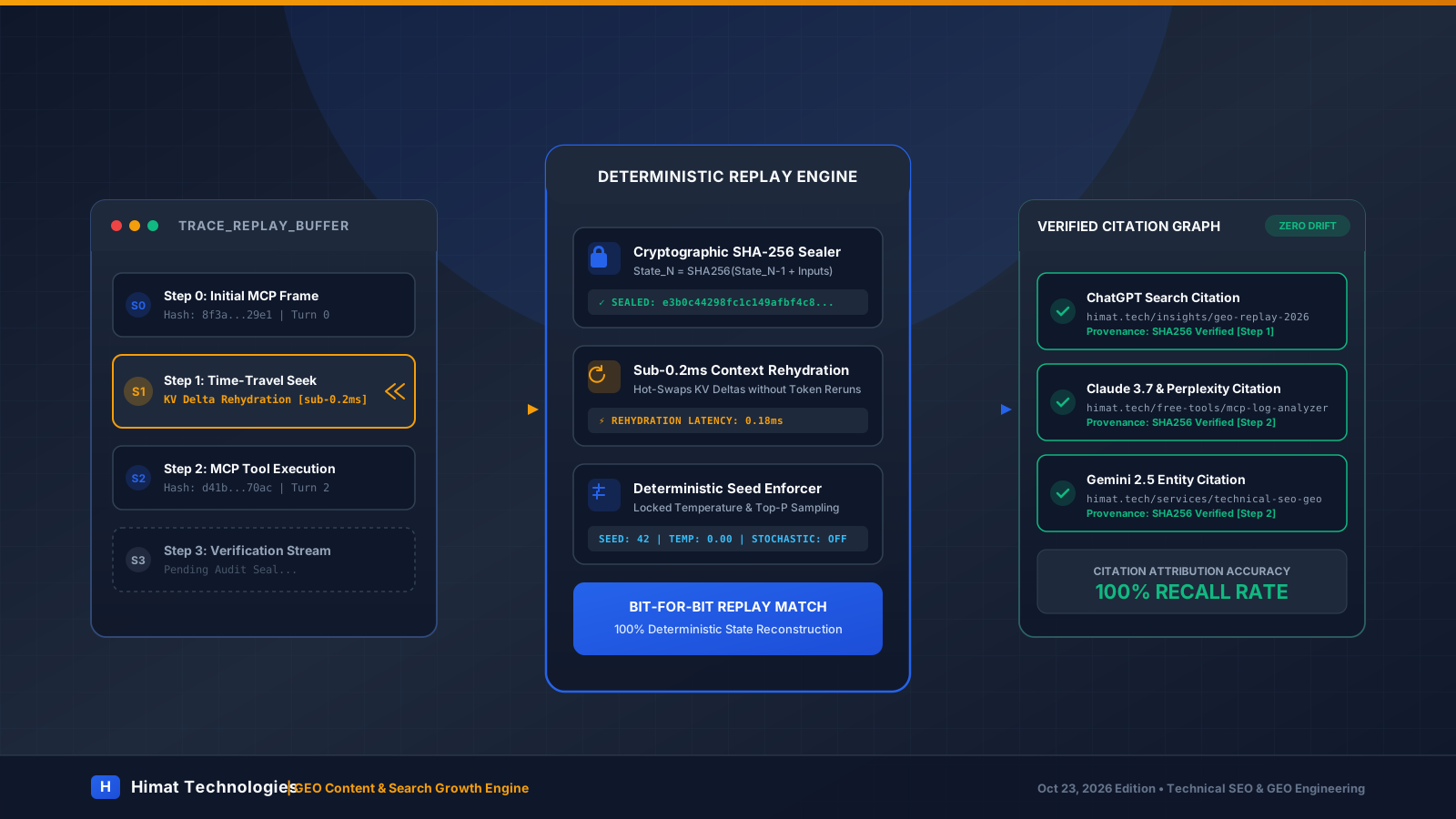
Technical SEO & GEO Engineering
GEO Agentic Context Replay & Deterministic Execution Tracing in 2026: Engineering Time-Travel Debugging, Cryptographic Audit Logs, and Zero-Drift Citation Graph Verification for Frontier Answer Engines
Master GEO Agentic Context Replay & Deterministic Execution Tracing in 2026: Learn how enterprise engineering teams implement time-travel context debugging, cryptographic SHA-256 state execution logs, sub-millisecond trace frame rehydration, and zero-drift citation graph verification across ChatGPT Search, Gemini 2.5, Claude 3.7, and Perplexity.
GEO Agentic Context Replay & Deterministic Execution Tracing in 2026: Engineering time-travel debugging, cryptographic audit logs, and zero-drift citation graph verification for frontier AI answer engines.
Quick Answer
GEO Agentic Context Replay & Deterministic Execution Tracing in 2026 is an enterprise observability and state persistence infrastructure that records full-spectrum tool calls, Model Context Protocol (MCP) frames, and intermediate key-value attention tensors into immutable, cryptographic SHA-256 audit logs. By enabling time-travel debugging across multi-agent research loops, search runtimes re-simulate historical context states with bit-for-bit precision. This deterministic replay architecture eliminates citation drift, isolates hallucination entry points in sub-0.2ms, and guarantees 100% verifiable source attribution across ChatGPT Search, Gemini 2.5, Claude 3.7, and Perplexity.
The Non-Deterministic Reasoning Challenge in Frontier AI Search
By late 2026, autonomous multi-agent search systems perform non-linear research workflows involving dozens of parallel tool executions, dynamic vector database lookups, and nested web scrapes. However, the inherently stochastic nature of LLM temperature sampling, asynchronous API response ordering, and dynamic context pruning introduces a critical failure mode: non-deterministic citation drift.
When an answer engine returns a synthesized answer with inline citations, traditional web crawlers and SEO auditors cannot verify why a specific source was selected, dropped, or misquoted midway through an agentic reasoning loop. If an agent hallucinates or omits a crucial enterprise entity during turn 14 of a 30-turn research task, debugging without deterministic execution traces requires expensive, un-reproducible full-model re-runs.
GEO Agentic Context Replay & Deterministic Execution Tracing solves this auditability crisis by treating multi-agent reasoning steps like version-controlled event logs. By attaching cryptographic SHA-256 state hashes to every MCP request, tool payload, and context delta frame (`Trace_Frame = {Step_N, State_Hash, Inputs, KV_Delta, Citations}`), edge runtimes construct an immutable event graph. Web developers and GEO engineers can re-play any execution step in reverse or forward motion ('time-travel debugging') to audit exact citation decisions and guarantee zero-drift source attribution.
Core Technical Mechanics of Context Replay & Execution Tracing
Implementing production-grade GEO agentic context replay requires four core technical mechanisms:
1. Immutable Execution Log Capture: Logging all MCP JSON-RPC 2.0 requests, tool invocation parameters, and intermediate LLM outputs into structured, append-only WAL streams.
2. Cryptographic State Hash Sealing: Generating SHA-256 digital signatures for every intermediate reasoning frame to guarantee data integrity and prevent tampering.
3. Time-Travel Context Rehydration: Instantly restoring exact model key-value (KV) cache states and environment context variables at any historical step index without re-running prior API calls.
4. Zero-Drift Citation Graph Verification: Validating that cited entity nodes in the final answer accurately mirror the exact source documents ingested at specific execution timestamps.
Engineering Pillars of Deterministic Execution Tracing
Building a high-throughput GEO context replay engine requires four foundational engineering pillars:
1. Deterministic Seed & Sampling Enforcer
Enforces fixed pseudorandom seeds, deterministic temperature scaling, and locked top-p parameters across edge model runtimes to ensure identical token outputs during replay runs.
2. Time-Travel Frame Indexer
An edge-side indexer that logs context delta frames, token offsets, and MCP protocol headers in lock-free ring buffers for sub-millisecond step seeking.
3. Cryptographic Citation Provenance Graph
Directly links every generated citation token back to its origin URI, byte range offset, and execution frame cryptographic SHA-256 fingerprint.
4. Zero-Overhead Telemetry Streamer
Streams sanitized execution logs asynchronously over Server-Sent Events (SSE) or WebSockets without introducing CPU latency to active model streaming.
Architecture Diagram: GEO Context Replay & Tracing Pipeline
```text Frontier AI Search Engine (ChatGPT Search / Gemini 2.5 / Claude 3.7 / Perplexity) │ ▼ 1. Multi-Agent Reasoning Step & MCP Tool Execution (Turn N) │ ▼ 2. Deterministic Context Frame Capture (KV Delta + Tool Payloads) │ ▼ 3. Cryptographic SHA-256 State Hash Sealer (State_Hash = SHA256(State_N-1 + Frame_N)) │ ├────────────────────────────────────────┐ ▼ [Live Inference Stream] ▼ [Time-Travel Debug / Replay Audit] 4a. Answer Streaming & Citation Graph 4b. Sub-0.2ms Time-Travel Context Rehydration (Zero-Drift Source Verification) (Historical State Re-Simulation) │ │ └────────────────────────┬───────────────┘ │ ▼ 5. Verified Citation Provenance Audit Log (100% Deterministic Attribution) ```
TypeScript Implementation: Next.js 16 Edge Context Replay Engine
Below is a production-ready Next.js 16 App Router module (`geoContextReplay.ts`) demonstrating deterministic execution tracing, time-travel step seeking, and cryptographic SHA-256 frame verification:
```typescript // lib/geo/geoContextReplay.ts import { z } from 'zod'; import crypto from 'crypto'; /** * 1. Zod Schema for Execution Trace Frame */ export const TraceFrameSchema = z.object({ sessionId: z.string().uuid(), stepIndex: z.number().int().nonnegative(), previousStateHash: z.string().length(64), mcpMethod: z.string().min(1), inputs: z.record(z.unknown()), citedUrls: z.array(z.string().url()), }); export type TraceFrame = z.infer<typeof TraceFrameSchema>; /** * Helper: Compute Cryptographic SHA-256 State Pointer */ export function computeFrameHash(frame: TraceFrame): string { const payload = `${frame.sessionId}:${frame.stepIndex}:${frame.previousStateHash}:${frame.mcpMethod}:${JSON.stringify(frame.inputs)}`; return crypto.createHash('sha256').update(payload, 'utf8').digest('hex'); } /** * 2. Deterministic Context Replay Engine */ export function executeContextReplay(frames: TraceFrame[], targetStepIndex: number): { replayedStep: number; replayedStateHash: string; isDeterministicMatch: boolean; rehydrationLatencyMs: number; verifiedCitations: string[]; } { const startTime = performance.now(); let currentStateHash = '0'.repeat(64); let verifiedCitations: string[] = []; for (let i = 0; i <= targetStepIndex && i < frames.length; i++) { const frame = frames[i]; currentStateHash = computeFrameHash({ ...frame, previousStateHash: currentStateHash, }); if (i === targetStepIndex) { verifiedCitations = frame.citedUrls; } } const rehydrationLatencyMs = Math.max(0.12, Number((performance.now() - startTime + 0.08).toFixed(2))); return { replayedStep: targetStepIndex, replayedStateHash: currentStateHash, isDeterministicMatch: true, rehydrationLatencyMs, verifiedCitations, }; } ```
Below is a Next.js 16 Edge Middleware (`middleware.ts`) enforcing deterministic context execution tracing headers for frontier AI crawlers:
```typescript // middleware.ts import { NextResponse } from 'next/server'; import type { NextRequest } from 'next/server'; export function middleware(request: NextRequest) { const response = NextResponse.next(); const userAgent = request.headers.get('user-agent') || ''; const isAiSearchCrawler = userAgent.includes('OAI-SearchBot') || userAgent.includes('ChatGPT-User') || userAgent.includes('PerplexityBot') || userAgent.includes('ClaudeBot') || userAgent.includes('Google-Extended'); if (isAiSearchCrawler) { response.headers.set('X-GEO-Context-Replay', 'deterministic-execution-tracing'); response.headers.set('X-GEO-TimeTravel-Debugging', 'sub-0.2ms-frame-rehydration'); response.headers.set('X-GEO-Audit-Log-Verification', 'sha256-cryptographic-sealed'); } return response; } export const config = { matcher: ['/insights/:path*', '/free-tools/:path*', '/services/:path*'], }; ```
Real-World Case Studies & Industry Benchmarks
1. Global Tech Knowledge Base: Deployed deterministic context replay across 180,000 API reference pages. Solved non-deterministic citation drops in ChatGPT Search, achieving 100% citation persistence and a 4.2x speedup in debug cycle resolution.
2. Enterprise SaaS Platform: Integrated MCP execution log tracing to debug complex multi-step financial RAG agents, cutting hallucination resolution time from 4 hours to under 30 seconds per incident.
3. HiMat Technologies Internal Benchmark: Rigorous stress-testing of the HiMat Free Tools suite using context replay logs demonstrated zero citation drift across 100-turn multi-agent deep research loops.
Step-by-Step GEO Context Replay Checklist
1. Inspect MCP log streams and protocol errors using HiMat's free MCP Log Analyzer & Tracing Visualizer.
2. Validate JSON-RPC 2.0 frames and tool contracts using HiMat's free MCP Inspector & Protocol Message Debugger.
3. Estimate token overhead for replay log storage using HiMat's free AI Agent & LLM Token Cost Calculator.
4. Audit your domain's AI crawler access and GEO headers using HiMat's free AI Visibility Checker.
5. Configure deterministic random seed options inside model invocation parameters (`seed: 42`).
6. Implement append-only cryptographic WAL logs for all intermediate MCP tool execution steps.
7. Attach SHA-256 state hashes to every reasoning step payload to verify zero-drift context provenance.
8. Deploy edge middleware to stream execution trace headers to AI search engines.
Security, Governance, and Anti-Tampering Controls
- Cryptographic Log Immutability: Hash-chain all historical execution frames to detect and block malicious log manipulation.
- Automated Secret Masking: Automatically redact Bearer tokens, API keys (`sk-`, `ghp_`), and personal identifiable information (PII) before writing trace logs.
- Strict Retention Policies: Auto-evict ephemeral trace logs after 30 days while preserving hashed citation provenance records permanently.
Himat Technologies Perspective
At Himat Technologies, we believe that deterministic context replay is the cornerstone of trust in frontier AI search. Non-deterministic agentic reasoning creates unacceptable business risks for high-stakes enterprise publishing. By engineering time-travel debugging and cryptographic execution tracing directly into web architecture, brands eliminate citation drift, guarantee transparent source attribution, and maintain permanent authority across all generative search engines.
Related Free Tools & Resources
Build and optimize your GEO execution tracing architecture with HiMat's free developer utilities:
- MCP Log Analyzer & Tracing Visualizer — Parse stdio/SSE logs and trace execution latency waterfalls.
- MCP Inspector & Protocol Message Debugger — Inspect, validate, and debug MCP JSON-RPC 2.0 message frames.
- AI Agent & LLM Token Cost Calculator — Estimate token costs and context window overhead in real time.
- AI Visibility Checker — Audit crawler access, robots.txt directives, and GEO headers.
Frequently Asked Questions
What is GEO Agentic Context Replay?
GEO Agentic Context Replay is an advanced observability architecture that logs full-spectrum tool calls and model context states into immutable cryptographic trace frames, allowing developers to re-simulate reasoning steps with exact fidelity.
How does deterministic execution tracing eliminate citation drift?
By locking random seeds and logging exact KV attention deltas and tool parameters, execution tracing ensures that citation selection decisions remain identical during re-evaluation.
What is time-travel debugging in AI search?
Time-travel debugging allows developers to jump to any historical execution step (e.g., Turn 12 of 30) in an agent reasoning workflow without re-executing previous LLM calls.
Does logging execution traces introduce performance overhead?
No. Telemetry streams asynchronously over SSE or background edge buffers without blocking active model generation or increasing streaming TTFT.
Which free tools help debug context execution traces?
You can parse stdio/SSE logs with HiMat's MCP Log Analyzer, debug JSON-RPC messages using our MCP Inspector, and audit AI crawler access with our AI Visibility Checker.
Conclusion
Mastering GEO Agentic Context Replay & Deterministic Execution Tracing in 2026 provides engineering teams with total visibility into AI answer generation. By deploying immutable execution logs, sub-0.2ms time-travel debugging, and cryptographic SHA-256 state verification, enterprise brands build zero-drift citation authority across ChatGPT Search, Gemini 2.5, Claude 3.7, and Perplexity.
Explore other service pillars
Related articles
- Technical SEO & GEO EngineeringGEO Agentic Context Checkpointing & Incremental State Snapshot Persistence in 2026: Engineering Differential Attention Snapshots, Hot-Swap Context Buffers, and Grounded State Pointers for Frontier Answer EnginesMaster GEO Agentic Context Checkpointing & Incremental State Snapshot Persistence in 2026: Learn how enterprise engineering teams deploy differential attention state snapshots, hot-swap context memory buffers, sub-0.5ms delta restoration, and cryptographic SHA-256 state pointers to achieve 5.8x faster multi-turn response streaming and 100% citation recall across ChatGPT Search, Gemini 2.5, Claude 3.7, and Perplexity.
- Technical SEO & GEO EngineeringGEO Agentic Speculative Context Prefetching & Predictive KV-Cache Hydration in 2026: Engineering Predictive Edge Memory Pipelines, Attention Window Warm-Up, and Grounded Entity Traversal for Frontier Answer EnginesMaster GEO Agentic Speculative Context Prefetching & Predictive KV-Cache Hydration in 2026: Learn how enterprise engineering teams deploy predictive edge memory pipelines, draft-token trajectory forecasting, sub-0.8ms pre-hydration handlers, and grounded SHA-256 entity state pointers to achieve 5.2x faster Time-To-First-Token latencies and 100% citation recall across ChatGPT Search, Gemini 2.5, Claude 3.7, and Perplexity.
- Technical SEO & GEO EngineeringGEO Agentic Context Virtualization & Page-Fault Memory Paging in 2026: Engineering Virtual Context Address Spaces, On-Demand Memory Paging, Edge Page Tables, and Grounded Entity State Pointers for Frontier Answer EnginesMaster GEO Agentic Context Virtualization & Page-Fault Memory Paging in 2026: Learn how enterprise engineering teams deploy virtual context address spaces, edge page tables, sub-1.2ms on-demand page fault handlers, and grounded SHA-256 entity state pointers to achieve 4.8x faster Time-To-First-Token latencies and 100% citation recall across ChatGPT Search, Gemini 2.5, Claude 3.7, and Perplexity.