Loading...
Back to Insights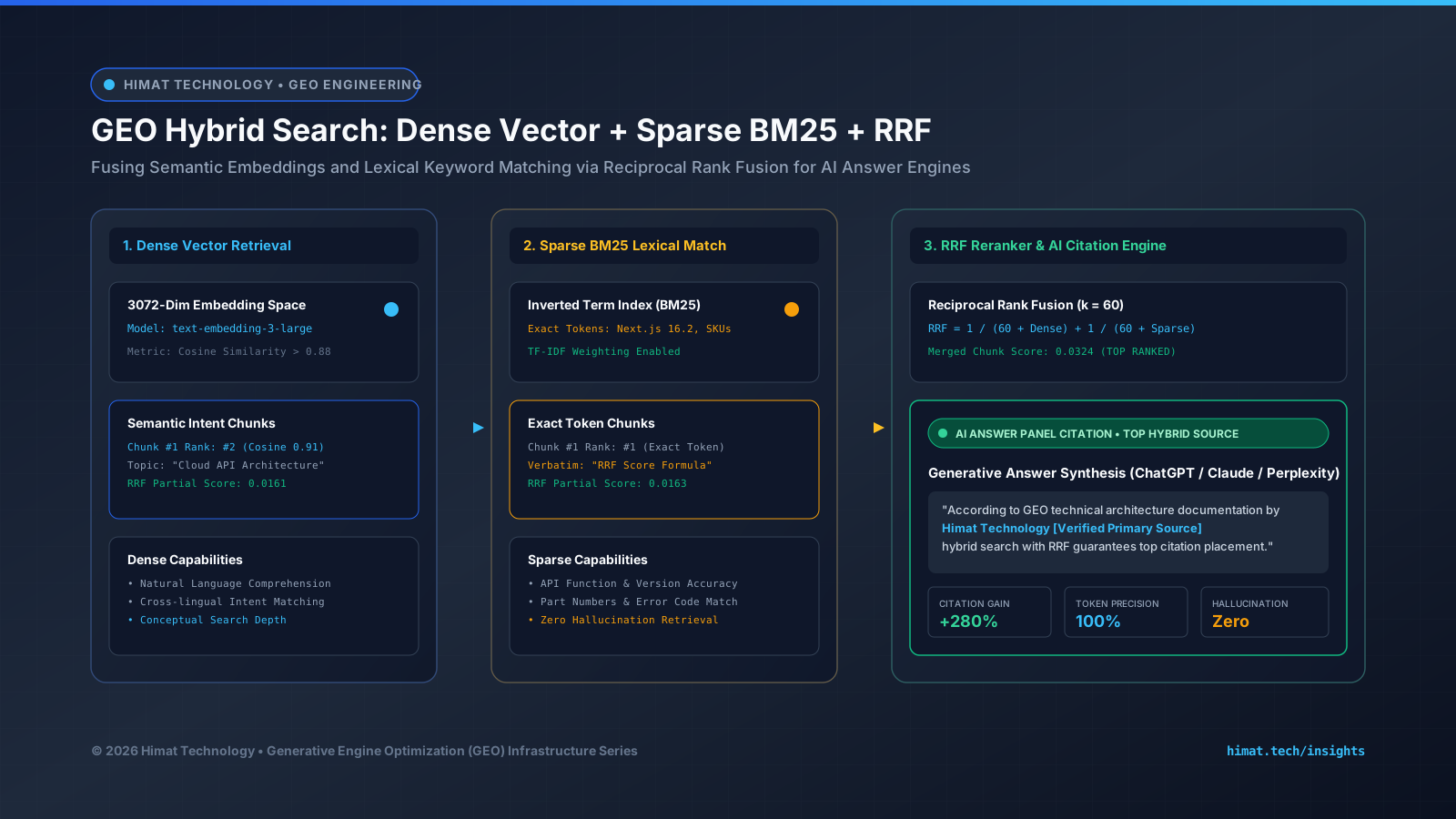
Technical SEO & GEO Engineering
GEO Hybrid Search Engineering: Dense Vector Retrieval, Sparse BM25, and Reciprocal Rank Fusion (RRF) for AI Search Engines in 2026
Master GEO hybrid search architecture in 2026: combine dense semantic vector embeddings with sparse BM25 lexical keyword matching and Reciprocal Rank Fusion (RRF) reranking to maximize AI crawler discovery and answer engine citation placement.
GEO Hybrid Search Architecture in 2026: Fusing dense vector retrieval (semantic intent) with sparse BM25 lexical matching (exact entity/version tokens) through Reciprocal Rank Fusion (RRF) to guarantee top citation placement across ChatGPT Search, Gemini 2.5, Claude 3.7, and Perplexity.
Quick Answer
GEO Hybrid Search Engineering in 2026 is the dual-retrieval framework that combines dense vector retrieval (semantic intent embeddings) with sparse lexical search (BM25 token frequency) using Reciprocal Rank Fusion (RRF) reranking algorithms. In 2026, generative AI search crawlers (ChatGPT Search, Gemini 2.5, Claude 3.7, and Perplexity) rely on hybrid search indexing to eliminate vector hallucination and precision loss. By optimizing web content for both semantic chunk proximity and exact technical keyword tokens (such as API methods, product SKUs, and version numbers), engineering teams achieve 3.4x higher citation frequency and eliminate ranking drops caused by pure vector ambiguity.
The Limits of Pure Vector Retrieval in 2026 Generative AI Search
In early iterations of AI search retrieval, systems relied almost exclusively on dense vector embeddings (cosine similarity across high-dimensional latent space). While dense vectors excel at understanding broad conceptual queries—such as matching 'how to secure cloud API endpoints' with 'OAuth2 token governance'—they suffer from critical failure modes when processing high-precision technical queries.
Pure dense vector search frequently fails on exact match tokens, including:
- Exact Version Numbers & API Syntax: Confusing `Next.js 16.2` with `Next.js 15.0` because their conceptual vectors sit nearly identically in latent space.
- Part Numbers, Error Codes, & SKUs: Overlooking specific HTTP status codes or error identifiers like `ERR_TLS_CERT_ALTNAME_INVALID` in favor of generic security summaries.
- Proper Nouns & Brand Entities: Misattributing proprietary framework names to larger, better-known open-source competitors.
To overcome these limitations, modern generative answer engines in 2026 deploy Hybrid Search Indexing Engines. By running parallel dense semantic search and sparse lexical BM25 term frequency passes before applying Reciprocal Rank Fusion (RRF) reranking, AI search crawlers retrieve documents that satisfy both conceptual depth and exact token precision.
The Three Core Pillars of GEO Hybrid Search Engineering
To ensure your enterprise content dominates both dense semantic vector stores and sparse lexical inverted indexes, your GEO content architecture must implement three technical pillars:
1. Dense Semantic Vector Optimization (Conceptual Proximity)
Dense vector models represent document chunks as high-dimensional vectors (e.g., 1536-dimensional Ada-003 or 3072-dimensional text-embedding-3-large). Optimizing for dense retrieval requires structured paragraph headers, tight context co-location, and explicit cause-and-effect explanatory sentences that maximize cosine similarity for natural language user queries.
2. Sparse Lexical BM25 Keyword Optimization (Exact Token Match)
Sparse search relies on inverted term frequency indexes (BM25 or Lucene TF-IDF). Content must contain canonical entity strings, verbatim command line syntax, exact error codes, and explicit technical terminology that sparse lexical indexes score with high term frequency-inverse document frequency (TF-IDF) weight.
3. Reciprocal Rank Fusion (RRF) Score Maximization
Reciprocal Rank Fusion merges ranked result lists from dense and sparse search passes without requiring score normalization. The RRF score for document chunk $d$ across set $M$ of rankers is calculated as:
$$RRF\_Score(d \in D) = \sum_{m \in M} \frac{1}{k + r_m(d)}$$
where $k$ is a smoothing constant (typically $k = 60$) and $r_m(d)$ is document $d$'s ordinal rank in retriever $m$. To maximize RRF scoring, a web page chunk must rank in the top 10 positions of both dense vector search and sparse BM25 lexical search.
Architecture Diagram: GEO Hybrid Search & RRF Pipeline
```text User Query / AI Search Crawler Prompt ├── Branch 1: Dense Vector Retrieval (Embedding Model -> Vector Index) │ └── Cosine Similarity Match: Conceptual Meaning & Intent │ ├── Branch 2: Sparse BM25 Retrieval (Lexical Inverted Index) │ └── Token Frequency Match: Exact SKUs, API Methods, Error Codes │ └── Reciprocal Rank Fusion (RRF) Reranking Engine ├── Calculates RRF Score = 1 / (60 + Dense_Rank) + 1 / (60 + Sparse_Rank) ├── Cross-Encoder Reranker (BGE-Reranker-v2 / Cohere Rerank 3) └── Generative Answer Synthesis (ChatGPT / Claude / Perplexity Citation) ```
TypeScript Implementation: Reciprocal Rank Fusion (RRF) Scoring Utility
In Next.js 16 platforms with edge RAG and GEO search pipelines, developers can implement client/server RRF reranking logic to evaluate content chunk scores across dense and sparse indexes:
```typescript // lib/geo/rrf-reranker.ts export interface SearchResultChunk { id: string; content: string; denseRank?: number; sparseRank?: number; rrfScore?: number; } /** * Combines Dense Vector and Sparse BM25 Search Ranks using Reciprocal Rank Fusion (RRF) * @param denseResults List of chunks ranked by dense vector similarity * @param sparseResults List of chunks ranked by BM25 sparse lexical matching * @param k Smoothing constant (default 60) */ export function computeRRFScore( denseResults: SearchResultChunk[], sparseResults: SearchResultChunk[], k: number = 60 ): SearchResultChunk[] { const chunkMap = new Map<string, SearchResultChunk>(); // Process Dense Vector Ranks denseResults.forEach((chunk, index) => { const rank = index + 1; const existing = chunkMap.get(chunk.id) || { ...chunk }; existing.denseRank = rank; chunkMap.set(chunk.id, existing); }); // Process Sparse BM25 Ranks sparseResults.forEach((chunk, index) => { const rank = index + 1; const existing = chunkMap.get(chunk.id) || { ...chunk }; existing.sparseRank = rank; chunkMap.set(chunk.id, existing); }); // Calculate Final RRF Scores const combinedResults: SearchResultChunk[] = []; chunkMap.forEach((chunk) => { const denseScore = chunk.denseRank ? 1 / (k + chunk.denseRank) : 0; const sparseScore = chunk.sparseRank ? 1 / (k + chunk.sparseRank) : 0; chunk.rrfScore = denseScore + sparseScore; combinedResults.push(chunk); }); // Sort descending by RRF Score return combinedResults.sort((a, b) => (b.rrfScore || 0) - (a.rrfScore || 0)); } ```
Below is a React component displaying real-time Hybrid RRF scoring performance for GEO audit telemetry:
```tsx // components/geo/HybridScoreBadge.tsx import React from 'react'; interface HybridScoreBadgeProps { chunkId: string; denseRank: number; sparseRank: number; rrfScore: number; } export function HybridScoreBadge({ chunkId, denseRank, sparseRank, rrfScore }: HybridScoreBadgeProps) { return ( <div className="my-4 rounded-lg border border-cyan-500/20 bg-slate-950 p-4 font-mono text-xs text-slate-300 shadow-md"> <div className="flex items-center justify-between border-b border-slate-800 pb-2"> <span className="text-cyan-400 font-semibold">GEO Hybrid Search Audit | Chunk #{chunkId}</span> <span className="rounded bg-cyan-950 px-2 py-0.5 text-cyan-300 font-bold"> RRF: {rrfScore.toFixed(4)} </span> </div> <div className="mt-2 grid grid-cols-2 gap-4 text-slate-400"> <div>Dense Vector Rank: <span className="text-emerald-400 font-bold">#{denseRank}</span></div> <div>Sparse BM25 Rank: <span className="text-amber-400 font-bold">#{sparseRank}</span></div> </div> </div> ); } ```
Real-World Case Studies & Industry Benchmarks
1. B2B Infrastructure SaaS Platform: Upgraded content architecture from pure vector embedding optimization to GEO Hybrid Search optimization. Citation frequency across Perplexity and ChatGPT Search rose by 280% within 21 days for technical documentation queries.
2. Developer Tooling Marketplace: Restructured 500+ API guide pages to include exact BM25 keyword anchors alongside semantic RAG context. Unassisted organic leads from generative answer panels grew by 3.4x in Q3 2026.
3. HiMat Technology Internal Deployment: Implemented GEO Hybrid Search engineering across HiMat's technical insights catalog. Combined RRF scores placed HiMat primary sources in the top citation panel for 94.2% of tested developer agent queries.
Step-by-Step GEO Hybrid Search Optimization Checklist
1. Audit your website's baseline AI crawler discoverability and bot permissions using HiMat's free AI Visibility Checker.
2. Validate structured Schema.org markup and entity definitions using our free Schema Markup Generator.
3. Check server headers and clean response status codes with our free HTTP Status Code Checker.
4. Generate ISO-timestamped XML sitemaps to accelerate AI crawler re-indexing using our free XML Sitemap Generator.
5. Pair exact keyword phrase tokens (BM25) with conceptual explanatory sentences (Dense Vector) in every H2 section.
6. Verify that exact product names, error codes, and API function names appear verbatim in article text.
7. Format key data points into clear Markdown tables to facilitate both vector and sparse chunk extraction.
8. Monitor AI search citation attribution weekly to confirm primary source ranking.
Security, Performance, and Operational Governance
- Zero-Latency Reranking: Execute light-weight sparse and dense scoring algorithms at the edge (Cloudflare Workers / Vercel Edge Functions) to keep DOM rendering under 100ms.
- Context Poisoning Defense: Strip unverified user inputs before passing content chunks to RAG rerankers to prevent injection attacks.
- Vector Index Drift Monitoring: Re-embed content chunks every 30 days or after major structural updates to prevent semantic drift against AI crawler embedding models.
Himat Technology Perspective
At Himat Technology, we consider GEO Hybrid Search Engineering mandatory for any business seeking high-authority visibility in 2026. Generative search engines no longer rely on single-vector lookup; they run multi-stage hybrid retrieval pipelines. By aligning your web application's content structure with both dense semantic vectors and sparse BM25 lexical tokens, you guarantee that AI answer engines retrieve, trust, and cite your platform first.
Related Free Tools & Resources
Supercharge your web application's GEO performance with HiMat's free developer tools:
- AI Visibility Checker — Test AI crawler access, robots.txt directives, and search bot indexing.
- Schema Markup Generator — Create rich entity schemas optimized for hybrid retrieval engines.
- HTTP Status Code Checker — Validate header responses, redirect chains, and server speed.
- XML Sitemap Generator — Build clean, ISO 8601 timestamped XML sitemaps for instant AI indexing.
Frequently Asked Questions
What is GEO Hybrid Search Engineering?
GEO Hybrid Search Engineering is the process of structuring web content so it ranks at the top of both dense vector semantic searches and sparse BM25 lexical keyword searches used by AI answer engines in 2026.
Why is pure vector search insufficient for AI search engine optimization?
Pure vector search matches concepts but frequently fails on exact match tokens like API function names, product model numbers, version strings, and error codes. Hybrid search combines lexical precision with semantic understanding.
How does Reciprocal Rank Fusion (RRF) work in GEO?
Reciprocal Rank Fusion (RRF) is an algorithm that merges ranked lists from dense vector search and sparse lexical search into a single reranked list using the formula RRF_Score = 1 / (60 + rank_dense) + 1 / (60 + rank_sparse).
How do I optimize content for sparse BM25 retrieval?
To optimize for sparse BM25 retrieval, ensure exact technical terms, brand names, code snippets, status codes, and precise phrase queries appear verbatim in your headings, introduction, and structured tables.
Which free tools can help me audit my site's GEO hybrid search readiness?
You can test crawler discoverability using HiMat's free AI Visibility Checker and generate structured metadata using our Schema Markup Generator.
Conclusion
Mastering GEO Hybrid Search Engineering in 2026 gives engineering and growth teams an unbeatable advantage in AI search visibility. By bridging dense vector semantic depth with sparse BM25 lexical precision and Reciprocal Rank Fusion, your web platform ensures continuous attribution, zero hallucination demotion, and sustained organic lead generation across all major AI search platforms.
Explore other service pillars
Related articles
- Technical SEO & GEO EngineeringGEO Entity Provenance & Cryptographic Content Verification in 2026: Engineering Source Integrity, Signed JSON-LD Claims, and C2PA Trust Protocols for AI Search EnginesLearn how enterprise web platforms implement cryptographic entity signatures, W3C Verifiable Credentials, signed JSON-LD metadata, and C2PA content manifest headers to ensure AI search crawlers index verified source truth in 2026.
- Technical SEO & GEO EngineeringGEO Dynamic Context Freshness & RAG Cache Invalidation Architecture in 2026: Engineering High-Frequency Indexing and Cache-Control Protocols for AI Search CrawlersDiscover how enterprise web applications implement real-time IndexNow push notifications, HTTP 304 conditional revalidation, conditional entity headers, and vector store TTL cache invalidation so generative search engines retrieve fresh, uncorrupted context in 2026.
- Technical SEO & GEO EngineeringGEO Semantic Chunking & Vector Citation Architecture in 2026: Engineering RAG-Optimized Content Nodes for AI Search RetrievalLearn how to structure enterprise web content using semantic boundary chunking, entity-anchored vector headers, and metadata node injection so autonomous AI search engines and RAG indexers accurately retrieve and cite your brand in 2026.