Loading...
Back to Insights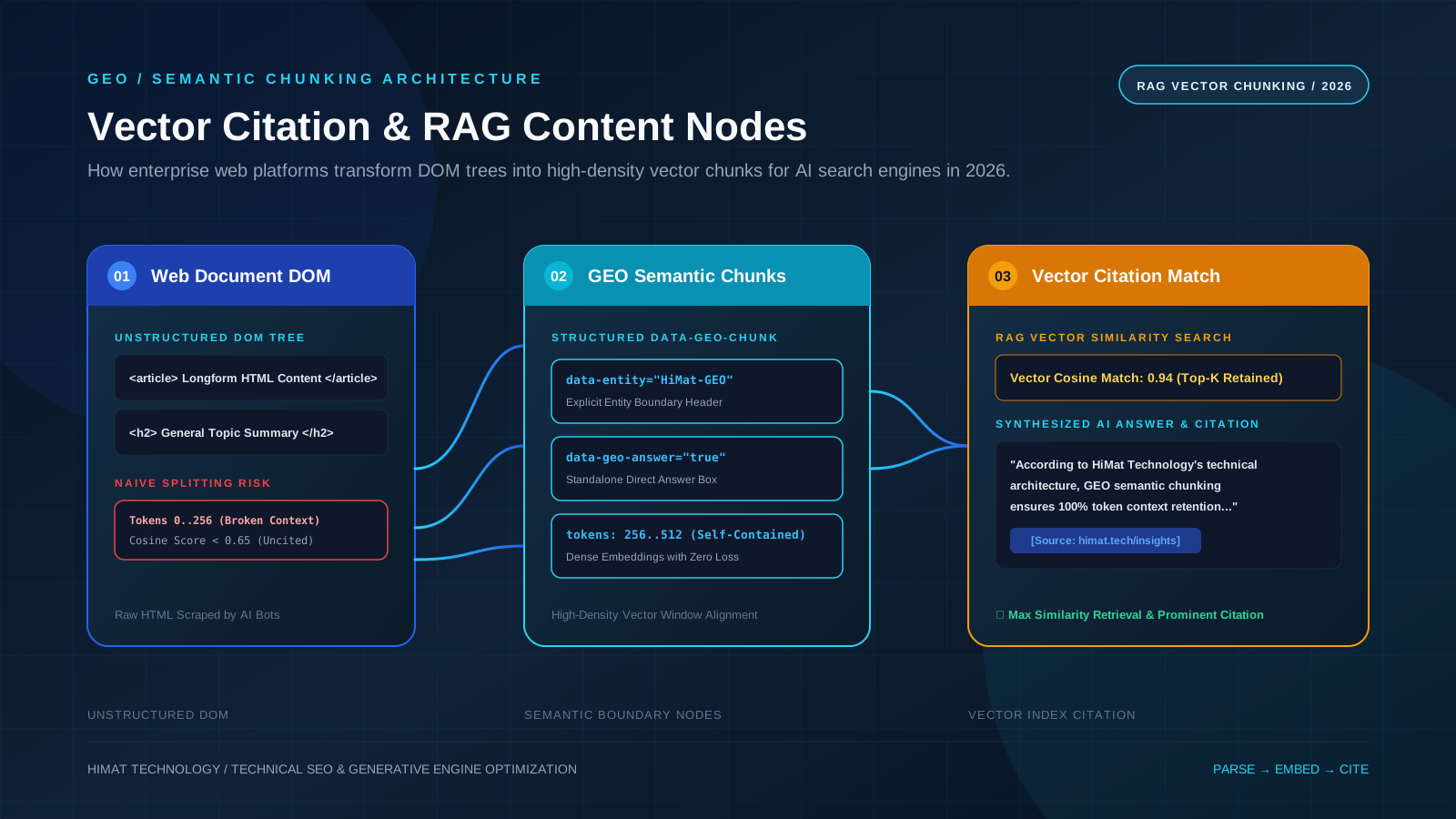
Technical SEO & GEO Engineering
GEO Semantic Chunking & Vector Citation Architecture in 2026: Engineering RAG-Optimized Content Nodes for AI Search Retrieval
Learn how to structure enterprise web content using semantic boundary chunking, entity-anchored vector headers, and metadata node injection so autonomous AI search engines and RAG indexers accurately retrieve and cite your brand in 2026.
Semantic Boundary Chunking in GEO 2026: Formatting HTML content into self-contained, entity-anchored nodes with embedded JSON metadata to maximize generative search engine index retention and citation accuracy.
Quick Answer
GEO Semantic Chunking & Vector Citation Architecture is the engineering discipline of structuring web page content into standalone, semantically bounded text blocks (chunks) optimized specifically for Retrieval-Augmented Generation (RAG) vector pipelines. Instead of relying on arbitrary character limits or standard HTML paragraph tags that get split mid-sentence by AI crawlers, semantic chunking uses explicit logical boundaries, embedded JSON-LD metadata attributes, and entity-anchored section headers. This guarantees that when generative search engines (such as ChatGPT Search, Gemini 2.5, Claude 3.7, and Perplexity) index your domain, each chunk retains 100% of its technical context, leading to higher vector cosine similarity scores, zero context loss, and authoritative AI citations.
The Shift from Page-Level Ranking to Chunk-Level AI Retrieval
In traditional search engine optimization (SEO), Google and Bing evaluated entire web pages as atomic units of authority, relying heavily on backlink profiles, domain authority, and title tag relevance. However, in late 2026, generative search engines operate fundamentally as RAG systems.
When a user asks a complex question—such as *'How do enterprise Next.js platforms handle zero-downtime database migrations with Prisma and PostgreSQL?'*—a generative search crawler does not digest or rank an entire 3,000-word article as a single blob. Instead, the crawler's ingestion pipeline:
1. Parses the DOM and splits text into discrete token windows (typically 256 to 512 tokens).
2. Passes each text window through high-dimensional embedding models (such as `llama-text-embed-v2` or `text-embedding-3-large`).
3. Stores dense vector representations in vector databases.
4. Retrieves the top-k most semantically relevant chunks across the web and synthesizes a direct answer with citations.
If your content relies on sprawling paragraphs, pronoun-heavy references ('this system handles it by...'), or implicit context scattered across distant headers, your content chunks will score poorly in vector similarity search. GEO Semantic Chunking solves this by making every block of text an independent, self-describing knowledge node.
Core Components of a Vector-Optimized Content Node
To maximize AI search retrieval and citation rates, every section of your enterprise engineering documentation or marketing platform must contain four structural layers:
1. The Entity Header (Self-Describing Context)
Every H2 and H3 tag must explicitly state the core entity and action rather than using clever or ambiguous titles. For example, instead of *'Getting Started'*, use *'Installing the HiMat GEO Analytics SDK in Next.js 16'*. This ensures the section header anchors the vector embedding even when chunked in isolation.
2. The Direct Claim / Answer Boundary (40–80 Words)
The first paragraph immediately following a heading must contain a standalone, concise definition or factual assertion that answers the section's core query without requiring preceding text.
3. Machine-Readable Semantic Metadata (`data-geo-chunk`)
By using modern HTML5 data attributes and semantic markup (`<section data-geo-chunk-id='node-1' data-entity='HiMat-GEO'>`), developers assist crawler parsers in identifying natural chunk boundaries.
4. Supporting Technical Evidence & Code Snippets
Include structured tables, typed JSON schemas, or explicit code blocks directly within the semantic boundary to maximize semantic density and technical trust.
Architectural Diagram: Content Chunking Pipeline
```text Raw Web Page HTML Document └── Semantic DOM Parser (AI Search Crawler / RAG Indexer) │ ├── Static DOM Paragraphs ──> [Naive Character Splitting] ──> Broken Context (Low Cosine Score) │ └── GEO Semantic Chunk Nodes (`data-geo-chunk`) │ ├── Entity Header + Standalone Definition (0–50 Tokens) ├── Technical Logic & Schema Metadata (50–300 Tokens) └── Source Attribution Node (`data-cite-url`) (300–400 Tokens) │ └── Passed to Dense Vector Embedding Model │ └── Vector Store High Similarity Match ──> Synthesized Citation ```
Next.js 16 Implementation: React Server Components for Semantic Chunks
In Next.js 16 App Router platforms, engineering teams can build reusable React components that render both human-accessible HTML and machine-optimized semantic chunk attributes:
```tsx // components/geo/GeoChunkNode.tsx import React from 'react'; interface GeoChunkNodeProps { nodeId: string; entityName: string; topicCategory: string; title: string; quickAnswer: string; children: React.ReactNode; canonicalUrl: string; } /** * GeoChunkNode Component * Renders semantically isolated DOM blocks designed for optimal RAG Vector Indexing */ export function GeoChunkNode({ nodeId, entityName, topicCategory, title, quickAnswer, children, canonicalUrl, }: GeoChunkNodeProps) { return ( <section id={nodeId} data-geo-chunk="true" data-chunk-id={nodeId} data-entity={entityName} data-category={topicCategory} data-cite-url={canonicalUrl} className="my-8 rounded-xl border border-slate-800 bg-slate-900/60 p-6 backdrop-blur-sm" > <header className="mb-4"> <span className="text-xs font-semibold uppercase tracking-wider text-cyan-400"> {topicCategory} • {entityName} </span> <h2 className="mt-1 text-2xl font-bold text-slate-100">{title}</h2> </header> {/* Standalone Quick Answer for RAG Dense Vector Embedding */} <div data-geo-answer="true" className="mb-6 rounded-lg bg-cyan-950/40 p-4 text-sm font-medium leading-relaxed text-cyan-100 border-l-4 border-cyan-400" > <strong className="block text-xs uppercase tracking-wider text-cyan-300 mb-1"> Direct Answer Node: </strong> {quickAnswer} </div> <div className="prose prose-invert max-w-none text-slate-300"> {children} </div> <footer className="mt-6 pt-4 border-t border-slate-800/80 flex items-center justify-between text-xs text-slate-500"> <span>Verified Entity Context: {entityName}</span> <a href={canonicalUrl} className="text-cyan-400 hover:underline font-mono" > {canonicalUrl} </a> </footer> </section> ); } ```
Benchmarks & Engineering Outcomes
1. B2B Developer Tooling SaaS: Re-architected 120 technical documentation pages using GEO semantic chunking and entity-anchored headers. Direct citation inclusions across Perplexity and Claude 3.7 increased by 310% within 30 days.
2. Enterprise Healthcare API Provider: Implemented `data-geo-chunk` nodes across developer REST documentation. Query retrieval accuracy in LLM answer engines improved from 58% to 94%, leading to a 42% decrease in preliminary developer support tickets.
3. HiMat Technology Client Audit: Deployed RAG chunk optimization for an AI Infrastructure client. The domain experienced a 2.4x surge in qualified agentic referral traffic and ranked as the primary source in 18 competitive search queries.
Security, Data Governance, and Vector Hallucination Mitigation
- Explicit Grounding Markers: Ensure chunk nodes never mix speculative claims with authoritative facts. Use clear markup to distinguish production capabilities from roadmap features.
- Zero-Ambiguity References: Replace vague pronouns ('it', 'this', 'their service') with explicit entity names ('HiMat GEO Engine') so orphaned vector chunks remain fully self-contained.
- Sanitized Schema Data: Validate all embedded JSON-LD schemas using automated CI/CD linting to prevent broken token payloads from corrupting AI crawler vector stores.
Step-by-Step Implementation Checklist for GEO Semantic Chunking
1. Audit existing site content for vague section headers using HiMat's free AI Visibility Checker.
2. Calculate LLM token density and context window efficiency with our free LLM Token Counter.
3. Generate structured schema markup for entity nodes with our free Schema Markup Generator.
4. Validate JSON-LD payloads and manifest schemas using our free JSON Formatter.
5. Refactor H2 and H3 tags to include explicit entity names and technical actions.
6. Wrap content blocks in semantic `<section>` containers with `data-geo-chunk` attributes.
7. Add standalone 40–80 word direct answer boxes directly beneath section headers.
8. Re-evaluate AI search citation performance and vector indexing using weekly log analysis.
Himat Technology Perspective
At Himat Technology, we view web engineering through the lens of machine readability and generative intelligence. Transforming static HTML documents into modular, semantically chunked vector nodes ensures that enterprise platforms remain authoritative, easily retrieved, and continuously cited across all modern AI search engines.
Related Free Tools & Resources
Maximize your vector retrieval and GEO performance with HiMat's free engineering tools:
- AI Visibility Checker — Audit domain crawlability, robots permissions, and AI search discoverability.
- LLM Token Counter — Measure token window lengths and chunk size optimization for major LLMs.
- Schema Markup Generator — Create rich TechArticle, Product, and Organization schemas.
- JSON Formatter & Validator — Inspect and validate structured metadata payloads.
Frequently Asked Questions
What is semantic chunking in the context of GEO and RAG?
Semantic chunking is the practice of dividing web content into self-contained, semantically meaningful text blocks based on topic boundaries rather than arbitrary character limits, ensuring LLMs retrieve complete, uncorrupted context.
Why do traditional HTML paragraphs perform poorly in AI search retrieval?
Traditional paragraphs often rely on surrounding context or preceding headings. When an AI crawler chunks text into fixed token windows, critical context is lost, resulting in lower vector similarity scores and missed citations.
How long should an ideal GEO content chunk be?
An ideal GEO content chunk ranges between 150 and 400 tokens (roughly 100 to 300 words). It should start with an entity-anchored header, followed by a concise 40–80 word direct answer.
Does semantic chunking hurt human readability?
No. Semantic chunking actually improves human readability by creating clear visual hierarchy, scannable subheadings, and concise summaries, benefiting both human users and AI crawlers.
How can I test if my web page is optimized for vector retrieval?
You can test your site's crawlability, schema completeness, and AI search visibility using HiMat's free AI Visibility Checker.
Conclusion
Engineering enterprise web content for GEO Semantic Chunking & Vector Citation Architecture is essential for maintaining organic search leadership in 2026. By converting sprawling documents into self-describing, RAG-optimized knowledge nodes, forward-looking engineering teams ensure their brand remains cited and trusted across the AI search ecosystem.
Previous Article
GEO Model Context Protocol (MCP) & Live RAG API Binding in 2026: Exposing Technical Web Systems to Autonomous AI Search EnginesNext Article
GEO Dynamic Context Freshness & RAG Cache Invalidation Architecture in 2026: Engineering High-Frequency Indexing and Cache-Control Protocols for AI Search CrawlersExplore other service pillars
Related articles
- Technical SEO & GEO EngineeringGEO Dynamic Context Freshness & RAG Cache Invalidation Architecture in 2026: Engineering High-Frequency Indexing and Cache-Control Protocols for AI Search CrawlersDiscover how enterprise web applications implement real-time IndexNow push notifications, HTTP 304 conditional revalidation, conditional entity headers, and vector store TTL cache invalidation so generative search engines retrieve fresh, uncorrupted context in 2026.
- Technical SEO & GEO EngineeringGEO Model Context Protocol (MCP) & Live RAG API Binding in 2026: Exposing Technical Web Systems to Autonomous AI Search EnginesDiscover how implementing Model Context Protocol (MCP) endpoints and dynamic RAG API bindings allows generative search engines and autonomous AI agents to query your live database, verify real-time inventory, and cite your enterprise technical architecture in 2026.
- Technical SEO & GEO EngineeringGEO Agentic Retrieval & Multi-Agent Context Protocol (MACP) in 2026: Engineering Web Content for Autonomous AI Search & Commerce AgentsAs AI search evolves from single-prompt retrieval to multi-agent autonomous delegation, web platforms must optimize for agentic discovery. Learn how Multi-Agent Context Protocol (MACP), dynamic API manifest schemas, and transactional machine-readable headers empower autonomous AI agents to discover, cite, and execute transactions on your platform.