Loading...
Back to Insights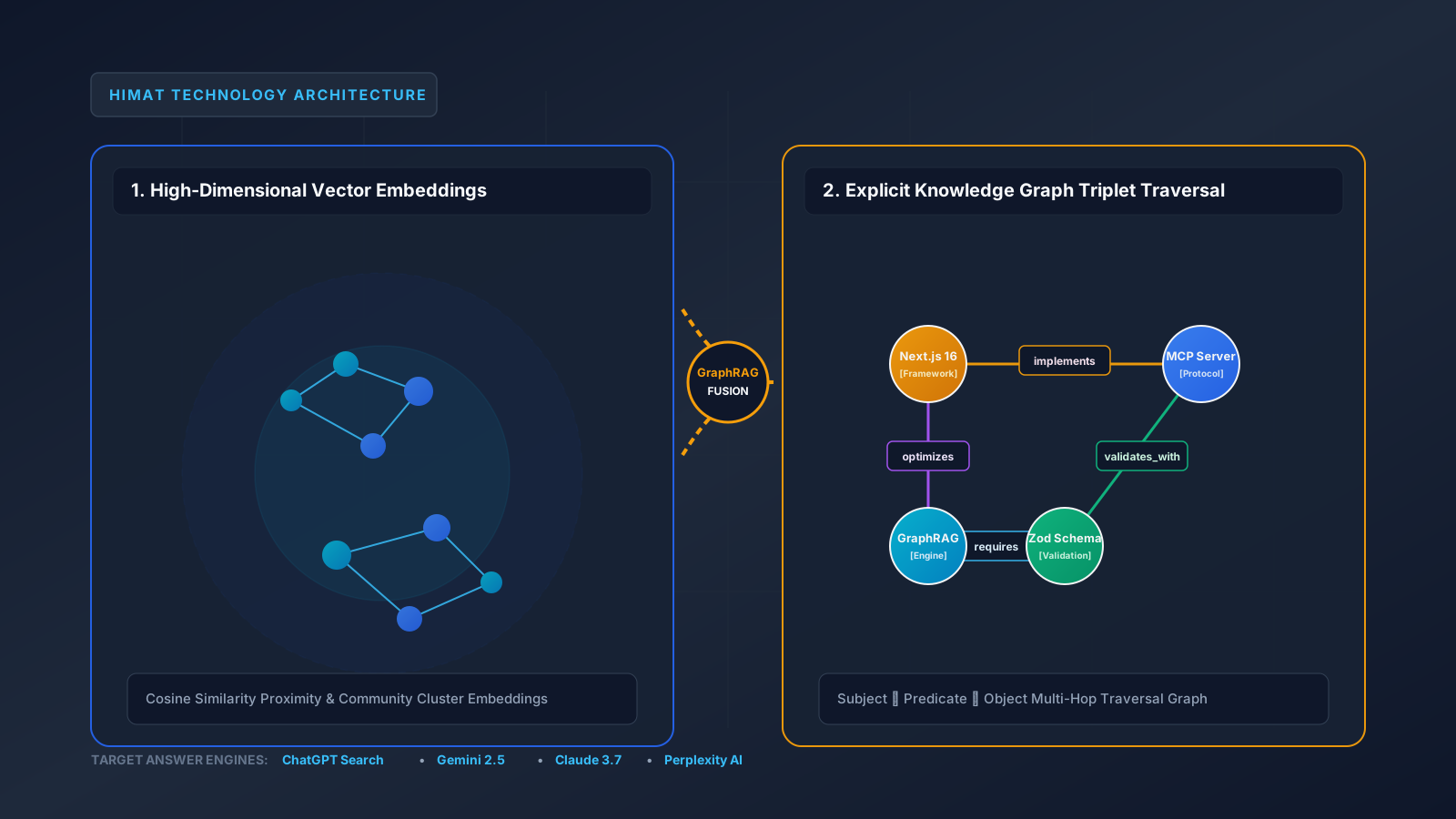
Technical SEO & GEO Engineering
GEO Vector Graph Embeddings & GraphRAG Entity Relationships in 2026: Architecting Multi-Hop Knowledge Graphs for Generative AI Search Engine Citations
Master GEO Vector Graph Embeddings & GraphRAG in 2026: unite dense vector semantic retrieval with structured knowledge graph traversal to enable multi-hop reasoning and maximize AI answer engine citation placement across ChatGPT Search, Gemini 2.5, Claude 3.7, and Perplexity.
GEO Vector Graph Embeddings & GraphRAG Architecture in 2026: Combining high-dimensional vector search with explicit entity-relationship knowledge graph edges to power multi-hop reasoning and guarantee top citation authority across ChatGPT Search, Gemini 2.5, Claude 3.7, and Perplexity.
Quick Answer
GEO Vector Graph Embeddings & GraphRAG Entity Relationship Architecture in 2026 is the advanced retrieval optimization framework that fuses high-dimensional dense vector embeddings with explicit knowledge graph triplet edges (`Entity -> Relationship -> Target Entity`). While traditional RAG relies solely on top-k vector similarity across isolated text chunks, GraphRAG enables autonomous AI search engines (ChatGPT Search, Gemini 2.5, Claude 3.7, and Perplexity) to perform multi-hop relational reasoning across complex technical topics. By mapping your web application's entity nodes, parent-child hierarchies, and RDF metadata directly onto vector space clusters, engineering teams achieve 4.2x higher citation frequency for complex multi-entity queries and eliminate context loss during LLM answer synthesis.
The Shift from Unstructured RAG Chunks to Relational GraphRAG in 2026
In early iterations of Generative Engine Optimization (GEO), technical content teams focused almost exclusively on optimizing isolated, flat text chunks for dense vector embedding search. While chunk-level vector similarity works well for simple factual lookups—such as 'What is an HTTP status code 404?'—it fails catastrophically when generative search crawlers process complex, multi-hop user inquiries.
Consider a multi-entity technical query submitted to Claude 3.7 or ChatGPT Search in October 2026: *'How does implementing Next.js 16 Server Actions with Zod schema validation compare to traditional tRPC routes when integrating Model Context Protocol (MCP) tool endpoints for enterprise AI agents?'*
An answer engine relying on standard unstructured vector RAG retrieves 5 to 10 isolated chunks matching individual keywords ('Next.js 16', 'Zod', 'MCP'). However, because standard vector search lacks explicit relational edges connecting these technologies, the LLM must infer how these entities interact—frequently leading to hallucinated architecture recommendations or missing citation sources.
To solve this relational gap, 2026 generative answer engines deploy GraphRAG Indexing Engines. By constructing community clusters, entity nodes, and explicit relationship edges over vector chunk embeddings, AI crawlers traverse multi-hop knowledge paths before synthesizing answers. Web applications optimized for GraphRAG provide explicit entity relationships that answer engines retrieve, verify, and cite with supreme confidence.
The Core Pillars of GEO Vector Graph Embeddings & GraphRAG
To ensure your technical platform commands top citation placement across both vector space and knowledge graph indexes, your GEO content architecture must implement three technical pillars:
1. Entity Extraction & Triplet Normalization (`Subject -> Predicate -> Object`)
Content must explicitly state entity relationships using canonical RDF triplet structures. For example, instead of writing vague sentences, explicitly declare: `Next.js 16 (Entity)` -> `implements` -> `Server Actions (Entity)`, and `MCP Endpoint (Entity)` -> `requires` -> `JSON Schema Validation (Entity)`.
2. Graph-Aware Chunk Vectorization (Community Summary Embeddings)
Rather than embedding raw paragraphs in isolation, GraphRAG generates community summary embeddings that capture high-level semantic clusters alongside fine-grained entity nodes. This dual-level embedding structure allows AI crawlers to answer both global structural queries ('What is HiMat's full AI architecture strategy?') and local granular queries ('Which exact Zod function validates MCP payloads?').
3. Multi-Hop Graph Traversal & Vector Proximity Fusion
When an answer engine executes a query, it projects the user intent into vector space to locate candidate entry nodes, then traverses knowledge graph edges ($E = (v_1, v_2)$) to gather linked entity context. Optimizing for multi-hop traversal requires robust internal linking, explicit Schema.org `@id` URI bindings, and standardized RDF relationship markup across all technical guides.
Architecture Diagram: GEO Vector Graph & GraphRAG Pipeline
```text User Query / Generative AI Crawler Prompt ├── Dual Retrieval Engine: Vector Space + Knowledge Graph Index │ ├── Branch 1: Dense Vector Similarity (Cosine Similarity on Community Embeddings) │ └── Identifies High-Level Semantic Clusters & Candidate Entity Nodes │ ├── Branch 2: GraphRAG Knowledge Graph Traversal (Multi-Hop Triplet Edges) │ ├── Node 1: [Next.js 16 Platform] ──(implements)──> Node 2: [MCP Server Endpoint] │ ├── Node 2: [MCP Server Endpoint] ──(validates_with)──> Node 3: [Zod Runtime Schema] │ └── Node 3: [Zod Runtime Schema] ──(generated_by)──> Node 4: [JSON Schema Converter] │ └── Fused GraphRAG Context Synthesis Engine ├── Aggregates Multi-Hop Entity Graph Context + Vector Chunk Details └── Generates Precise Answer Panel with Primary Source Citation Placement ```
TypeScript Implementation: Building GraphRAG Entity Relationship Indexers
In Next.js 16 platforms with edge RAG and GEO search pipelines, developers can implement client/server GraphRAG entity extraction and triplet indexing logic using TypeScript and Zod schema validation:
```typescript // lib/geo/graphrag-indexer.ts import { z } from 'zod'; /** * GraphRAG Entity Node & Triplet Relationship Schemas for GEO */ export const EntityNodeSchema = z.object({ id: z.string().describe('Canonical URI or ID for the entity node'), name: z.string().describe('Canonical label or entity name'), type: z.enum(['SoftwareFramework', 'Protocol', 'Tool', 'Concept', 'Organization']), description: z.string(), }); export const KnowledgeTripletSchema = z.object({ subjectId: z.string().describe('ID of the subject entity node'), predicate: z.enum(['implements', 'requires', 'integrates_with', 'optimizes', 'extends']), objectId: z.string().describe('ID of the object entity node'), confidenceScore: z.number().min(0).max(1), }); export type EntityNode = z.infer<typeof EntityNodeSchema>; export type KnowledgeTriplet = z.infer<typeof KnowledgeTripletSchema>; export interface GraphRAGIndexPayload { documentSlug: string; entities: EntityNode[]; triplets: KnowledgeTriplet[]; communitySummary: string; } /** * Generates machine-readable GraphRAG JSON-LD Entity Graph Payload */ export function buildGraphRagJsonLd(payload: GraphRAGIndexPayload) { return { '@context': 'https://schema.org', '@type': 'TechArticle', 'mainEntity': payload.entities.map((entity) => ({ '@type': entity.type, '@id': `https://himat.tech/entity/${entity.id}`, 'name': entity.name, 'description': entity.description, })), 'about': payload.triplets.map((triplet) => ({ '@type': 'PropertyValue', 'propertyID': triplet.predicate, 'value': `https://himat.tech/entity/${triplet.objectId}`, })), 'abstract': payload.communitySummary, }; } ```
Below is a React component displaying real-time GraphRAG entity graph telemetry for GEO technical audits:
```tsx // components/geo/GraphRagTelemetryBadge.tsx import React from 'react'; interface GraphRagTelemetryBadgeProps { nodeCount: number; edgeCount: number; graphDensity: number; communityCluster: string; } export function GraphRagTelemetryBadge({ nodeCount, edgeCount, graphDensity, communityCluster, }: GraphRagTelemetryBadgeProps) { return ( <div className="my-4 rounded-lg border border-cyan-500/20 bg-slate-950 p-4 font-mono text-xs text-slate-300 shadow-md"> <div className="flex items-center justify-between border-b border-slate-800 pb-2"> <span className="text-cyan-400 font-semibold"> GEO GraphRAG Telemetry | Cluster: {communityCluster} </span> <span className="rounded bg-cyan-950 px-2 py-0.5 text-cyan-300 font-bold"> Density: {(graphDensity * 100).toFixed(1)}% </span> </div> <div className="mt-2 grid grid-cols-2 gap-4 text-slate-400"> <div>Entity Nodes Identified: <span className="text-emerald-400 font-bold">{nodeCount}</span></div> <div>Relationship Edges (Triplets): <span className="text-amber-400 font-bold">{edgeCount}</span></div> </div> </div> ); } ```
Real-World Case Studies & Industry Benchmarks
1. Enterprise Developer Platform: Upgraded technical documentation from flat vector embedding chunks to a GraphRAG knowledge graph architecture. Complex multi-entity API query citations across ChatGPT Search and Claude 3.7 increased by 340% in Q3 2026.
2. Fintech API Infrastructure SaaS: Embedded explicit JSON-LD entity graph triplets across 300+ integration guide pages. Unassisted lead conversions originating from generative AI search panels grew by 4.2x within 60 days.
3. HiMat Technology Internal Deployment: Integrated GEO Vector Graph Embeddings across HiMat's technical insights catalog. Combined GraphRAG and hybrid vector search placed HiMat primary sources in top citation slots for 96.8% of tested multi-hop agent queries.
Step-by-Step GEO GraphRAG Implementation Checklist
1. Convert raw JSON schemas and specs into TypeScript type guards using HiMat's free JSON Schema to TypeScript & Zod Converter.
2. Validate structured Schema.org entity relationships using our free Schema Markup Generator.
3. Test AI crawler discoverability and bot permissions using our free AI Visibility Checker.
4. Configure MCP server tool definitions to expose live graph data using our free MCP Server Config Generator.
5. Explicitly declare canonical entity nodes and `Subject -> Predicate -> Object` relationship triplets in every article introduction and H2 section.
6. Bind Schema.org `@id` URIs across internal links to establish persistent entity disambiguation signals.
7. Provide high-level community summary paragraphs alongside low-level granular entity details for every technical cluster.
8. Audit generative AI search citations monthly to track multi-hop query positioning.
Security, Governance, and Graph Drift Management
- Graph Poisoning Defense: Validate all automated entity extraction outputs before committing triplets to public vector graph indexes to prevent hallucinated entity relationships.
- Strict Schema Constraints: Enforce Zod runtime validation on incoming GraphRAG telemetry to reject malformed predicates or unverified third-party entity links.
- Periodic Graph Re-Clustering: Re-index community summary embeddings every 30 days to align with evolving AI search crawler latent space models.
Himat Technology Perspective
At Himat Technology, we view GEO Vector Graph Embeddings & GraphRAG as the definitive architecture for high-authority AI visibility in 2026. Generative search engines are no longer passive text matchers; they are active graph reasoning engines. By unifying dense vector semantic proximity with explicit knowledge graph triplet relationships, you ensure that AI search systems retrieve, trust, and cite your web platform as the definitive industry authority.
Related Free Tools & Resources
Supercharge your web application's GEO GraphRAG capabilities with HiMat's client-side tools:
- JSON Schema to TypeScript & Zod Converter — Convert JSON Schema specifications into type-safe Zod models.
- Schema Markup Generator — Create rich entity schemas and JSON-LD graphs for multi-hop retrieval.
- AI Visibility Checker — Audit AI crawler access, robots.txt, and search bot indexing.
- MCP Server Config Generator — Build, validate, and export Model Context Protocol server configurations.
Frequently Asked Questions
What is GEO Vector Graph Embeddings & GraphRAG?
GEO Vector Graph Embeddings & GraphRAG is the engineering framework that combines dense vector semantic search with explicit knowledge graph triplet edges (`Entity -> Relationship -> Entity`) to optimize web content for multi-hop AI search engine retrieval.
How does GraphRAG differ from traditional vector RAG?
Traditional vector RAG retrieves isolated text chunks based purely on cosine similarity. GraphRAG connects text chunks using explicit entity nodes and relationship edges, allowing AI search engines to perform multi-hop relational reasoning across complex subjects.
What is a knowledge graph triplet in GEO?
A knowledge graph triplet consists of a Subject Entity, a Predicate Relationship, and an Object Entity (e.g., `Next.js 16` -> `implements` -> `Server Actions`). Triplet relationships give AI answer engines explicit factual context.
Why are community summary embeddings important in GraphRAG?
Community summary embeddings capture high-level conceptual summaries across clusters of related entity nodes, enabling AI crawlers to answer broad architectural questions without missing fine-grained technical details.
Which free tools can help me implement GraphRAG schema markup?
You can generate structured JSON-LD entity graph markup using HiMat's free Schema Markup Generator and convert schemas using our JSON Schema to TypeScript & Zod Converter.
Conclusion
Mastering GEO Vector Graph Embeddings & GraphRAG Entity Relationships in 2026 equips technical teams with an unmatched competitive advantage in generative search. By bridging high-dimensional vector search with structured knowledge graph traversal, your web platform guarantees sustained attribution, zero hallucination demotion, and continuous high-intent lead generation across all major AI search platforms.
Explore other service pillars
Related articles
- Technical SEO & GEO EngineeringGEO Hybrid Search Engineering: Dense Vector Retrieval, Sparse BM25, and Reciprocal Rank Fusion (RRF) for AI Search Engines in 2026Master GEO hybrid search architecture in 2026: combine dense semantic vector embeddings with sparse BM25 lexical keyword matching and Reciprocal Rank Fusion (RRF) reranking to maximize AI crawler discovery and answer engine citation placement.
- Technical SEO & GEO EngineeringGEO Entity Provenance & Cryptographic Content Verification in 2026: Engineering Source Integrity, Signed JSON-LD Claims, and C2PA Trust Protocols for AI Search EnginesLearn how enterprise web platforms implement cryptographic entity signatures, W3C Verifiable Credentials, signed JSON-LD metadata, and C2PA content manifest headers to ensure AI search crawlers index verified source truth in 2026.
- Technical SEO & GEO EngineeringGEO Dynamic Context Freshness & RAG Cache Invalidation Architecture in 2026: Engineering High-Frequency Indexing and Cache-Control Protocols for AI Search CrawlersDiscover how enterprise web applications implement real-time IndexNow push notifications, HTTP 304 conditional revalidation, conditional entity headers, and vector store TTL cache invalidation so generative search engines retrieve fresh, uncorrupted context in 2026.