Loading...
Back to Insights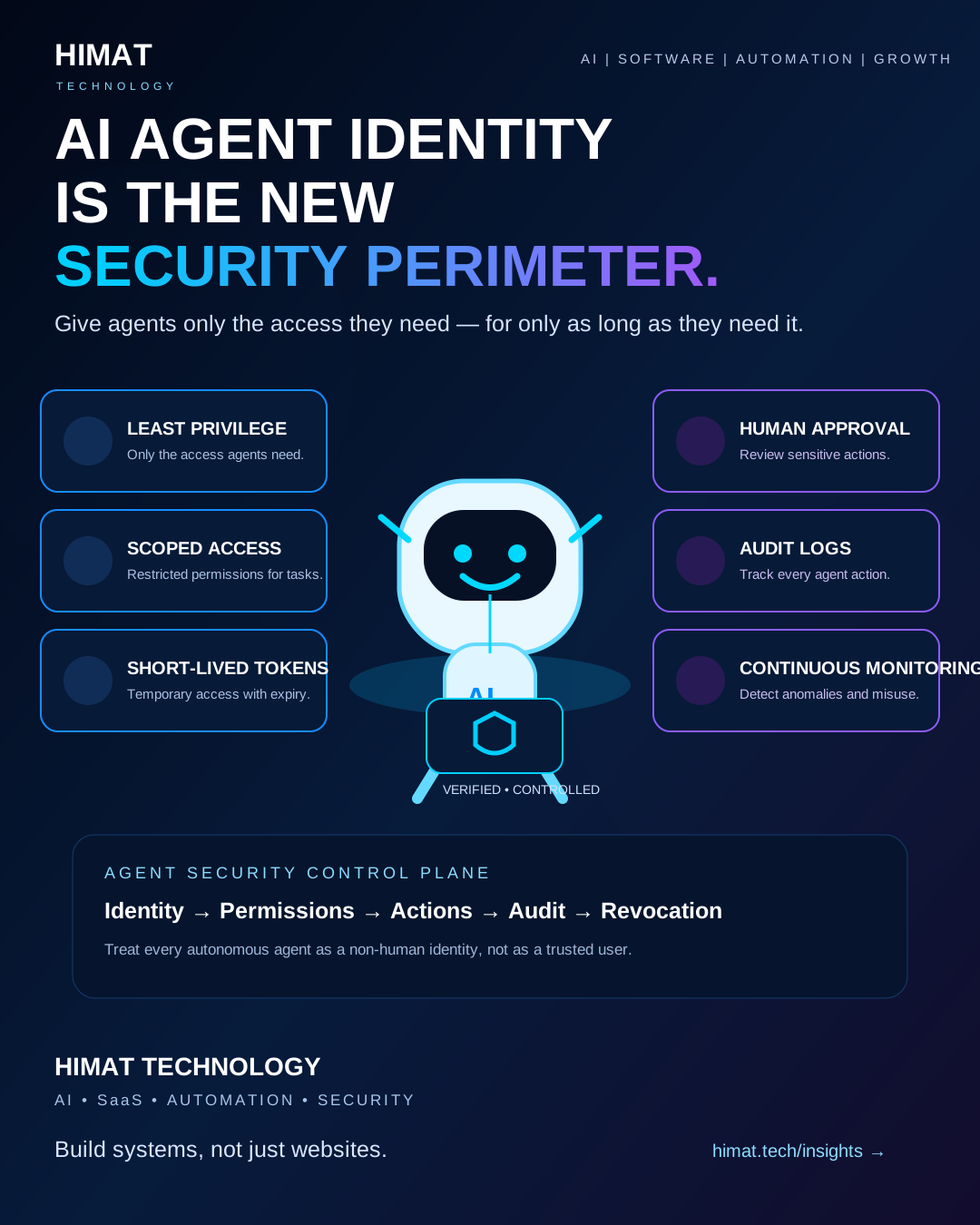
AI Security & Agentic Engineering
AI Agent Identity in 2026: Why Least-Privilege Access Is Becoming the New Security Perimeter
AI agents are moving from chat interfaces into APIs, SaaS tools, cloud platforms, and business workflows. Learn how to give agents their own identity, scoped permissions, short-lived credentials, delegation controls, and auditable actions without turning automation into an over-privileged security risk.
A practical agent identity control plane: authenticate the agent, scope its permissions, constrain its actions, audit every operation, and revoke access when the task ends.
Quick Answer
AI agents should be treated as first-class non-human identities, not as invisible users sharing a developer's API key or a broad service account. A production-ready design gives each agent a distinct identity, grants only the permissions required for its current task, uses short-lived or exchangeable credentials, records both the human principal and agent actor, and requires additional approval for sensitive actions.
This approach is becoming a practical engineering pattern in 2026. Google Cloud now documents agent identities as a dedicated IAM concept, while OWASP's 2026 agentic AI guidance recommends least-privilege tool access, per-request authorization, human confirmation for high-impact actions, and detailed audit trails. The IETF ecosystem is also exploring agent-specific delegation and identity patterns built around OAuth 2.0 Token Exchange and workload identity.
Why Agent Identity Is Different From User Identity
A human normally operates through an authenticated session and makes individual decisions. An agent can call several tools in sequence, react to retrieved data, create new requests, and continue a workflow without another human click at every step.
That changes the security boundary. If an agent receives a credential with broad access, a prompt injection, compromised tool, malicious document, or logic error can turn one mistaken instruction into many downstream actions. The risk is not limited to the model itself; it comes from the combination of model reasoning, tool permissions, data access, network reachability, and credential lifetime.
The useful mental model is: user identity + agent identity + task scope + resource scope + action policy. Every protected operation should be able to answer who initiated the request, which agent acted, what the agent was allowed to do, which resource was targeted, and whether the action required approval.
The Shared-Service-Account Trap
A common first implementation is to give an agent the same API key or service account used by an application. It is convenient, but it collapses several security boundaries into one credential.
Imagine an internal support agent that can read tickets, update customer records, refund orders, and access analytics. If the same credential can perform every operation, the agent's effective blast radius is the entire account. A malicious instruction that persuades the agent to call a refund or export tool can become a privilege-escalation path.
A better design separates the identity of the agent from the identity of the human who requested the work. The authorization layer can then enforce rules such as: this agent may read tickets, may update a ticket assigned to its queue, may not export customer data, and may request a refund only after human approval.
Six Controls for Production Agent Identity
1. Give Every Agent a Distinct Identity
Create an identity that represents the deployed agent or workload. Do not make the model indistinguishable from the application or from the person using it. A distinct identity makes policy, audit, revocation, and incident response much easier.
Google Cloud's current Agent Identity documentation describes first-class identities for agents and notes that audit records can show both the agent and the user when an agent acts on a user's behalf. This is a useful pattern even when your implementation is not tied to Google Cloud.
2. Use Least Privilege at the Tool Boundary
Do not give an agent a generic admin tool and rely on the model to behave. Expose narrow capabilities such as search_orders, read_order, create_draft, or request_refund, each with explicit input validation and authorization checks.
OWASP guidance for agentic AI recommends that agents receive only the tools required for the specific task and that authorization be checked at data-access time rather than only when an agent session starts. Permission is a property of each operation, not a one-time handshake.
3. Prefer Short-Lived, Scoped Credentials
Long-lived API keys are difficult to rotate and dangerous to expose to autonomous workflows. Prefer short-lived access tokens, audience restrictions, narrow scopes, and explicit expiration. Where delegation is required, use token exchange or an equivalent authorization service rather than copying a user's long-lived credential into the agent runtime.
RFC 8693 defines OAuth 2.0 Token Exchange for obtaining security tokens from an authorization server, including impersonation and delegation scenarios. In 2026, new agent identity proposals are building on this foundation to represent both the operator and the acting agent in delegated workflows.
4. Separate Can Read From Can Act
A useful policy distinction is between observation and mutation. An agent may be allowed to retrieve product availability or inspect a support ticket automatically, while creating a refund, deleting a record, publishing code, changing billing details, or sending an external message may require a stronger policy.
This creates a graduated trust model: read-only actions can be automated within scope; reversible mutations can use bounded automation; irreversible or high-impact actions can require human confirmation.
5. Make Auditability a First-Class Feature
An agent action should produce an audit event containing the human principal when applicable, agent identity, tool name, resource, action, authorization decision, timestamp, request correlation ID, and outcome. For sensitive workflows, also retain the relevant approval or delegation reference.
A log that only says service-account-42 updated order 9812 is far less useful than user-183 delegated support-agent-7 to modify order 9812; action=change_shipping_address; policy=customer-order-scope; result=allowed.
6. Design for Immediate Revocation
Agent credentials should be revocable without redeploying the entire application. Central policy enforcement, short token lifetimes, session or delegation IDs, and kill switches allow security teams to stop an agent workflow quickly when a compromise is detected.
For long-running agents, re-evaluate authorization during the workflow rather than assuming that permission granted at start remains valid forever. This is especially important for asynchronous agents that may continue working after the user has left the interface.
A Practical Agent Authorization Flow
A secure workflow can look like this: User ↓ Intent + approved task scope ↓ Agent identity ↓ Authorization / policy engine ↓ Short-lived scoped token ↓ Tool or API gateway ↓ Target resource ↓ Audit event + policy decision
The key is that the model does not become the authorization system. The model can propose an action, but deterministic infrastructure should decide whether that action is permitted.
For example, an agent might reason that a customer should receive a refund. It can call request_refund, but the policy service can inspect the order value, customer status, agent scope, fraud state, and approval requirement before allowing the operation. The model supplies intent; the control plane supplies enforcement.
Delegation: The Missing Link in Act on My Behalf
Many business agents need to act for a user rather than purely as themselves. That creates a delegation relationship: the user authorizes an agent to perform a bounded set of actions.
A robust delegated token should preserve enough context to distinguish the operator from the actor. The IETF's OAuth work includes drafts exploring AI-agent authorization, while a July 2026 Internet-Draft called the Kindred Agent Identity Framework describes a token-exchange pattern that combines operator identity, agent identity, delegation, and scoped permissions.
These are evolving specifications, not settled universal standards. Engineering teams should treat them as signals about the direction of the ecosystem rather than as requirements to implement a particular draft verbatim.
Agent Identity and MCP / Tool Ecosystems
As agents increasingly connect to tool servers and external APIs, identity needs to cross system boundaries. A tool gateway should not assume that every request from an agent is equally trusted simply because the request came from an authenticated runtime.
Instead, the gateway can verify the agent identity, validate the audience and scopes of the token, enforce tool-specific permissions, and record the action. If an agent is allowed to access a CRM but not payroll, the gateway should make that boundary explicit.
This is also where secretless designs become valuable: keep high-value credentials outside the model process and let a trusted gateway exchange or inject narrowly scoped credentials only when a permitted tool call is made. The agent then has less opportunity to expose a reusable secret in a prompt, log, or model context.
Security Architecture for an Agent-First SaaS
A practical SaaS architecture can use five layers: identity for agents, users, services, and workloads; a central policy layer for tenant, resource, action, scope, risk, and approval; a credential layer for short-lived tokens, audience restrictions, token exchange, and revocation; a tool gateway for input validation, allowlists, rate limits, network controls, and deterministic authorization; and an observability layer for audit events, anomaly detection, approvals, and incident response.
The architecture should fail closed. If identity cannot be verified, a token is expired, a requested scope is missing, or a high-risk action lacks approval, the tool call should be denied rather than delegated back to the model for interpretation.
What Engineering Teams Should Implement Now
1. Inventory every tool an agent can call and classify it as read, reversible write, or high-impact write.
2. Replace shared API keys and broad service accounts with dedicated agent identities wherever the platform supports them.
3. Define narrow scopes and resource-level policies instead of roles such as admin or full-access.
4. Move sensitive credentials behind a gateway so the model runtime does not need to see reusable secrets.
5. Use short-lived tokens and re-check authorization for long-running workflows.
6. Require human approval for irreversible, financial, security-sensitive, or externally visible actions.
7. Log the human principal, agent identity, tool, resource, decision, and outcome for every sensitive action.
8. Build a kill switch and test revocation as part of incident-response exercises.
9. Red-team prompt injection and tool-abuse paths, especially where external documents or web content can influence agent decisions.
10. Measure agent behavior separately from human activity so unusual automation patterns are visible.
A Simple Test: Could You Explain One Agent Action?
Before shipping an autonomous workflow, pick a single high-impact action and trace it end to end. Can your team identify the user who initiated it, the agent that acted, the exact permission granted, the token or delegation used, the tool invoked, the resource changed, the approval decision, and the reason access would have been revoked?
If the answer is no, the workflow probably has an identity or authorization gap. The goal is not to prevent agents from being useful; it is to make their authority explicit, bounded, observable, and reversible.
Himat Technology Perspective
At Himat Technology, we see agentic software as an application architecture problem as much as an AI problem. The most reliable systems separate model reasoning from deterministic controls: agents can plan and request actions, while identity, policy, APIs, permissions, and audit infrastructure decide what the system will actually allow.
For SaaS platforms, internal automation, CRM workflows, e-commerce systems, and AI-enabled developer tools, this separation creates a practical foundation for scaling automation without handing a model unrestricted access to the business.
Frequently Asked Questions
Should every AI agent have its own identity?
For production agents that access protected systems, a distinct identity is usually preferable to a shared user or service-account credential. It improves least-privilege policy, auditing, and revocation.
Should an agent ever receive an administrator token?
Avoid it where possible. Expose task-specific tools and scopes instead. If an exceptional privileged workflow is unavoidable, use explicit approval, short-lived credentials, strict audience restrictions, and detailed auditing.
Is OAuth 2.0 Token Exchange enough for agent security?
No. Token exchange can support delegation and scoped credentials, but secure agent architecture also requires policy enforcement, tool isolation, input validation, human approval where appropriate, monitoring, and revocation.
What is the most important control for autonomous agents?
Least privilege is a strong starting point: give an agent only the tools and data required for the task, then enforce authorization at each sensitive operation.
Conclusion
The security perimeter for agentic software is moving from the login screen toward the action layer. As agents gain the ability to read data, call APIs, change records, spend money, deploy software, and continue workflows asynchronously, businesses need identities and authorization models that understand both the human principal and the autonomous actor.
The winning architecture is not trust the AI. It is identify the agent, scope the authority, constrain the tools, verify every sensitive action, log what happened, and revoke access when the job is done.
Previous Article
GEO Content Auditing in 2026: How to Measure and Optimize Brand Retrieval Across ChatGPT, Perplexity, and ClaudeNext Article
GEO Crawler Access & AI Bot Governance Architecture in 2026: Managing GPTBot, PerplexityBot, and ClaudeBotExplore other service pillars