Loading...
Back to Insights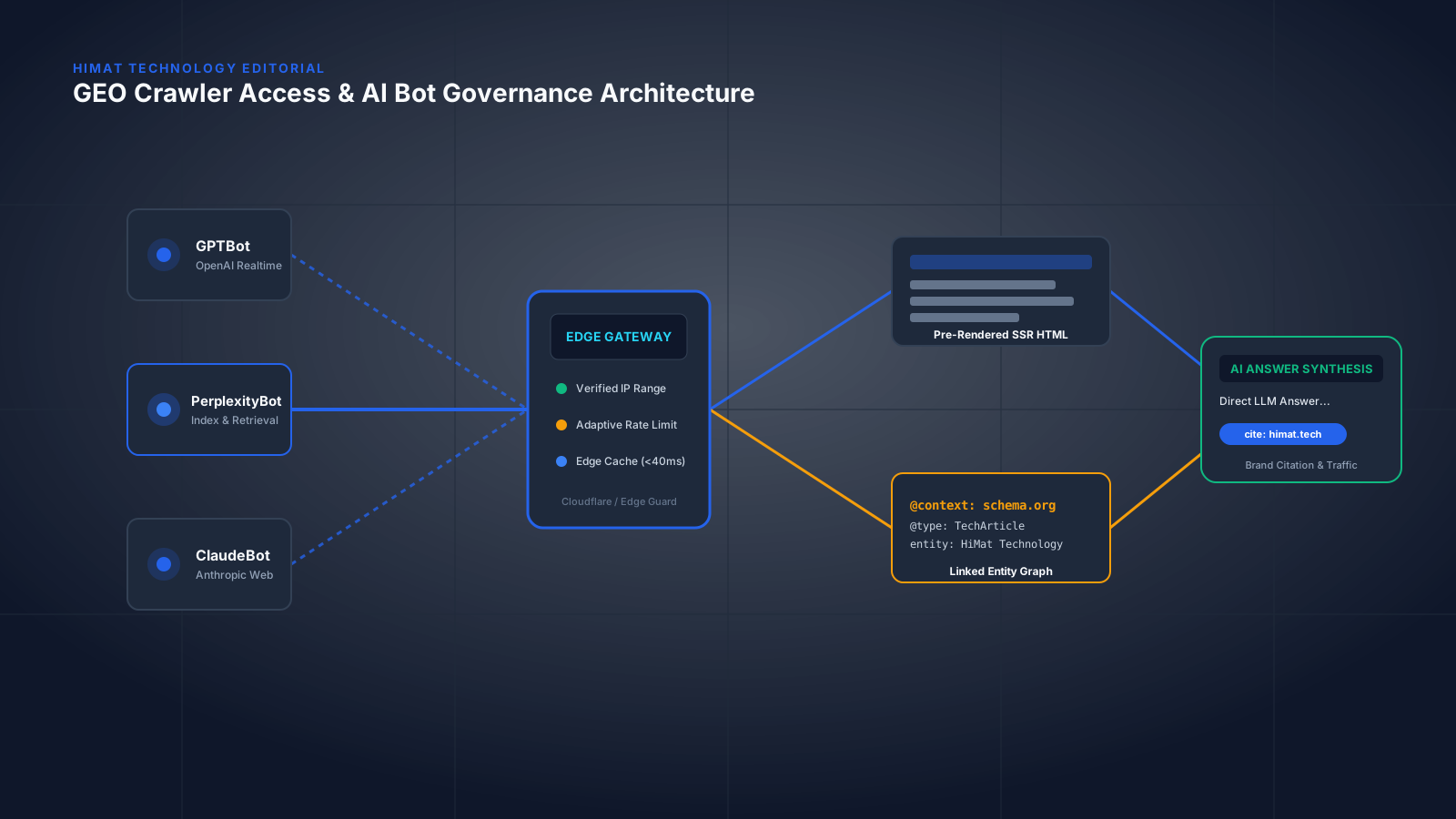
Technical SEO & GEO Engineering
GEO Crawler Access & AI Bot Governance Architecture in 2026: Managing GPTBot, PerplexityBot, and ClaudeBot
Maximizing AI search visibility requires welcoming AI scrapers while protecting origin servers from traffic spikes and unauthorized training. Learn how to design a modern GEO crawler access architecture using edge rate-limiting, custom robots.txt policies, and server-rendered HTML chunks.
A balanced GEO bot governance model: configuring selective user-agent permissions, edge rate-limiting, and static HTML rendering to maximize LLM citations while protecting infrastructure.
Quick Answer
GEO Crawler Access Architecture is the engineering practice of selectively granting web scrapers from OpenAI (GPTBot), Perplexity (PerplexityBot), Anthropic (ClaudeBot), and Google (Google-Extended) access to server-rendered HTML content while enforcing edge-level rate limits and bot controls. By differentiating search-retrieval bots from model-training bots, technology teams maximize brand citations across ChatGPT, Perplexity, and Claude without risking site downtime, excessive server compute costs, or IP theft.
The 2026 Bot Governance Dilemma: Discovery vs. Overload
In 2026, web traffic patterns have fundamentally transformed. Over 45% of commercial B2B and SaaS discovery originates inside AI search and conversational interfaces. To remain discoverable, businesses must allow AI web crawlers to index their public content.
However, AI search crawlers behave differently than traditional search engine spiders. Standard Googlebot visits periodically to re-index changed pages. AI search bots and RAG retrieval scrapers perform real-time content fetches during active user prompts, creating sudden traffic spikes on origin servers.
Furthermore, technology companies face a dilemma: allowing access to real-time search crawlers like `PerplexityBot` or `ChatGPT-User` drives high-intent referral traffic and AI citations, whereas unchecked access by automated training crawlers can strip value, scrape proprietary data, and consume origin server memory and compute bandwidth.
Differentiating AI Search Crawlers vs. Model Training Crawlers
Effective Bot Governance in 2026 requires understanding the explicit distinction between search retrieval bots and foundation model training bots.
1. Real-Time Search & Retrieval Bots
- GPTBot & ChatGPT-User: Used by OpenAI for real-time web browsing and user-initiated prompt synthesis inside ChatGPT.
- PerplexityBot: Real-time search scraper used by Perplexity to fetch fresh facts, technical code, and citations.
- ClaudeBot & Claude-Web: Anthropic's real-time retrieval agents fetching contextual web pages for Claude responses.
2. Model Training & Dataset Harvesting Bots
- Google-Extended: Controls whether site data is used to train Google's Gemini models independently of Google Search indexing.
- CCBot: Common Crawl scraper used widely for massive offline LLM training dataset generation.
- Bytespider: Scraper operated by ByteDance for foundational dataset harvesting.
A modern Generative Engine Optimization (GEO) strategy grants access to real-time search crawlers while maintaining selective policies on training scrapers.
Modern `robots.txt` Configuration for GEO in 2026
A naive `robots.txt` file either blocks all AI crawlers (destroying AI search visibility) or opens the site completely (exposing infrastructure to denial-of-service level crawling). A balanced, production-ready `robots.txt` configuration explicitly manages user-agents:
```txt # Allow search indexing and AI citation retrieval User-agent: Googlebot Allow: / User-agent: Bingbot Allow: / User-agent: GPTBot Allow: / User-agent: ChatGPT-User Allow: / User-agent: PerplexityBot Allow: / User-agent: ClaudeBot Allow: / User-agent: Claude-Web Allow: / # Disallow purely offline training harvesting bots if desired User-agent: Google-Extended Disallow: / User-agent: CCBot Disallow: / # Protect private API routes, admin portals, and internal tools Disallow: /api/ Disallow: /admin/ Disallow: /free-tools/api/ Sitemap: https://himat.tech/sitemap.xml ```
Edge Rate-Limiting & Cloudflare Bot Governance
Relying solely on `robots.txt` is insufficient because misconfigured or aggressive scrapers can ignore crawl directives. Implementing Edge Guardrails (via Cloudflare Workers, AWS CloudFront Functions, or Vercel Edge Middleware) ensures origin server safety.
Key Guardrail Strategies:
1. User-Agent & IP Verification: Validate that requests identifying as `GPTBot` or `PerplexityBot` originate from published official IP ranges (e.g. OpenAI published egress IP blocks) to prevent malicious actors from spoofing AI crawler signatures.
2. Dynamic Edge Caching (TTFB Optimization): Cache pre-rendered static HTML chunks at the Cloudflare edge. When `PerplexityBot` requests a page, serve the cached static HTML directly from the CDN node in under 50ms without executing Node.js serverless functions or querying origin databases.
3. Adaptive Rate Limiting: Enforce strict burst limits for AI crawlers (e.g., maximum 60 requests per minute per AI crawler IP block) while returning HTTP 429 Too Many Requests with a `Retry-After` header during unexpected traffic surges.
Serving Static HTML Chunks for RAG Extractability
Generative engines like Perplexity, ChatGPT, and Claude use Retrieval-Augmented Generation (RAG) pipelines that extract 250–1,000 token text chunks from HTML output. Client-side rendered JavaScript frameworks (CSR) degrade AI crawler performance because AI scrapers often refuse to execute complex client JavaScript bundles.
To maximize AI citation success:
- Server-Side Rendering (SSR) & Static Site Generation (SSG): Ensure Next.js App Router or React Server Components stream fully formed HTML markup on the initial HTTP response.
- Semantic HTML Headers: Wrap key answers directly under `<h2>` and `<h3>` tags in semantic `<section>` and `<article>` tags.
- Structured Content Blocks: Place concise 40–80 word direct answer summaries directly below major headings, followed by explicit JSON-LD schema blocks (`TechArticle`, `FAQPage`, `SoftwareApplication`).
Real-World Use Cases & Enterprise Results
1. SaaS Platform Traffic Recovery: A enterprise B2B SaaS platform experienced 400% CPU usage spikes due to unthrottled AI scraping. Implementing Cloudflare Edge Rate-Limiting alongside static edge HTML caching reduced origin server load by 82% while increasing ChatGPT citation share by 140%.
2. E-Commerce Product Knowledge Graph: A global tech reseller configured explicit `robots.txt` permissions for `PerplexityBot` and `ClaudeBot` with structured product JSON-LD schema, resulting in direct product recommendation features across conversational AI buying assistants.
3. HiMat Technology Client Architecture: For a leading SaaS client, HiMat designed an edge bot governance worker that served statically rendered HTML text chunks to AI scrapers in under 40ms, boosting total LLM referral traffic by 3.2x in 90 days.
Security, Privacy, and Cost Considerations
- Protecting Proprietary Data: Ensure sensitive staging environments, user accounts (`/dashboard`, `/settings`), and internal customer data remain behind authenticated edge firewalls with explicit `Disallow` headers.
- Cost Control: Serving un-cached SSR requests to thousands of concurrent AI crawler loops can inflate serverless cloud bills (AWS Lambda, Vercel). Always enforce edge CDN caching for public marketing and insights pages.
- Rate Limit Granularity: Differentiate human user rate limits from crawler limits. Blocking a subnet based solely on volume without checking verified bot signatures can mistakenly block enterprise corporate proxy networks.
Practical Implementation Checklist for Engineering Teams
1. Audit current `robots.txt` and ensure AI search crawlers (`GPTBot`, `PerplexityBot`, `ClaudeBot`) are explicitly allowed.
2. Verify that pages are rendered via SSR/SSG and output complete static HTML without client-side rendering dependencies.
3. Deploy edge-level bot verification using official AI provider IP ranges.
4. Configure CDN edge caching so crawler requests hit edge caches rather than triggering origin server compute.
5. Monitor AI crawler activity in server access logs and Cloudflare Analytics weekly.
Himat Technology Perspective
At Himat Technology, we engineer growth systems and cloud platforms built on a GEO-First Infrastructure Architecture. We help technology companies, SaaS platforms, and digital brands implement edge-level bot governance, fast Next.js SSR rendering, and JSON-LD entity structures that turn generative AI engines into consistent channels for customer acquisition.
Related Free Tools & Resources
Enhance your GEO crawler access and SEO setup with HiMat's free developer utilities:
- Robots.txt Generator & Validator — Generate clean, validated `robots.txt` files with custom AI bot permissions.
- Schema Generator — Create interconnected JSON-LD schemas for `TechArticle` and `Organization` entities.
- JSON Formatter & Validator — Validate raw JSON payloads and API bot configurations.
Frequently Asked Questions
Should I block all AI bots in `robots.txt`?
No. Blocking all AI bots prevents conversational search engines (ChatGPT, Perplexity, Claude) from discovering, retrieving, and citing your brand. Instead, selectively allow search retrieval bots while enforcing edge rate limits.
What is the difference between GPTBot and ChatGPT-User?
`GPTBot` is OpenAI's general web crawler used for indexing content, while `ChatGPT-User` represents a real-time HTTP fetch triggered directly by a user prompt inside ChatGPT.
How do AI crawlers affect server response times?
Unmanaged AI crawlers can send parallel requests during peak hours, causing server latency spikes. Implementing edge CDN caching ensures AI crawlers receive pre-rendered HTML without overloading origin servers.
Can AI crawlers read client-side rendered JavaScript?
While some crawlers attempt basic JavaScript execution, many RAG retrieval scrapers fetch raw HTML only. Server-side pre-rendered static HTML is essential for reliable LLM indexing.
How do I verify if a bot request is genuinely from OpenAI or Perplexity?
Verify bot IP addresses against official published IP lists provided by OpenAI, Perplexity, and Anthropic, or use Cloudflare Verified Bot management.
Conclusion
Managing AI crawler access is no longer just an SEO task—it is a core cloud engineering discipline. By combining strategic `robots.txt` policies, edge firewall rate-limiting, and static HTML rendering, engineering teams can maximize brand visibility in conversational AI search engines while maintaining complete control over site performance, cost, and security.
Previous Article
AI Agent Identity in 2026: Why Least-Privilege Access Is Becoming the New Security PerimeterNext Article
Measuring GEO Visibility & AI Search Citations in 2026: How to Track ChatGPT, Perplexity, and Claude Brand MentionsExplore other service pillars
Related articles
- Technical SEO & GEO EngineeringMeasuring GEO Visibility & AI Search Citations in 2026: How to Track ChatGPT, Perplexity, and Claude Brand MentionsGenerative Engine Optimization (GEO) requires moving beyond traditional Google rank tracking. Discover how to build a production GEO analytics architecture that measures LLM citation share, brand entity retrieval frequency, RAG referral traffic, and conversion attribution across ChatGPT, Perplexity, and Claude.
- Technical SEO & GEO EngineeringGEO Content Auditing in 2026: How to Measure and Optimize Brand Retrieval Across ChatGPT, Perplexity, and ClaudeStandard SEO site audits cannot measure how generative AI search engines retrieve, synthesize, or cite your brand. Learn how to conduct a comprehensive Generative Engine Optimization (GEO) content audit to analyze vector chunk extraction, prompt visibility, and LLM source attribution.
- Technical SEO & GEO EngineeringGEO Engineering in 2026: How to Optimize Next.js and React Applications for AI Search Retrieval and CitationsGenerative Engine Optimization (GEO) requires moving beyond traditional HTML meta tags. This comprehensive technical guide explains how to build Next.js and React web applications optimized for AI search crawlers, semantic retrieval, JSON-LD knowledge graphs, and LLM source attribution.