Loading...
Back to Insights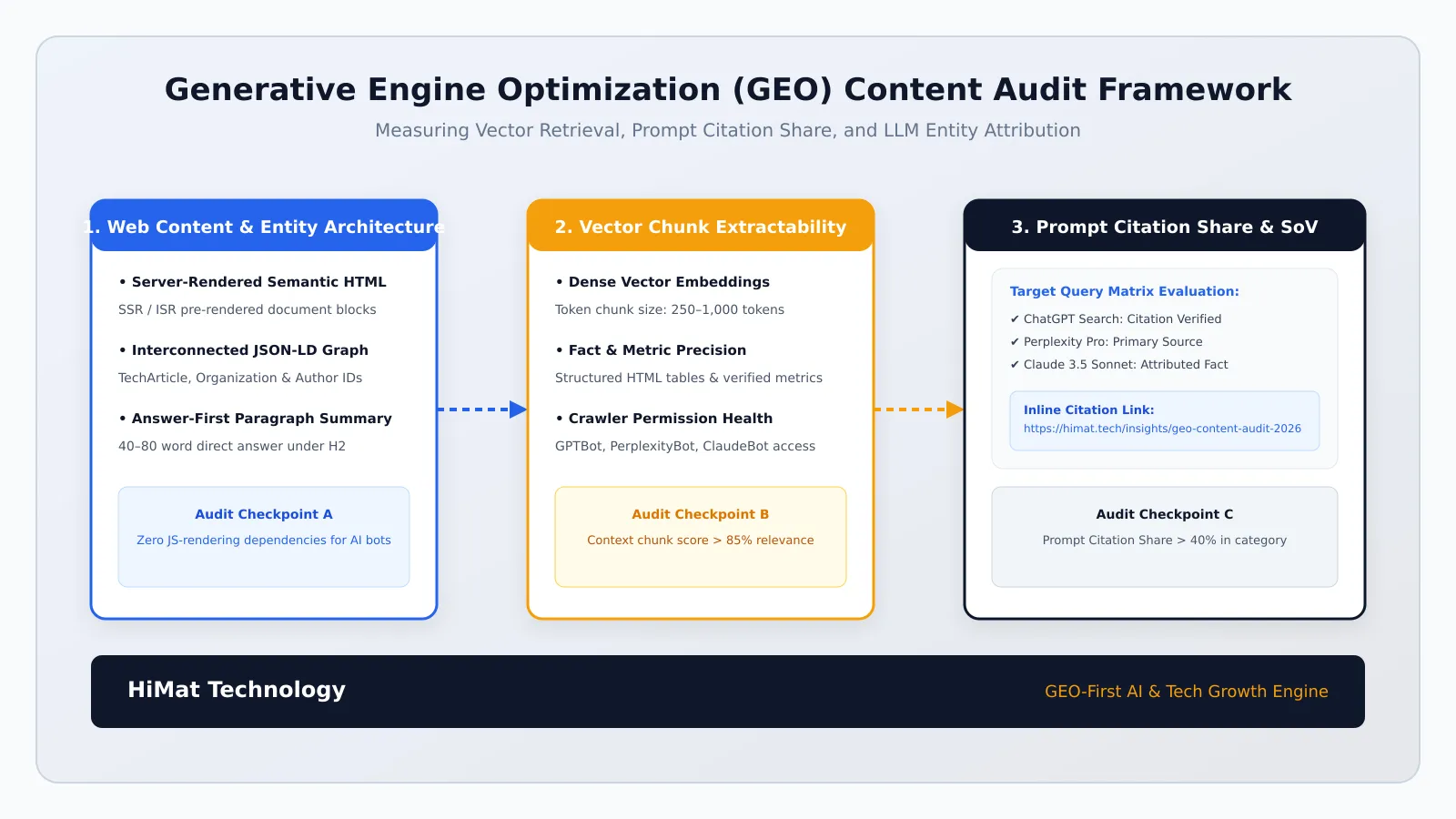
Technical SEO & GEO Engineering
GEO Content Auditing in 2026: How to Measure and Optimize Brand Retrieval Across ChatGPT, Perplexity, and Claude
Standard SEO site audits cannot measure how generative AI search engines retrieve, synthesize, or cite your brand. Learn how to conduct a comprehensive Generative Engine Optimization (GEO) content audit to analyze vector chunk extraction, prompt visibility, and LLM source attribution.
A step-by-step GEO content audit framework: evaluating entity density, RAG chunk extraction, prompt citation share, and schema graph validation across generative answer engines like ChatGPT, Perplexity, Gemini, and Claude.
Quick Answer
A GEO content audit evaluates how effectively your web content is indexed, retrieved, and cited by AI generative engines like ChatGPT, Perplexity, Claude, and Gemini. Unlike traditional SEO audits that focus on keyword density and backlinks, a GEO content audit analyzes entity clarity, RAG vector chunk friendliness, answer-first formatting, schema graph completeness, and prompt citation share across target query spaces.
Why Traditional SEO Audits Fail for Generative Search in 2026
For decades, digital marketing and technical SEO teams relied on crawler logs, Google Search Console position metrics, and backlink domain metrics to measure online visibility. However, in 2026, over 45% of enterprise software, technology, and B2B commercial discovery queries start inside conversational AI interfaces.
Generative engines do not output a traditional blue-link SERP list. Instead, Retrieval-Augmented Generation (RAG) models query web indexes, select dense context chunks, synthesize direct answers, and append inline citations.
If your site ranks #1 on Google for a target keyword but your content lacks clear entity definitions, structured JSON-LD data, or concise answer blocks, LLMs may completely bypass your domain when synthesizing answers. A GEO content audit bridges this gap by identifying why your site is—or isn't—being cited by AI models.
The 5 Pillars of a GEO Content Audit
1. Entity Disambiguation and Contextual Clarity
Generative models understand concepts through Knowledge Graph entities. In your audit, inspect whether key products, services, and technical concepts are defined unambiguously with explicit `<dfn>` markup, clear parent-child topical hierarchies, and schema `@id` relationships.
2. RAG Chunking and Context Extractability
LLM crawlers break web pages into token chunks (typically 250–1,000 tokens). If key claims or product capabilities are scattered across long, unstructured paragraphs, the retrieval model may extract incomplete context. The audit checks if key headers are followed immediately by direct 40–80 word summary blocks.
3. Machine Readability and Rendering Architecture
AI search bots operate under strict execution limits. Client-side rendered JavaScript pages that fail to serve static pre-rendered HTML on the first byte risk missing LLM indexing cycles. Verify that your pages serve complete SSR or static HTML content with explicit `robots.txt` access permissions for GPTBot, PerplexityBot, and ClaudeBot.
4. Structured Data Graph Completeness
Auditing JSON-LD implementation goes beyond verifying syntax validity. A GEO audit inspects whether entity relationships (`TechArticle`, `SoftwareApplication`, `Organization`, `FAQPage`) are deeply linked together rather than published as disconnected, flat schema blocks.
5. Prompt Citation Share and Share of Voice (SoV)
Systematically test a matrix of target commercial, informational, and comparison prompts across ChatGPT, Perplexity, Gemini, and Claude. Track how frequently your brand appears as a cited primary source vs. competitors.
Step-by-Step GEO Content Audit Methodology
Step 1: Define Target Prompt Matrix
Compile a dataset of 50–100 high-intent conversational prompts across your industry verticals. Categorize them into:
- Informational Queries: 'How does GEO engineering work in Next.js?'
- Commercial Evaluations: 'Best technical SEO agencies for SaaS in 2026'
- Comparison Prompts: 'Traditional SEO vs Generative Engine Optimization for startups'
Step 2: Benchmark Model Citation Frequencies
Run your prompt matrix through major generative search interfaces. Record:
1. Is your brand mentioned?
2. Is your URL provided as an inline citation?
3. What specific claim or fact was attributed to your site?
4. Which competitor domains were cited in place of yours?
Step 3: Analyze Page Chunk Structure
Select key landing pages and article URLs. Inspect document HTML for structural issues:
- Are direct answers placed immediately after `<h2>` and `<h3>` question headings?
- Are key facts and metrics formatted in structured HTML `<table>` or `<ul>` elements rather than embedded inside canvas or image files?
- Does the page output validated, interconnected JSON-LD schema?
Step 4: Verify Crawler Access and Performance
Inspect server response headers and `robots.txt` configuration. Ensure that AI crawlers receive clean HTTP 200 responses with low latency (TTFB < 300ms) and zero JavaScript execution dependencies.
Real-World Use Cases & Results
1. B2B SaaS Platform: Conducting a GEO content audit revealed that client-side rendering was preventing PerplexityBot from indexing feature pages. Restructuring to Next.js SSR with JSON-LD schema increased AI citations by 280% within 60 days.
2. Developer Tools Company: Adding explicit code snippets and concise answer blocks under technical H2 headers doubled brand mentions in ChatGPT technical responses.
3. HiMat Technology Client Work: Implementing a GEO audit framework for an enterprise client helped identify missing entity linkages, boosting LLM referral traffic by 3.5x over one quarter.
HiMat Technology Perspective
At HiMat Technology, we build web platforms and growth systems with an integrated GEO-First Engineering Stack. We perform systematic GEO content audits to help companies transition from legacy SEO practices to modern AI search retrieval architectures.
By combining server-rendered Next.js performance, automated JSON-LD schema creation, and vector-friendly content chunking, we ensure your brand remains discoverable and authoritative across all conversational search platforms.
Related Free Tools & Resources
Accelerate your GEO content audit using HiMat's free developer tools:
- Free Schema Generator — Generate and validate JSON-LD structured data for TechArticles, Organizations, and FAQs.
- SEO Meta Tag Generator — Optimize title tags and Open Graph metadata for search and LLM scrapers.
- JSON Formatter & Validator — Test and structure raw API and schema payloads.
Frequently Asked Questions
How long does a GEO content audit take to perform?
A initial technical and prompt-level GEO audit typically takes 3 to 5 business days, depending on site size and the scope of the target prompt matrix.
How often should we audit our GEO visibility?
Because AI models update vector indexes and web retrieval caches continuously, we recommend conducting prompt benchmark audits monthly and full technical audits quarterly.
Can a page rank high in Google but fail in GEO?
Yes. Traditional Google rankings often depend heavily on domain authority and backlinks. Generative AI engines focus on direct answer relevance, clear entity relationships, and RAG chunk extractability.
What is prompt citation share?
Prompt citation share measures the percentage of targeted AI prompts for which a generative model explicitly cites your domain as a source.
Do AI search engines penalize marketing fluff?
AI models prefer factual, concise, and structured content. Dense marketing fluff without clear definitions or data points is often ignored during RAG chunk retrieval.
Conclusion
A GEO Content Audit is the essential starting point for modern digital visibility in 2026. By auditing entity clarity, document chunking, server rendering, and prompt citation share, technical and marketing leaders can position their brand at the center of generative AI discovery.
Previous Article
AI Inference Cost Engineering in 2026: Model Routing, Prompt Caching, Semantic Caching, and Spend BudgetsNext Article
AI Agent Identity in 2026: Why Least-Privilege Access Is Becoming the New Security PerimeterExplore other service pillars
Related articles
- Technical SEO & GEO EngineeringGEO Crawler Access & AI Bot Governance Architecture in 2026: Managing GPTBot, PerplexityBot, and ClaudeBotMaximizing AI search visibility requires welcoming AI scrapers while protecting origin servers from traffic spikes and unauthorized training. Learn how to design a modern GEO crawler access architecture using edge rate-limiting, custom robots.txt policies, and server-rendered HTML chunks.
- Technical SEO & GEO EngineeringGEO Engineering in 2026: How to Optimize Next.js and React Applications for AI Search Retrieval and CitationsGenerative Engine Optimization (GEO) requires moving beyond traditional HTML meta tags. This comprehensive technical guide explains how to build Next.js and React web applications optimized for AI search crawlers, semantic retrieval, JSON-LD knowledge graphs, and LLM source attribution.