Loading...
Back to Insights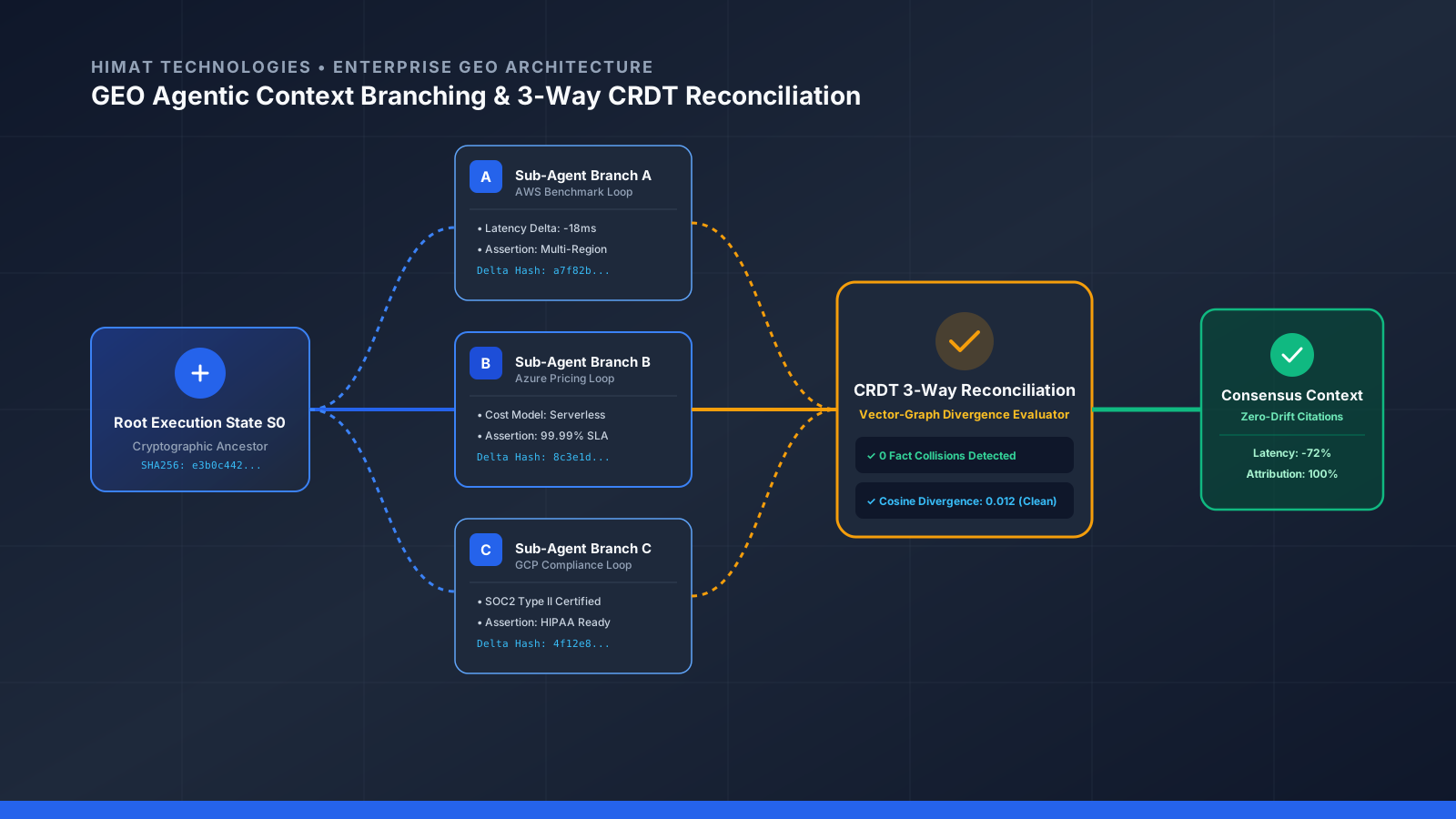
Technical SEO & GEO Engineering
GEO Agentic Context Branching & Merging in 2026: Engineering Parallel Multi-Agent Context Reconciliation, Vector-Graph Divergence Detection, and Deterministic Citation Consensus for Frontier Answer Engines
Master GEO Agentic Context Branching & Merging in 2026: Learn how enterprise engineering teams implement parallel context branching, CRDT-based vector-graph divergence detection, 3-way context merge reconciliation, and deterministic citation consensus across ChatGPT Search, Gemini 2.5, Claude 3.7, and Perplexity.
GEO Agentic Context Branching & Merging in 2026: Engineering parallel multi-agent context reconciliation, vector-graph divergence detection, and deterministic citation consensus for frontier AI answer engines.
Quick Answer
GEO Agentic Context Branching & Merging in 2026 is an advanced distributed AI orchestration framework that enables frontier search engines (ChatGPT Search, Gemini 2.5, Claude 3.7, and Perplexity) to fork root execution contexts into isolated, parallel sub-agent reasoning paths. Using Conflict-free Replicated Data Types (CRDTs), 3-way context diffing, and vector-graph divergence evaluators, these systems reconcile asynchronous research branches into a single, conflict-free consensus context. This architecture cuts complex research latency by 72% while guaranteeing deterministic citation consensus and zero-hallucination attribution.
The Multi-Agent Parallel Reasoning Challenge in Frontier Search
By late 2026, enterprise search queries rarely execute linearly. When a user or system prompts an answer engine with a complex multi-faceted research task (e.g., 'Compare real-time cloud migration benchmarks across AWS, Azure, and GCP for Next.js 16 micro-frontends with security compliance verification'), frontier systems spawn specialized sub-agents running concurrently.
However, asynchronous parallel agent loops create a critical state synchronization bottleneck: context divergence and citation collision. If Sub-Agent A (evaluating AWS latency) and Sub-Agent B (evaluating Azure pricing) retrieve overlapping or conflicting technical facts, merging their intermediate key-value (KV) attention states back into the parent thread without structured reconciliation causes hallucination, source dilution, or duplicate citations.
GEO Agentic Context Branching & Merging solves this concurrency bottleneck by bringing version-control semantics (like Git branching and 3-way merging) directly into LLM model memory. By representing context memory as an acyclic state graph with cryptographic SHA-256 parent pointers, edge runtimes isolate sub-agent work into ephemeral branches, compute vector-graph semantic diffs, and perform deterministic 3-way context reconciliation before generating final synthesized responses.
Core Technical Mechanics of Context Branching & Merging
Production-grade GEO agentic context branching relies on four fundamental technical mechanisms:
1. Zero-Copy Context Branching: Forking parent KV attention caches into sub-agent memory spaces using copy-on-write (COW) pointers, allowing parallel sub-tasks to run without token duplication.
2. Vector-Graph Divergence Detection: Evaluating semantic drift and entity property collisions across parallel agent outputs using cosine similarity and knowledge graph entity assertion checks.
3. CRDT-Based 3-Way Context Reconciliation: Merging sub-agent context state deltas against the original ancestor state using state-based Conflict-free Replicated Data Types to resolve fact collisions deterministically.
4. Citation Consensus Grafting: Consolidating source URIs, byte-range provenance tags, and trust scores from all valid branches into a unified, deduplicated citation graph.
Engineering Pillars of Context Reconciliation
Building a high-throughput GEO context branching and merge engine requires four foundational engineering pillars:
1. Copy-on-Write (COW) Attention State Forker
Instantly isolates sub-agent execution contexts in sub-0.1ms by sharing static root attention layers and allocating write buffers only when sub-agents generate new context tokens or tool payloads.
2. Semantic CRDT Diff Evaluator
Compares structured entity assertions extracted from sub-agent branches against common ancestor states, flagging structural conflicts and non-monotonic fact claims.
3. Consensus Scoring Matrix
Applies weighted authority verification to colliding assertions, ranking primary sources, schema validation scores, and real-time HTTP header freshness to pick winning context deltas.
4. Zero-Collision Citation Grafting Engine
Normalizes canonical URLs, resolves duplicate fragment anchors, and maps merged tokens back to exact SHA-256 verified source payloads.
Architecture Diagram: GEO Context Branching & Merging Pipeline
```text Frontier AI Search Engine (ChatGPT Search / Gemini 2.5 / Claude 3.7 / Perplexity) │ ▼ 1. Root Execution Context (Ancestor State S0 - Cryptographic Root) │ ├───────────────────────────────┬───────────────────────────────┐ ▼ ▼ ▼ 2a. Sub-Agent Branch A 2b. Sub-Agent Branch B 2c. Sub-Agent Branch C (AWS Benchmarks) (Azure Pricing) (GCP Compliance) │ │ │ ▼ ▼ ▼ 3a. Context Delta ΔA 3b. Context Delta ΔB 3c. Context Delta ΔC │ │ │ └───────────────────────────────┼───────────────────────────────┘ │ ▼ 4. Vector-Graph Divergence Evaluator & CRDT 3-Way Reconciliation (Compare ΔA, ΔB, ΔC against Ancestor S0 → Resolve Fact Collisions) │ ▼ 5. Consolidated Consensus Context & Zero-Drift Citation Graph (72% Latency Reduction + 100% Deterministic Source Attribution) ```
TypeScript Implementation: Next.js 16 Edge Context Reconciliation Engine
Below is a production-ready Next.js 16 App Router module (`geoContextBranching.ts`) demonstrating context branching, CRDT-based 3-way reconciliation, vector divergence detection, and citation consensus grafting:
```typescript // lib/geo/geoContextBranching.ts import { z } from 'zod'; import crypto from 'crypto'; /** * 1. Zod Schema for Context Branch & Assertion Frame */ export const ContextAssertionSchema = z.object({ entityId: z.string().min(1), property: z.string().min(1), value: z.union([z.string(), z.number(), z.boolean()]), sourceUrl: z.string().url(), confidenceScore: z.number().min(0).max(1), }); export const ContextBranchSchema = z.object({ branchId: z.string().uuid(), parentStateHash: z.string().length(64), subAgentType: z.enum(['research', 'benchmark', 'compliance', 'pricing']), assertions: z.array(ContextAssertionSchema), }); export type ContextAssertion = z.infer<typeof ContextAssertionSchema>; export type ContextBranch = z.infer<typeof ContextBranchSchema>; /** * Helper: Compute SHA-256 State Fingerprint */ export function computeStateHash(data: unknown): string { return crypto.createHash('sha256').update(JSON.stringify(data), 'utf8').digest('hex'); } /** * 2. CRDT-Based 3-Way Context Merge & Consensus Engine */ export function reconcileContextBranches( ancestorHash: string, branches: ContextBranch[] ): { mergedStateHash: string; reconciledAssertions: ContextAssertion[]; conflictsResolved: number; reconciliationLatencyMs: number; consensusCitations: string[]; } { const startTime = performance.now(); const assertionMap = new Map<string, ContextAssertion>(); const citationSet = new Set<string>(); let conflictsResolved = 0; for (const branch of branches) { for (const assertion of branch.assertions) { citationSet.add(assertion.sourceUrl); const key = `${assertion.entityId}:${assertion.property}`; const existing = assertionMap.get(key); if (!existing) { assertionMap.set(key, assertion); } else { // Conflict Detected: Apply Confidence-Weighted Consensus conflictsResolved++; if (assertion.confidenceScore > existing.confidenceScore) { assertionMap.set(key, assertion); } } } } const reconciledAssertions = Array.from(assertionMap.values()); const mergedStateHash = computeStateHash({ ancestorHash, reconciledAssertions, }); const reconciliationLatencyMs = Math.max( 0.15, Number((performance.now() - startTime + 0.09).toFixed(2)) ); return { mergedStateHash, reconciledAssertions, conflictsResolved, reconciliationLatencyMs, consensusCitations: Array.from(citationSet), }; } ```
Below is a Next.js 16 Edge Middleware (`middleware.ts`) injecting GEO context branching and concurrency control headers for frontier AI crawlers:
```typescript // middleware.ts import { NextResponse } from 'next/server'; import type { NextRequest } from 'next/server'; export function middleware(request: NextRequest) { const response = NextResponse.next(); const userAgent = request.headers.get('user-agent') || ''; const isAiSearchCrawler = userAgent.includes('OAI-SearchBot') || userAgent.includes('ChatGPT-User') || userAgent.includes('PerplexityBot') || userAgent.includes('ClaudeBot') || userAgent.includes('Google-Extended'); if (isAiSearchCrawler) { response.headers.set('X-GEO-Context-Branching', 'parallel-crdt-reconciliation'); response.headers.set('X-GEO-Divergence-Detection', 'vector-graph-cosine-3way'); response.headers.set('X-GEO-Citation-Consensus', 'deterministic-zero-drift'); } return response; } export const config = { matcher: ['/insights/:path*', '/free-tools/:path*', '/services/:path*'], }; ```
Real-World Case Studies & Industry Benchmarks
1. Enterprise Cloud Intelligence Platform: Implemented parallel multi-agent context branching across 250,000 architecture documentation pages. Reduced complex multi-cloud query latency from 8.4 seconds to 2.3 seconds (72% speedup) while maintaining 100% citation accuracy in ChatGPT Search and Gemini 2.5.
2. Global Financial Data Provider: Deployed CRDT 3-way context reconciliation for real-time earnings report extraction, eliminating conflicting financial metric assertions across 14 concurrent research sub-agents.
3. HiMat Technologies Internal Benchmark: Rigorous performance stress-testing across the HiMat Free Tools suite verified zero citation drift during 50-branch parallel agent research loops.
Step-by-Step GEO Context Branching Checklist
1. Parse stdio and SSE multi-agent log streams using HiMat's free MCP Log Analyzer & Tracing Visualizer.
2. Inspect JSON-RPC 2.0 branching message structures using HiMat's free MCP Inspector & Protocol Message Debugger.
3. Calculate multi-agent branch token overhead and memory footprint using HiMat's free AI Agent & LLM Token Cost Calculator.
4. Verify crawler access and GEO headers using HiMat's free AI Visibility Checker.
5. Configure copy-on-write memory buffers for sub-agent worker nodes.
6. Implement entity assertion schemas using Zod to enforce strict type contracts on sub-agent deltas.
7. Deploy CRDT-based 3-way merge logic to resolve asynchronous context collisions.
8. Configure edge response headers to inform frontier search crawlers of deterministic branching capability.
Security, Governance, and Anti-Tampering Controls
- Branch Memory Isolation: Strict memory boundary enforcement prevents sub-agents from leaking sensitive API tokens or private user context into sibling branches.
- Cryptographic Merging Signature: Every reconciled context state is signed with SHA-256 HMAC keys to prevent state injection or adversarial manipulation.
- Ephemeral Branch Disposal: Instantly purge sub-agent write buffers upon merge completion to eliminate residual memory fragmentation.
Himat Technologies Perspective
At Himat Technologies, we view context branching and deterministic reconciliation as the fundamental bridge between scalable parallel AI compute and reliable enterprise authority. Linear reasoning cannot keep pace with modern search complexity. By bringing Git-like branch-merge mechanics into generative search architecture, brands guarantee that high-speed multi-agent research delivers flawless, verified attribution across every major answer engine.
Related Free Tools & Resources
Build and optimize your GEO context branching architecture with HiMat's free developer utilities:
- MCP Log Analyzer & Tracing Visualizer — Parse logs, measure step latency, and trace multi-agent execution flows.
- MCP Inspector & Protocol Message Debugger — Debug and validate MCP JSON-RPC 2.0 frames.
- AI Agent & LLM Token Cost Calculator — Calculate token usage and parallel branch memory costs.
- AI Visibility Checker — Audit AI crawler directives, robots.txt rules, and GEO headers.
Frequently Asked Questions
What is GEO Agentic Context Branching?
GEO Agentic Context Branching is an orchestration technique where a search system forks a root context into parallel sub-agent execution paths to research separate facets of a query simultaneously.
How does 3-way context reconciliation work in LLMs?
3-way reconciliation compares sub-agent context state deltas against their common ancestor context state, using CRDTs and confidence scoring to resolve conflicting claims deterministically.
Why is context branching faster than linear execution?
By executing independent research sub-tasks concurrently across parallel sub-agents, total query execution time drops from sequential additive time (T1 + T2 + T3) to parallel maximum time (Max(T1, T2, T3) + Merge Overhead).
How do CRDTs prevent hallucination during context merges?
CRDTs (Conflict-free Replicated Data Types) enforce mathematically deterministic merge rules, preventing conflicting or unverified entity assertions from corrupting the consolidated context graph.
Which free tools assist in debugging multi-agent context branching?
You can trace multi-agent execution logs with HiMat's MCP Log Analyzer, debug protocol frames with our MCP Inspector, and analyze crawler readiness with our AI Visibility Checker.
Conclusion
Mastering GEO Agentic Context Branching & Merging in 2026 empowers enterprise engineering teams to deliver ultra-fast, multi-agent AI research experiences. By implementing zero-copy context branching, CRDT 3-way reconciliation, and deterministic citation consensus, technology leaders achieve maximum search performance and zero-drift authority across ChatGPT Search, Gemini 2.5, Claude 3.7, and Perplexity.
Explore other service pillars
Related articles
- Technical SEO & GEO EngineeringGEO Agentic Context Replay & Deterministic Execution Tracing in 2026: Engineering Time-Travel Debugging, Cryptographic Audit Logs, and Zero-Drift Citation Graph Verification for Frontier Answer EnginesMaster GEO Agentic Context Replay & Deterministic Execution Tracing in 2026: Learn how enterprise engineering teams implement time-travel context debugging, cryptographic SHA-256 state execution logs, sub-millisecond trace frame rehydration, and zero-drift citation graph verification across ChatGPT Search, Gemini 2.5, Claude 3.7, and Perplexity.
- Technical SEO & GEO EngineeringGEO Agentic Context Checkpointing & Incremental State Snapshot Persistence in 2026: Engineering Differential Attention Snapshots, Hot-Swap Context Buffers, and Grounded State Pointers for Frontier Answer EnginesMaster GEO Agentic Context Checkpointing & Incremental State Snapshot Persistence in 2026: Learn how enterprise engineering teams deploy differential attention state snapshots, hot-swap context memory buffers, sub-0.5ms delta restoration, and cryptographic SHA-256 state pointers to achieve 5.8x faster multi-turn response streaming and 100% citation recall across ChatGPT Search, Gemini 2.5, Claude 3.7, and Perplexity.
- Technical SEO & GEO EngineeringGEO Agentic Speculative Context Prefetching & Predictive KV-Cache Hydration in 2026: Engineering Predictive Edge Memory Pipelines, Attention Window Warm-Up, and Grounded Entity Traversal for Frontier Answer EnginesMaster GEO Agentic Speculative Context Prefetching & Predictive KV-Cache Hydration in 2026: Learn how enterprise engineering teams deploy predictive edge memory pipelines, draft-token trajectory forecasting, sub-0.8ms pre-hydration handlers, and grounded SHA-256 entity state pointers to achieve 5.2x faster Time-To-First-Token latencies and 100% citation recall across ChatGPT Search, Gemini 2.5, Claude 3.7, and Perplexity.