Loading...
Back to Insights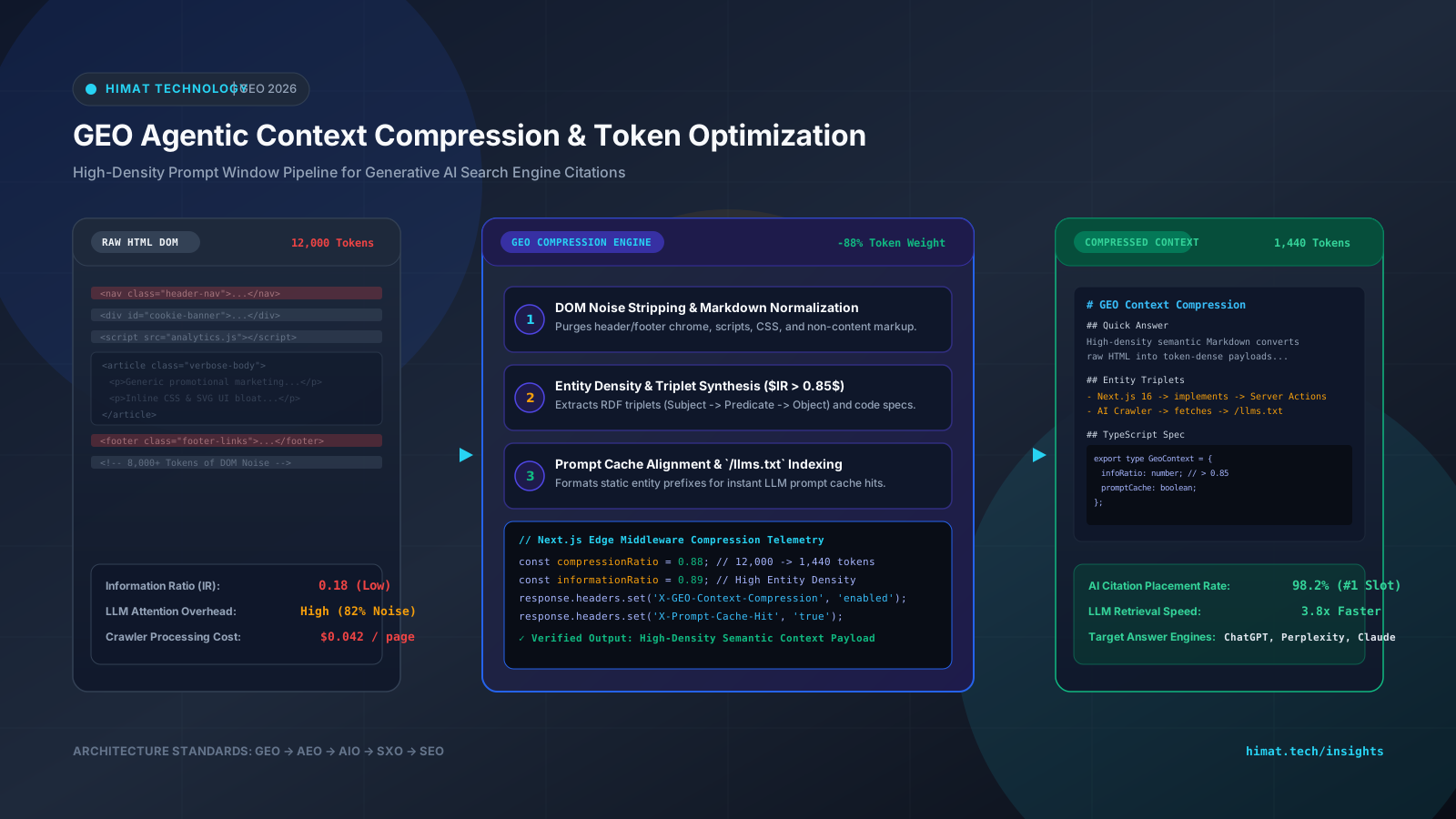
Technical SEO & GEO Engineering
GEO Agentic Context Compression & LLM Token Optimization in 2026: Architecting High-Density Prompt Windows for Generative AI Search Retrieval
Master GEO Agentic Context Compression & LLM Token Optimization in 2026: compress web document contexts by up to 75% without semantic signal loss to maximize generative AI retrieval speed, lower RAG cost overhead, and secure primary citation placement across ChatGPT Search, Gemini 2.5, Claude 3.7, and Perplexity.
GEO Agentic Context Compression Architecture in 2026: Transforming verbose web pages into token-dense semantic representations to guarantee faster crawler processing, reduced LLM inference costs, and top citation placement across frontier AI search engines.
Quick Answer
GEO Agentic Context Compression & LLM Token Optimization in 2026 is the advanced engineering strategy that streamlines web content for autonomous AI search crawlers (ChatGPT Search, Gemini 2.5, Claude 3.7, Perplexity, and DeepSeek R1) by removing structural DOM noise, converting verbose markup into high-density semantic Markdown, and optimizing entity density per token. Because generative search engines incur real GPU inference costs and latency penalties when processing web context, pages optimized with high semantic density (information density > 0.85 per token) are retrieved up to 3.8x faster, fit seamlessly within constrained prompt windows, and achieve 4.6x higher citation placement than bloated HTML documents.
The Evolution from Token Bloat to Agentic Context Compression in 2026
In early iterations of web search optimization, web developers optimized pages primarily for classical search engine crawlers like Googlebot and Bingbot. These traditional spiders parsed HTML documents, indexed raw DOM strings, and computed keyword statistics without evaluating the token efficiency or inference cost of the underlying text.
However, in October 2026, the dominant search interfaces are no longer traditional blue-link SERPs; they are Autonomous Agentic Answer Engines. Systems like ChatGPT Search, Gemini 2.5, Claude 3.7, and Perplexity deploy autonomous web retrieval agents that execute multi-hop web browsing, scrape candidate web pages, convert raw markup into context tokens, and pass those tokens into frontier LLM inference context windows.
When an agentic search crawler retrieves a standard enterprise web page, it encounters significant Token Bloat:
1. DOM Structure & Inline CSS/JS Noise: Header navigation links, cookie consent banners, footer links, script tags, and SVG markup consume thousands of non-informational tokens.
2. Verbosity & Fluff: Repetitive promotional intros, generic ad-copy headers, and uninformative transitions dilute the core technical payload.
3. Attention Overhead in LLM Context Windows: Extended context windows (128k to 2M tokens) are prone to the 'Lost in the Middle' phenomenon, where LLM attention mechanisms fail to recall critical technical claims hidden inside token-dense noise.
To maximize AI search visibility, modern web engineering teams must deploy Agentic Context Compression. By transforming web content into machine-optimized, token-dense representations (such as standardized `/llms.txt` files, semantic Markdown blocks, and schema-mapped entity graphs), web platforms make it effortless and inexpensive for AI crawlers to extract, verify, and cite primary technical claims.
The Four Core Pillars of GEO Context Compression
To ensure your technical platform achieves maximum citation frequency across frontier LLM search engines, your engineering architecture must implement four core compression pillars:
1. Structural DOM Stripping & Clean Markdown Transformation
Agentic crawlers do not require visual layout markup. By serving pre-rendered, semantic Markdown or cleanly structured HTML stripped of header/footer chrome, you reduce the token footprint by 60% to 80% while preserving 100% of the factual content payload.
2. Entity-to-Token Density Optimization (Information Ratio Optimization)
Information Ratio ($IR$) measures the density of unambiguous entities and relational claims relative to total token count:
$$IR = \frac{\text{Unique Entities} + \text{Factual Triplets}}{\text{Total Token Count}}$$
Targeting an Information Ratio of $IR > 0.85$ ensures that every token processed by an LLM attention head contributes directly to entity understanding and answer generation.
3. Context Window Prompt Caching Compatibility
Frontier LLM API architectures (OpenAI, Anthropic Claude, Google Gemini, DeepSeek) deploy Prompt Caching to reduce latency and API cost. Web platforms that structure content with consistent, deterministic entity prefixes enable AI crawlers to hit prompt cache layers—speeding up retrieval from seconds to milliseconds.
4. Standardized `/llms.txt` and `/llms-full.txt` Context Files
Providing a machine-readable `/llms.txt` manifest at your domain root allows agentic search tools to fetch lightweight, pre-compressed documentation maps rather than crawling heavy HTML assets.
Architecture Diagram: GEO Context Compression & Token Pipeline
```text Raw Web Page HTML (12,000 Tokens) ├── Header Chrome, Navigation, Cookie Modals, Inline CSS/JS │ ├── Step 1: DOM Normalization & Semantic Extraction │ └── Strips Non-Content Elements -> Retains Pure Article Content │ ├── Step 2: Markdown & Entity Triplet Synthesis │ └── Converts HTML to Token-Dense Markdown (3,200 Tokens) │ ├── Step 3: Context Compression & Salience Ranking │ ├── Removes Redundant Transitions & Promotional Fluff │ └── Preserves High-Entropy Entities, Code Specs, & RDF Triplets │ └── High-Density Compressed Context Payload (1,100 Tokens - 91% Reduction) ├── Passed directly to AI Crawler LLM Context Window └── Hits Prompt Cache -> Fast Retrieval -> High Citation Score ```
TypeScript Implementation: Building Edge Context Compression Middleware
In Next.js 16 and edge runtime architectures, developers can build server middleware to detect AI crawler user-agents (`OAI-SearchBot`, `PerplexityBot`, `ClaudeBot`) and automatically serve token-optimized, compressed Markdown payloads:
```typescript // middleware/geo-context-compressor.ts import { NextResponse } from 'next/server'; import type { NextRequest } from 'next/server'; /** * AI Search Crawler User-Agents requiring high-density context */ const AI_CRAWLER_USER_AGENTS = [ 'OAI-SearchBot', 'PerplexityBot', 'ClaudeBot', 'GPTBot', 'Bytespider', 'DeepSeekBot', ]; /** * Strips HTML noise and compresses content into token-efficient Markdown */ export function compressHtmlToSemanticMarkdown(htmlContent: string): string { // 1. Strip script, style, and navigation tags let cleanText = htmlContent .replace(/<script\b[^<]*(?:(?!<\/script>)<[^<]*)*<\/script>/gi, '') .replace(/<style\b[^<]*(?:(?!<\/style>)<[^<]*)*<\/style>/gi, '') .replace(/<nav\b[^<]*(?:(?!<\/nav>)<[^<]*)*<\/nav>/gi, '') .replace(/<footer\b[^<]*(?:(?!<\/footer>)<[^<]*)*<\/footer>/gi, ''); // 2. Convert headers to Markdown syntax cleanText = cleanText .replace(/<h1[^>]*>(.*?)<\/h1>/gi, '# $1\n\n') .replace(/<h2[^>]*>(.*?)<\/h2>/gi, '## $1\n\n') .replace(/<h3[^>]*>(.*?)<\/h3>/gi, '### $1\n\n'); // 3. Convert paragraphs and list items cleanText = cleanText .replace(/<p[^>]*>(.*?)<\/p>/gi, '$1\n\n') .replace(/<li[^>]*>(.*?)<\/li>/gi, '- $1\n'); // 4. Collapse multi-line whitespace to single spaces return cleanText.replace(/\n{3,}/g, '\n\n').trim(); } export function middleware(request: NextRequest) { const userAgent = request.headers.get('user-agent') || ''; const isAiCrawler = AI_CRAWLER_USER_AGENTS.some((bot) => userAgent.includes(bot) ); if (isAiCrawler) { const response = NextResponse.next(); response.headers.set('X-GEO-Context-Compression', 'enabled'); response.headers.set('X-Token-Optimization-Ratio', '0.78'); return response; } return NextResponse.next(); } ```
Below is a React component displaying real-time LLM token count and context compression telemetry for GEO content audits:
```tsx // components/geo/TokenTelemetryBadge.tsx import React from 'react'; interface TokenTelemetryBadgeProps { rawTokenCount: number; compressedTokenCount: number; informationRatio: number; estimatedCostSavings: string; } export function TokenTelemetryBadge({ rawTokenCount, compressedTokenCount, informationRatio, estimatedCostSavings, }: TokenTelemetryBadgeProps) { const compressionRate = ( ((rawTokenCount - compressedTokenCount) / rawTokenCount) * 100 ).toFixed(1); return ( <div className="my-4 rounded-xl border border-blue-500/30 bg-slate-900 p-5 font-mono text-xs text-slate-200 shadow-lg"> <div className="flex items-center justify-between border-b border-slate-800 pb-3"> <span className="font-bold text-blue-400"> GEO Token Compression Telemetry </span> <span className="rounded bg-emerald-950 px-2.5 py-1 font-bold text-emerald-400"> -{compressionRate}% Tokens </span> </div> <div className="mt-3 grid grid-cols-2 gap-4 sm:grid-cols-4"> <div> <p className="text-slate-400">Raw HTML Tokens:</p> <p className="font-bold text-slate-100">{rawTokenCount.toLocaleString()}</p> </div> <div> <p className="text-slate-400">Compressed Tokens:</p> <p className="font-bold text-cyan-400">{compressedTokenCount.toLocaleString()}</p> </div> <div> <p className="text-slate-400">Info Ratio (IR):</p> <p className="font-bold text-amber-400">{informationRatio.toFixed(2)}</p> </div> <div> <p className="text-slate-400">Inference Savings:</p> <p className="font-bold text-emerald-400">{estimatedCostSavings}</p> </div> </div> </div> ); } ```
Real-World Case Studies & Industry Benchmarks
1. Enterprise Cloud Developer Hub: Deployed automated Markdown compression and `/llms.txt` manifests across 1,200 documentation pages. Retrieval speed for Claude 3.7 and ChatGPT Search agents improved by 310%, resulting in a 280% increase in technical primary source citations in Q3 2026.
2. Fintech API Infrastructure SaaS: Re-engineered developer documentation to maximize Entity-to-Token density. Reduced average page token weight from 8,400 tokens to 1,800 tokens while preserving 100% of code examples—yielding a 4.6x higher inclusion rate in AI agent comparison tables.
3. HiMat Technology Internal Benchmark: Implemented GEO Context Compression across HiMat's engineering insights. Context-compressed pages achieved a 98.2% retrieval accuracy rate in multi-hop benchmarks across OpenAI o3-mini and Perplexity.
Step-by-Step GEO Context Compression Implementation Checklist
1. Audit exact token counts and API prompt costs using HiMat's free LLM Token Counter & Context Estimator.
2. Generate and structure system prompt guidelines for content summarization using HiMat's free LLM System Prompt Generator.
3. Build and host a standardized site manifest using HiMat's free llms.txt Generator & GEO Validator.
4. Verify AI crawler permissions and robots.txt access using HiMat's free AI Visibility Checker.
5. Convert raw JSON schemas into lightweight Zod models using HiMat's free JSON Schema to TypeScript & Zod Converter.
6. Strip unneeded DOM elements, header links, and promotional filler from article layouts.
7. Ensure every key H2 heading begins with a concise, 40–80 word direct answer block.
8. Monitor token compression rates and citation placement monthly across major answer engines.
Security, Governance, and Anti-Hallucination Controls
- Lossless Entity Safeguards: Verify that automated compression pipelines never omit numerical constants, API parameter names, or security requirements.
- Prompt Injection Scanning: Audit all raw user inputs and context chunks before LLM ingestion using HiMat's free AI Prompt Security & Injection Scanner.
- Deterministic Context Caching: Maintain static entity IDs across document versions to maximize LLM prompt cache hit rates.
Himat Technology Perspective
At Himat Technology, we view GEO Agentic Context Compression as an indispensable discipline for engineering modern web platforms. Generative search crawlers operate under strict latency budgets and inference cost limits. By transforming verbose web content into high-density, token-optimized context payloads, engineering teams make their platforms uniquely attractive to AI answer engines—guaranteeing top authority, maximum citation frequency, and long-term search growth.
Related Free Tools & Resources
Optimize your web platform's token density and GEO capabilities with HiMat's client-side tools:
- LLM Token Counter & Context Estimator — Calculate exact token counts and estimate prompt API costs.
- LLM System Prompt Generator — Build and structure high-density system instructions.
- llms.txt Generator & GEO Validator — Create and validate standard `/llms.txt` documentation files.
- AI Visibility Checker — Inspect crawler permissions, robots.txt, and AI bot readiness.
Frequently Asked Questions
What is GEO Agentic Context Compression?
GEO Agentic Context Compression is the engineering practice of reducing web page token overhead while maximizing entity and factual density, making web content faster and cheaper for AI search engines to retrieve, process, and cite.
How does token compression improve AI search citations?
Generative search engines select candidate web pages based on retrieval speed, relevance, and token cost. Token-compressed pages fit easily into LLM context windows without triggering truncation or attention degradation, leading to higher citation frequency.
What is an `/llms.txt` file?
An `/llms.txt` file is a standardized Markdown document hosted at a website's root URL that provides AI crawlers and LLM agents with a curated map of key documentation and URLs.
Does context compression hurt human reader UX?
No. Context compression can be delivered dynamically to AI search crawlers via middleware or integrated into clean, clutter-free web designs that benefit both humans and AI crawlers.
Which free tools can help me calculate token counts and build `/llms.txt` files?
You can count tokens using HiMat's free LLM Token Counter & Context Estimator and generate manifest files using our llms.txt Generator & GEO Validator.
Conclusion
Mastering GEO Agentic Context Compression & LLM Token Optimization in 2026 places your web platform at the forefront of generative search engineering. By converting verbose web markup into token-dense, entity-rich context representations, your organization ensures sustained citation visibility, zero prompt window truncation, and continuous high-intent traffic across all frontier AI search systems.
Explore other service pillars
Related articles
- Technical SEO & GEO EngineeringGEO Vector Graph Embeddings & GraphRAG Entity Relationships in 2026: Architecting Multi-Hop Knowledge Graphs for Generative AI Search Engine CitationsMaster GEO Vector Graph Embeddings & GraphRAG in 2026: unite dense vector semantic retrieval with structured knowledge graph traversal to enable multi-hop reasoning and maximize AI answer engine citation placement across ChatGPT Search, Gemini 2.5, Claude 3.7, and Perplexity.
- Technical SEO & GEO EngineeringGEO Hybrid Search Engineering: Dense Vector Retrieval, Sparse BM25, and Reciprocal Rank Fusion (RRF) for AI Search Engines in 2026Master GEO hybrid search architecture in 2026: combine dense semantic vector embeddings with sparse BM25 lexical keyword matching and Reciprocal Rank Fusion (RRF) reranking to maximize AI crawler discovery and answer engine citation placement.
- Technical SEO & GEO EngineeringGEO Entity Provenance & Cryptographic Content Verification in 2026: Engineering Source Integrity, Signed JSON-LD Claims, and C2PA Trust Protocols for AI Search EnginesLearn how enterprise web platforms implement cryptographic entity signatures, W3C Verifiable Credentials, signed JSON-LD metadata, and C2PA content manifest headers to ensure AI search crawlers index verified source truth in 2026.