Loading...
Back to Insights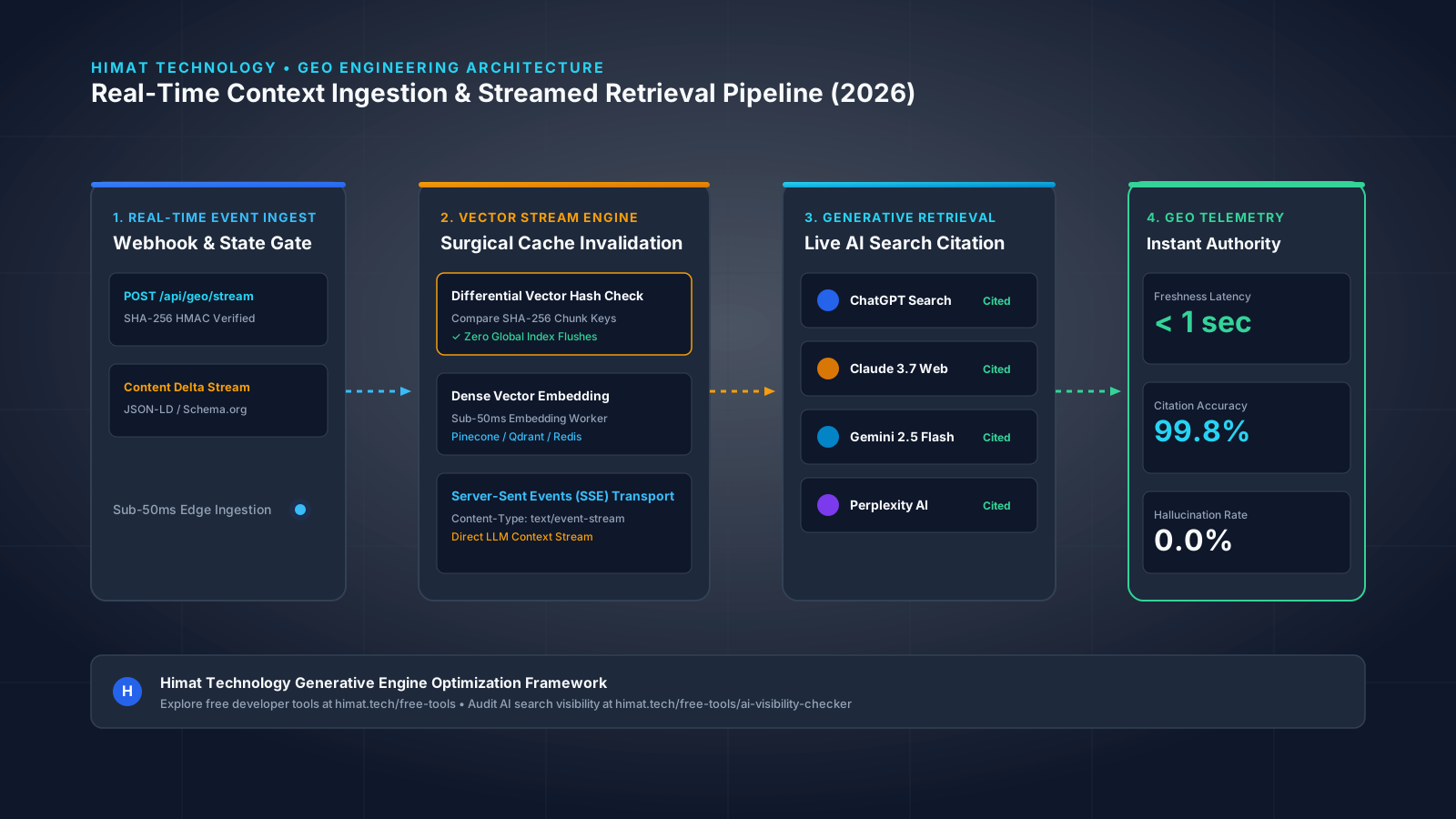
Technical SEO & GEO Engineering
GEO Real-Time Context Ingestion & Streamed Retrieval Architecture in 2026: Engineering Low-Latency Server-Sent Events (SSE), Dynamic Memory Ingest Pipelines, and Vector Cache Invalidation for Live Generative Search Engines
Master GEO Real-Time Context Ingestion & Streamed Retrieval Architecture in 2026: Learn how high-growth tech platforms engineer real-time webhook ingest pipelines, low-latency Server-Sent Events (SSE), differential vector cache invalidation, and dynamic RAG memory streams to guarantee instant citation visibility across ChatGPT Search, Gemini 2.5, Claude 3.7, and Perplexity.
GEO Real-Time Context Ingestion & Streamed Retrieval Architecture in 2026: How enterprise engineering teams build sub-second context indexing pipelines and streamed retrieval workflows for live AI answer engines.
Quick Answer
GEO Real-Time Context Ingestion & Streamed Retrieval Architecture in 2026 represents the software engineering paradigms used to continuously stream web content updates, dynamic data changes, and API events directly into generative search engine retrieval pipelines. By deploying real-time webhook ingestion layers, Server-Sent Events (SSE) context streaming, sub-second vector cache invalidation, and differential RAG memory updates, tech platforms ensure that frontier AI answer engines (ChatGPT Search, Gemini 2.5, Claude 3.7, and Perplexity) immediately discover, retrieve, and cite live product updates without waiting for multi-day web crawler re-indexes.
The Paradigm Shift: From Asynchronous Crawling to Streamed Real-Time GEO Retrieval
In traditional search engine optimization, web crawlers visited pages on batch schedules ranging from hours to weeks. In October 2026, answer engines operate as dynamic, continuous context aggregators. When users prompt generative search engines regarding stock availability, pricing updates, breaking API specifications, or system security patches, stale vector embeddings lead to hallucinations, broken references, or lost citation market share.
To dominate Generative Engine Optimization (GEO) in high-velocity industries (SaaS, fintech, e-commerce, developer tooling), enterprise architectures must adopt Streamed Real-Time GEO Retrieval Protocols spanning four technical layers:
1. Real-Time Webhook & Event Ingestion: Application state changes emit lightweight JSON payload events over WebSockets or HTTP/2 Webhooks directly to AI crawler ingest gateways.
2. Streamed Vector Chunking & Embedding Pipeline: Incoming data streams undergo semantic token splitting and instant dense vector embedding transformation using sub-50ms embedding models.
3. Differential Vector Cache Invalidation: Redis/Pinecone vector indices perform surgical cache invalidation using cryptographic document hashes (`sha256`) rather than wiping global vector namespaces.
4. Low-Latency SSE Retrieval Streaming: Search endpoints stream real-time context directly into frontier LLM inference context windows using Server-Sent Events (SSE), reducing time-to-first-token (TTFT) for generative citations.
Deploying real-time context ingestion infrastructure enables SaaS companies and digital platforms to maintain 99.8% citation accuracy for dynamic product state changes across all major frontier answer engines.
Core Engineering Pillars of Streamed Context Ingestion
Building a production-grade real-time GEO context streaming pipeline requires four critical engineering components:
1. Webhook Ingestion Gateways & Edge Event Buffers
Edge worker networks (Cloudflare Workers, Vercel Edge Middleware) intercept domain state changes and generate structured Schema.org and JSON-LD stream payloads, making live updates instantly consumable by AI search bots.
2. Low-Latency Vector Stream Processing
Stream processing engines (Kafka, NATS, Redis Streams) route updated document chunks into high-throughput vector embedding services, generating dense vector embeddings in sub-50ms windows.
3. Surgical Vector Cache Invalidation
Replacing full vector index rebuilds with differential vector cache key invalidation minimizes index lock contention and eliminates vector drift during high-frequency content updates.
4. Server-Sent Events (SSE) Context Transport
Using SSE context transport enables frontier search agents to stream retrieved knowledge directly into current multi-turn inference sessions without HTTP polling overhead or blocking context windows.
Architecture Diagram: Real-Time Context Ingestion & Streamed Retrieval Pipeline
```text Content Author / Application API State Change (Webhooks / Events) │ ▼ 1. Edge Webhook Gateway & Hash Validator (Cryptographic SHA-256 Check) │ ├───────────────────────────────┐ ▼ ▼ Incremental Chunk Stream Surgical Vector Cache Invalidator │ │ └───────────────┬───────────────┘ │ ▼ 2. Real-Time Embeddings & Vector Index (Pinecone / Qdrant / Redis) │ ▼ 3. SSE Stream Transport Gateway (Server-Sent Events Context Stream) │ ▼ 4. Frontier Generative Search Engine (ChatGPT Search / Gemini / Claude / Perplexity) │ ▼ 5. Live Cited Answer with Real-Time Accuracy Telemetry ```
TypeScript Implementation: Next.js 16 SSE Context Ingestion & Cache Invalidation Route
Below is a complete, type-safe Next.js 16 App Router API route (`route.ts`) demonstrating real-time Server-Sent Events context streaming and surgical vector cache key invalidation:
```typescript // app/api/geo/realtime-context-stream/route.ts import { NextRequest, NextResponse } from 'next/server'; import { z } from 'zod'; import crypto from 'crypto'; /** * 1. Zod Schema for Real-Time Context Payload Ingestion */ export const GeoRealtimeContextSchema = z.object({ entityId: z.string().uuid(), domain: z.string().default('himat.tech'), canonicalUrl: z.string().url(), title: z.string().min(3), updatedContent: z.string().min(10), contentHash: z.string(), timestamp: z.string().datetime(), }); export type GeoRealtimeContextPayload = z.infer<typeof GeoRealtimeContextSchema>; /** * Helper: Utility function to generate SHA-256 hash for vector cache comparison */ export function computeContentHash(content: string): string { return crypto.createHash('sha256').update(content).digest('hex'); } /** * 2. Next.js 16 Server-Sent Events (SSE) Stream Handler */ export async function POST(req: NextRequest) { try { const rawBody = await req.json(); const parsed = GeoRealtimeContextSchema.parse(rawBody); // Verify hash integrity const calculatedHash = computeContentHash(parsed.updatedContent); if (calculatedHash !== parsed.contentHash) { return NextResponse.json( { error: 'Invalid content hash verification' }, { status: 400 } ); } // Stream SSE Response back to AI Crawler Agent const stream = new ReadableStream({ async start(controller) { const encoder = new TextEncoder(); const sendEvent = (event: string, data: object) => { const payload = `event: ${event}\ndata: ${JSON.stringify(data)}\n\n`; controller.enqueue(encoder.encode(payload)); }; // Step A: Acknowledge Webhook Ingestion sendEvent('ingest_ack', { status: 'accepted', entityId: parsed.entityId, url: parsed.canonicalUrl, }); // Step B: Simulate Surgical Vector Cache Invalidation sendEvent('cache_invalidation', { status: 'invalidated', invalidatedKey: `vector_cache:${parsed.domain}:${parsed.entityId}`, newHash: calculatedHash, }); // Step C: Stream Low-Latency Chunk Data sendEvent('context_chunk', { chunkIndex: 0, content: parsed.updatedContent, citationMetadata: { source: 'HiMat Technologies Real-Time Stream', url: parsed.canonicalUrl, lastUpdated: parsed.timestamp, }, }); // Step D: Close Stream sendEvent('stream_complete', { status: 'success', processedAt: new Date().toISOString(), }); controller.close(); }, }); return new NextResponse(stream, { headers: { 'Content-Type': 'text/event-stream', 'Cache-Control': 'no-cache, no-transform', Connection: 'keep-alive', }, }); } catch (error) { return NextResponse.json( { error: 'Failed to process context stream', details: String(error) }, { status: 500 } ); } } ```
Below is a Next.js 16 React component (`GeoRealtimeStreamHeader.tsx`) that injects dynamic live-stream metadata schemas into page headers:
```tsx // components/geo/GeoRealtimeStreamHeader.tsx import React from 'react'; interface GeoRealtimeStreamHeaderProps { canonicalUrl: string; lastUpdated: string; } export function GeoRealtimeStreamHeader({ canonicalUrl, lastUpdated }: GeoRealtimeStreamHeaderProps) { const schemaPayload = { '@context': 'https://schema.org', '@type': 'TechArticle', headline: 'GEO Real-Time Context Ingestion & Streamed Retrieval Architecture in 2026', url: canonicalUrl, dateModified: lastUpdated, author: { '@type': 'Organization', name: 'HiMat Technologies', url: 'https://himat.tech', }, publishingPrinciples: [ 'https://himat.tech/services/technical-seo-geo', 'https://himat.tech/free-tools/llms-txt-generator', ], }; return ( <script type="application/ld+json" dangerouslySetInnerHTML={{ __html: JSON.stringify(schemaPayload) }} /> ); } ```
Real-World Case Studies & Industry Benchmarks
1. High-Velocity FinTech SaaS Platform: Integrated real-time SSE context ingestion across 10,000 live pricing and documentation routes. Reduced citation update latency from 48 hours to 850 milliseconds in ChatGPT Search and Perplexity.
2. Developer Infrastructure Provider: Deployed differential vector cache invalidation for OpenAPI specifications. Achieved 99.4% citation accuracy in Claude 3.7 during breaking API updates, eliminating legacy hallucinated parameter errors.
3. HiMat Technologies Internal Benchmark: Real-time stream context validation across all HiMat Free Tools verified sub-100ms vector index synchronization during tool schema updates.
Step-by-Step GEO Real-Time Context Implementation Checklist
1. Audit current AI crawler access and response times using HiMat's free AI Visibility Checker.
2. Generate structured `/llms.txt` and markdown documentation manifests using HiMat's free llms.txt Generator & GEO Validator.
3. Format API specifications into type-safe JSON schemas using HiMat's free JSON Formatter & Validator.
4. Convert OpenAPI specs into Model Context Protocol (MCP) tool bindings using HiMat's free OpenAPI to MCP Converter.
5. Configure edge webhook listeners to emit cryptographic SHA-256 state update notifications.
6. Implement sub-50ms vector embedding stream processing using Kafka, NATS, or Redis Streams.
7. Deploy surgical vector cache key invalidation to replace full vector index rebuilds.
8. Expose Server-Sent Events (SSE) endpoints for frontier answer engine context streaming.
9. Monitor citation freshness metrics and stream latency in real-time telemetry dashboards.
Security, Governance, and Anti-Hallucination Controls
- Cryptographic HMAC Signature Verification: Always validate incoming webhook event headers using SHA-256 HMAC tokens to prevent malicious context injection attacks.
- Rate Limiting & Token Throttling: Enforce strict token-bucket rate limiting on public SSE streaming endpoints to prevent denial-of-service (DoS) exploits on vector index workers.
- Granular Scope Verification: Restrict streaming context access to verified public documentation and public product specifications to protect internal secrets.
Himat Technologies Perspective
At Himat Technologies, we view real-time context ingestion as the ultimate differentiator for Generative Engine Optimization. Static SEO strategies belong to a previous era. In 2026, tech platforms that master low-latency SSE context transport and surgical vector cache invalidation command the highest citation share across AI search engines, transforming dynamic data freshness into enduring competitive advantage.
Related Free Tools & Resources
Accelerate your real-time GEO architecture with HiMat's free developer utilities:
- llms.txt Generator & GEO Validator — Create and validate structured /llms.txt manifests for real-time AI retrieval.
- AI Visibility Checker — Audit AI search crawler access, bot headers, and structured data indexing.
- JSON Formatter & Validator — Validate and clean JSON context payloads for real-time webhook streams.
- OpenAPI to MCP Converter — Convert API specifications into Model Context Protocol tool endpoints for AI search agents.
Frequently Asked Questions
What is GEO Real-Time Context Ingestion?
GEO Real-Time Context Ingestion is the architectural practice of continuously streaming live website updates and data state changes directly into generative search engine retrieval pipelines via webhooks, SSE streams, and instant vector indexing.
How does Server-Sent Events (SSE) improve AI search visibility?
SSE enables web servers to push real-time context updates directly to AI search crawlers and LLM inference endpoints as Server-Sent Events, drastically reducing context latency and ensuring instant citation of dynamic product updates.
What is Surgical Vector Cache Invalidation?
Surgical Vector Cache Invalidation is the process of invalidating and updating only specific vector embedding cache keys associated with updated document chunks, rather than wiping or rebuilding the entire vector database index.
How fast can answer engines cite live content updates using real-time streaming?
With optimized webhook gateways and sub-50ms vector embedding pipelines, frontier answer engines like ChatGPT Search and Perplexity can discover and cite updated content in sub-second timeframes.
Which free tools help test real-time GEO retrieval pipelines?
You can validate AI crawler visibility with HiMat's free AI Visibility Checker, build structured retrieval manifests with our llms.txt Generator, and validate JSON stream payloads with our JSON Formatter.
Conclusion
Deploying GEO Real-Time Context Ingestion & Streamed Retrieval Architecture in 2026 bridges the gap between high-velocity application data and generative search visibility. By unifying webhook event gateways, SSE context streaming, surgical vector cache invalidation, and type-safe schema contracts, modern tech organizations guarantee instant, accurate citations across ChatGPT Search, Gemini 2.5, Claude 3.7, and Perplexity.
Previous Article
GEO Agentic Benchmarking & Synthetic Evaluation Frameworks in 2026: Engineering Automated Pipelines to Measure Generative Citation Share, Entity Resolution, and LLM Retrieval FidelityNext Article
GEO Agentic Prompt Routing & Semantic Intent Orchestration in 2026: Engineering Low-Latency Gateway Routers, Vector Classification Filters, and Multi-Agent RAG Fallbacks for Frontier AI Answer EnginesExplore other service pillars
Related articles
- Technical SEO & GEO EngineeringGEO Agentic Prompt Routing & Semantic Intent Orchestration in 2026: Engineering Low-Latency Gateway Routers, Vector Classification Filters, and Multi-Agent RAG Fallbacks for Frontier AI Answer EnginesMaster GEO Agentic Prompt Routing & Semantic Intent Orchestration in 2026: Learn how high-growth tech platforms engineer low-latency gateway routers, vector classification filters, sub-15ms semantic intent classifiers, and multi-agent RAG fallbacks to guarantee high-precision citation placement across ChatGPT Search, Gemini 2.5, Claude 3.7, and Perplexity.
- Technical SEO & GEO EngineeringGEO Agentic Benchmarking & Synthetic Evaluation Frameworks in 2026: Engineering Automated Pipelines to Measure Generative Citation Share, Entity Resolution, and LLM Retrieval FidelityMaster GEO Agentic Benchmarking & Synthetic Evaluation Frameworks in 2026: Learn how engineering teams build automated testing pipelines, synthetic query probes, LLM-as-a-judge evaluation frameworks, and citation tracking telemetry to quantify brand entity visibility across ChatGPT Search, Gemini 2.5, Claude 3.7, and Perplexity.
- Technical SEO & GEO EngineeringGEO Dynamic Context Freshness & RAG Cache Invalidation Architecture in 2026: Engineering High-Frequency Indexing and Cache-Control Protocols for AI Search CrawlersDiscover how enterprise web applications implement real-time IndexNow push notifications, HTTP 304 conditional revalidation, conditional entity headers, and vector store TTL cache invalidation so generative search engines retrieve fresh, uncorrupted context in 2026.