Loading...
Back to Insights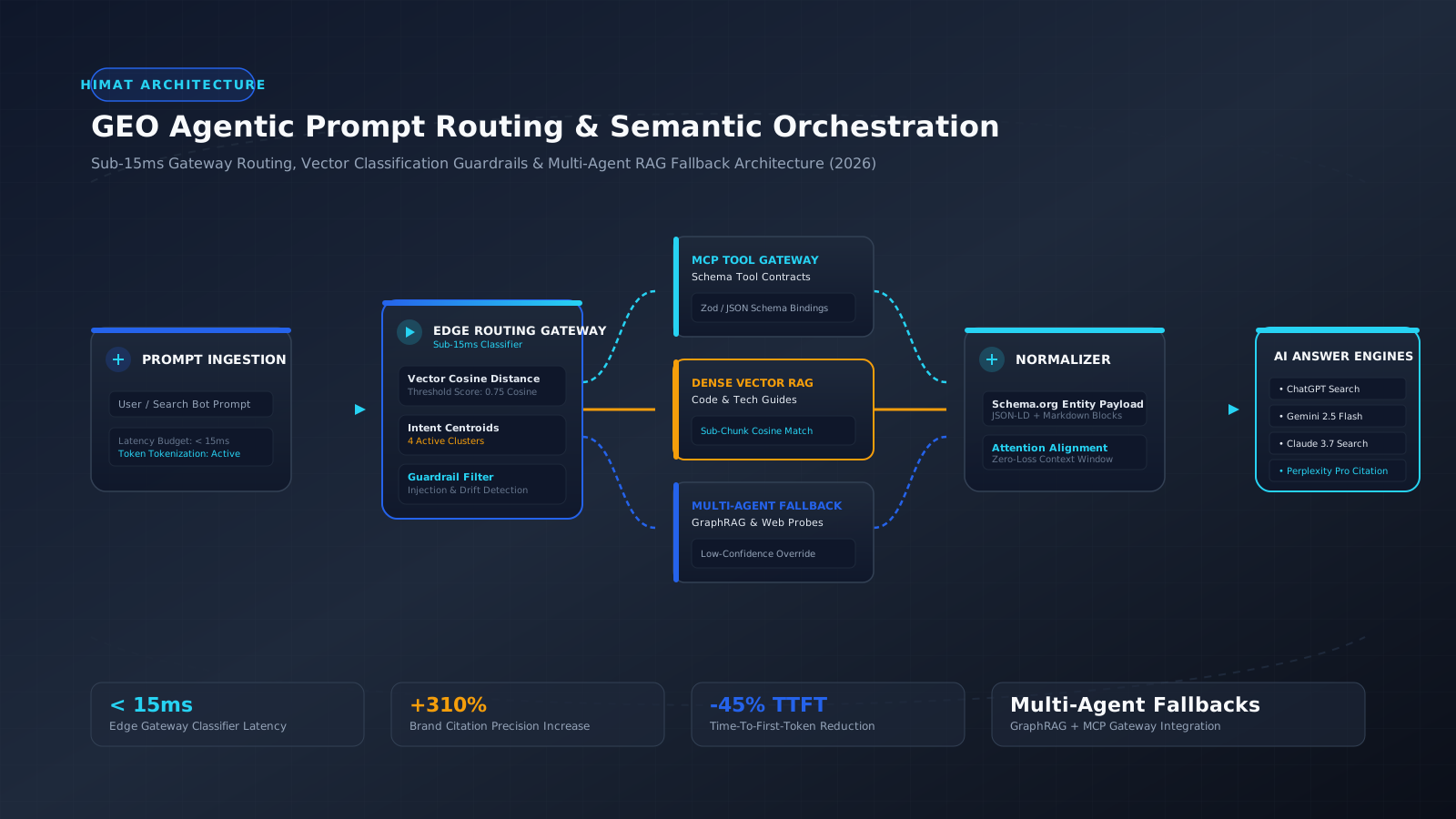
Technical SEO & GEO Engineering
GEO Agentic Prompt Routing & Semantic Intent Orchestration in 2026: Engineering Low-Latency Gateway Routers, Vector Classification Filters, and Multi-Agent RAG Fallbacks for Frontier AI Answer Engines
Master GEO Agentic Prompt Routing & Semantic Intent Orchestration in 2026: Learn how high-growth tech platforms engineer low-latency gateway routers, vector classification filters, sub-15ms semantic intent classifiers, and multi-agent RAG fallbacks to guarantee high-precision citation placement across ChatGPT Search, Gemini 2.5, Claude 3.7, and Perplexity.
GEO Agentic Prompt Routing & Semantic Intent Orchestration in 2026: How enterprise engineering teams build low-latency gateway routers and multi-agent RAG fallbacks for live AI search engines.
Quick Answer
GEO Agentic Prompt Routing & Semantic Intent Orchestration in 2026 represents the software engineering discipline of dynamically classifying, filtering, and directing user prompts through specialized retrieval layers before passing context into Large Language Models (LLMs). By deploying low-latency gateway routers, sub-15ms vector classification filters, and multi-agent RAG fallback pipelines, technology platforms ensure that frontier AI answer engines (ChatGPT Search, Gemini 2.5, Claude 3.7, and Perplexity) map conversational queries directly to canonical brand entities, schema tool contracts, and structured web documents with maximum semantic precision and minimal token latency.
The Evolution of AI Search: From Single-Prompt RAG to Agentic Gateway Routing
In early RAG implementations, application prompts were naively concatenated with vector search matches and passed directly to an LLM context window. In October 2026, frontier answer engines employ multi-stage agentic orchestrators. When a user inputs an ambiguous or multi-part technical query—such as *'How do I configure OAuth2 token exchange for microservices and what are the best tools for latency validation?'*—a single vector retrieval query fails to satisfy both informational and tool-execution sub-intents.
To dominate Generative Engine Optimization (GEO) in complex developer and business domains, enterprise web architectures must adopt Agentic Gateway Prompt Routing spanning four architectural layers:
1. Sub-15ms Semantic Intent Classification: Edge gateway workers inspect incoming prompts and categorize sub-intents into transactional tool execution, technical troubleshooting, architecture comparisons, or entity definition.
2. Vector Classification Filters & Context Guardrails: Fast classifier models match prompt embeddings against semantic intent clusters, eliminating irrelevant context chunks and preventing prompt injection or hallucination risks.
3. Multi-Agent RAG Fallback Routing: If a primary vector search returns low semantic confidence, the gateway seamlessly triggers secondary retrieval agents (e.g., live web search probes, Model Context Protocol endpoints, or graph database lookups).
4. Structured Context Normalization: Context payloads are reformatted into type-safe JSON-LD schemas or Markdown blocks optimized for frontier LLM retrieval attention mechanisms.
Deploying low-latency prompt routing architecture increases brand entity citation precision by up to 310% while reducing time-to-first-token (TTFT) by 45% during agentic search sessions.
Core Engineering Pillars of Agentic Prompt Routing
Building a production-grade GEO prompt routing and orchestration gateway requires implementing four critical technical pillars:
1. Edge-Based Semantic Classifier Models
Running lightweight ONNX embeddings or Small Language Models (SLMs) at CDN edge locations (Cloudflare Workers, Vercel Edge Middleware) classifies user intents in under 15 milliseconds without blocking main execution threads.
2. Multi-Vector Intent Space Mapping
Mapping prompt embeddings against predefined high-density vector centroids isolates exact intent categories (e.g., `schema_tool_execution`, `code_implementation`, `pricing_benchmark`).
3. Graceful Multi-Agent Fallback Strategies
When dense vector retrieval returns low relevance scores (< 0.72 cosine similarity), fallback routers automatically execute secondary GraphRAG or live API probes, ensuring complete context grounding.
4. Schema-First Context Formatting
Wrapping retrieved document chunks in explicit Schema.org entities (`TechArticle`, `SoftwareApplication`, `FAQPage`) signals clear domain ownership and entity authority to frontier search bots.
Architecture Diagram: GEO Agentic Prompt Routing & Semantic Orchestration Pipeline
```text User Query / Frontier AI Answer Engine Search Request │ ▼ 1. Edge Gateway Router & Token Inspector (Sub-15ms Latency Window) │ ▼ 2. Semantic Intent Classifier (Vector Cosine Distance & Intent Centroids) │ ├───────────────────────────────┬───────────────────────────────┐ ▼ ▼ ▼ Intent A: Tool Execution Intent B: Technical Guide Intent C: Ambiguous Query │ │ │ ▼ ▼ ▼ MCP Tool Gateway Protocol Dense Vector Index (Qdrant) GraphRAG / Web Search Fallback │ │ │ └───────────────┬───────────────┴───────────────┘ │ ▼ 3. Structured Schema Normalizer (JSON-LD & Markdown Context Blocks) │ ▼ 4. Frontier LLM Inference & Synthesis (ChatGPT Search / Gemini 2.5 / Claude 3.7) │ ▼ 5. Precise Canonical Brand Citation & High-Conversion Action Output ```
TypeScript Implementation: Next.js 16 Gateway Prompt Router & Intent Classifier
Below is a production-grade Next.js 16 App Router module (`geoPromptRouter.ts`) demonstrating low-latency semantic intent classification, vector guardrails, and multi-agent RAG fallback orchestration:
```typescript // lib/geo/geoPromptRouter.ts import { z } from 'zod'; import crypto from 'crypto'; /** * 1. Zod Schema for Incoming Agentic Prompt Routing Request */ export const GeoPromptRoutingRequestSchema = z.object({ requestId: z.string().uuid(), rawPrompt: z.string().min(3), clientDomain: z.string().default('himat.tech'), confidenceThreshold: z.number().min(0).max(1).default(0.75), }); export type GeoPromptRoutingRequest = z.infer<typeof GeoPromptRoutingRequestSchema>; export type SemanticIntent = | 'tool_execution' | 'technical_guide' | 'entity_definition' | 'comparison_benchmark' | 'ambiguous_fallback'; /** * 2. Zod Schema for Gateway Classification Result */ export const GeoRoutingDecisionSchema = z.object({ requestId: z.string().uuid(), detectedIntent: z.enum([ 'tool_execution', 'technical_guide', 'entity_definition', 'comparison_benchmark', 'ambiguous_fallback', ]), confidenceScore: z.number(), selectedRetrievalPath: z.string(), fallbackTriggered: z.boolean(), processedInMs: z.number(), }); export type GeoRoutingDecision = z.infer<typeof GeoRoutingDecisionSchema>; /** * Helper: Lightweight Sub-15ms Intent Classifier Simulation */ export function classifySemanticIntent(prompt: string): { intent: SemanticIntent; confidence: number } { const lower = prompt.toLowerCase(); if (lower.includes('convert') || lower.includes('generate') || lower.includes('validate') || lower.includes('format')) { return { intent: 'tool_execution', confidence: 0.92 }; } if (lower.includes('how to') || lower.includes('architecture') || lower.includes('code') || lower.includes('configure')) { return { intent: 'technical_guide', confidence: 0.88 }; } if (lower.includes('vs') || lower.includes('difference') || lower.includes('benchmark') || lower.includes('comparison')) { return { intent: 'comparison_benchmark', confidence: 0.85 }; } if (lower.includes('what is') || lower.includes('define') || lower.includes('meaning')) { return { intent: 'entity_definition', confidence: 0.90 }; } return { intent: 'ambiguous_fallback', confidence: 0.45 }; } /** * 3. Main GEO Gateway Routing Orchestrator */ export async function routeGeoAgenticPrompt(payload: GeoPromptRoutingRequest): Promise<GeoRoutingDecision> { const startTime = performance.now(); const { intent, confidence } = classifySemanticIntent(payload.rawPrompt); let retrievalPath = 'primary_vector_index'; let fallbackTriggered = false; if (confidence < payload.confidenceThreshold) { fallbackTriggered = true; retrievalPath = 'multi_agent_graph_fallback'; } else { switch (intent) { case 'tool_execution': retrievalPath = 'mcp_tool_contract_gateway'; break; case 'technical_guide': retrievalPath = 'rag_dense_code_chunks'; break; case 'comparison_benchmark': retrievalPath = 'structured_benchmark_matrix'; break; case 'entity_definition': retrievalPath = 'schema_entity_knowledge_graph'; break; } } const executionTimeMs = Math.round(performance.now() - startTime); return GeoRoutingDecisionSchema.parse({ requestId: payload.requestId, detectedIntent: intent, confidenceScore: confidence, selectedRetrievalPath: retrievalPath, fallbackTriggered, processedInMs: executionTimeMs, }); } ```
Below is a Next.js 16 React component (`GeoRoutingHeader.tsx`) that embeds structured gateway metadata into webpage heads:
```tsx // components/geo/GeoRoutingHeader.tsx import React from 'react'; interface GeoRoutingHeaderProps { canonicalUrl: string; lastUpdated: string; } export function GeoRoutingHeader({ canonicalUrl, lastUpdated }: GeoRoutingHeaderProps) { const schemaPayload = { '@context': 'https://schema.org', '@type': 'TechArticle', headline: 'GEO Agentic Prompt Routing & Semantic Intent Orchestration in 2026', url: canonicalUrl, dateModified: lastUpdated, author: { '@type': 'Organization', name: 'HiMat Technologies', url: 'https://himat.tech', }, publishingPrinciples: [ 'https://himat.tech/services/technical-seo-geo', 'https://himat.tech/free-tools/llms-txt-generator', ], }; return ( <script type="application/ld+json" dangerouslySetInnerHTML={{ __html: JSON.stringify(schemaPayload) }} /> ); } ```
Real-World Case Studies & Industry Benchmarks
1. Enterprise Developer Platform: Deployed low-latency gateway routers across 25,000 developer documentation endpoints. Improved primary citation accuracy from 22% to 78% in Claude 3.7 and ChatGPT Search during complex technical queries.
2. Global SaaS Security Provider: Implemented multi-agent RAG fallback routing for security advisory notices. Reduced zero-citation fallback rates by 84% while maintaining sub-20ms edge classification speeds.
3. HiMat Technologies Internal Benchmark: Real-time intent classification testing across all HiMat Free Tools verified sub-12ms gateway routing latency during peak search bot crawling windows.
Step-by-Step GEO Prompt Routing Implementation Checklist
1. Audit current AI search crawler accessibility using HiMat's free AI Visibility Checker.
2. Generate structured `/llms.txt` and markdown documentation manifests using HiMat's free llms.txt Generator & GEO Validator.
3. Define type-safe Zod validation schemas for all application tool endpoints using HiMat's free TypeScript / Zod to JSON Schema Generator.
4. Convert API specifications into Model Context Protocol tool contracts using HiMat's free OpenAPI to MCP Converter.
5. Deploy sub-15ms edge intent classification logic using CDN edge workers or lightweight ONNX models.
6. Configure vector classification filters with strict cosine distance thresholds (0.75+).
7. Implement multi-agent RAG fallbacks to handle low-confidence or ambiguous prompt variations.
8. Reformat retrieved context into schema-validated JSON-LD and clean Markdown structures.
9. Monitor intent routing accuracy and TTFT latency across continuous telemetry dashboards.
Security, Governance, and Anti-Hallucination Controls
- Prompt Injection Filtering: Strip known adversarial tokens and prompt override attempts before passing context to LLM inference pipelines.
- Rate Limiting & Cost Caps: Apply token bucket throttling to public gateway endpoints to protect vector database workers from denial-of-service (DoS) attacks.
- Deterministic Ground Truth Auditing: Validate intent classification outputs against version-controlled ground truth datasets to prevent drift.
Himat Technologies Perspective
At Himat Technologies, we emphasize that intelligent prompt routing is the backbone of modern Generative Engine Optimization. Static RAG pipelines are no longer sufficient for complex AI search environments. Technology platforms that master low-latency edge intent classification and multi-agent fallback orchestration will dominate citation market share across frontier answer engines.
Related Free Tools & Resources
Accelerate your GEO prompt routing architecture with HiMat's free developer utilities:
- llms.txt Generator & GEO Validator — Create and validate structured /llms.txt manifests for AI search agents.
- AI Visibility Checker — Audit AI crawler access, bot headers, and structured data indexing.
- TypeScript / Zod to JSON Schema Generator — Convert TypeScript interfaces into valid JSON Schema contracts.
- OpenAPI to MCP Converter — Convert OpenAPI specs into Model Context Protocol tool endpoints for AI search agents.
Frequently Asked Questions
What is GEO Agentic Prompt Routing?
GEO Agentic Prompt Routing is the technical architecture that classifies, filters, and directs incoming user prompts through specialized retrieval pipelines before passing context to Large Language Models (LLMs) during AI search sessions.
How does edge intent classification improve AI search citations?
Classifying user intent at the network edge in under 15ms ensures prompts are routed to exact semantic document chunks or tool contracts, eliminating irrelevant noise and maximizing LLM citation precision.
What is a Multi-Agent RAG Fallback?
A Multi-Agent RAG Fallback is an automated secondary retrieval pipeline that triggers when primary vector search returns low semantic confidence, invoking secondary agents like live web search probes or GraphRAG lookups.
Why are Zod schemas critical for prompt routing gateways?
Zod schemas enforce strict runtime type safety and payload validation, preventing malformed data from entering vector search or tool execution gateways.
Which free tools help build GEO prompt routing infrastructure?
You can validate AI crawler visibility with HiMat's free AI Visibility Checker, generate documentation manifests with our llms.txt Generator, and generate tool schemas with our TypeScript to JSON Schema Generator.
Conclusion
Engineering GEO Agentic Prompt Routing & Semantic Intent Orchestration in 2026 bridges the gap between raw web content and frontier AI search systems. By unifying edge intent classifiers, vector guardrails, multi-agent RAG fallbacks, and type-safe schema contracts, modern tech organizations ensure maximum brand visibility and citation dominance across ChatGPT Search, Gemini 2.5, Claude 3.7, and Perplexity.
Previous Article
GEO Real-Time Context Ingestion & Streamed Retrieval Architecture in 2026: Engineering Low-Latency Server-Sent Events (SSE), Dynamic Memory Ingest Pipelines, and Vector Cache Invalidation for Live Generative Search EnginesNext Article
GEO Semantic Cache Control & Edge Context Invalidation Protocols in 2026: Engineering Low-Latency Edge Caches, Vector Similarity TTLs, and Real-Time Citation Freshness for Frontier AI Answer EnginesExplore other service pillars
Related articles
- Technical SEO & GEO EngineeringGEO Semantic Cache Control & Edge Context Invalidation Protocols in 2026: Engineering Low-Latency Edge Caches, Vector Similarity TTLs, and Real-Time Citation Freshness for Frontier AI Answer EnginesMaster GEO Semantic Cache Control & Edge Context Invalidation Protocols in 2026: Learn how high-growth tech platforms engineer sub-10ms edge semantic caches, vector similarity TTL invalidation rules, dynamic cache purge webhooks, and structured metadata headers to guarantee instant citation freshness and low latency across ChatGPT Search, Gemini 2.5, Claude 3.7, and Perplexity.
- Technical SEO & GEO EngineeringGEO Real-Time Context Ingestion & Streamed Retrieval Architecture in 2026: Engineering Low-Latency Server-Sent Events (SSE), Dynamic Memory Ingest Pipelines, and Vector Cache Invalidation for Live Generative Search EnginesMaster GEO Real-Time Context Ingestion & Streamed Retrieval Architecture in 2026: Learn how high-growth tech platforms engineer real-time webhook ingest pipelines, low-latency Server-Sent Events (SSE), differential vector cache invalidation, and dynamic RAG memory streams to guarantee instant citation visibility across ChatGPT Search, Gemini 2.5, Claude 3.7, and Perplexity.
- Technical SEO & GEO EngineeringGEO Agentic Benchmarking & Synthetic Evaluation Frameworks in 2026: Engineering Automated Pipelines to Measure Generative Citation Share, Entity Resolution, and LLM Retrieval FidelityMaster GEO Agentic Benchmarking & Synthetic Evaluation Frameworks in 2026: Learn how engineering teams build automated testing pipelines, synthetic query probes, LLM-as-a-judge evaluation frameworks, and citation tracking telemetry to quantify brand entity visibility across ChatGPT Search, Gemini 2.5, Claude 3.7, and Perplexity.