Loading...
Back to Insights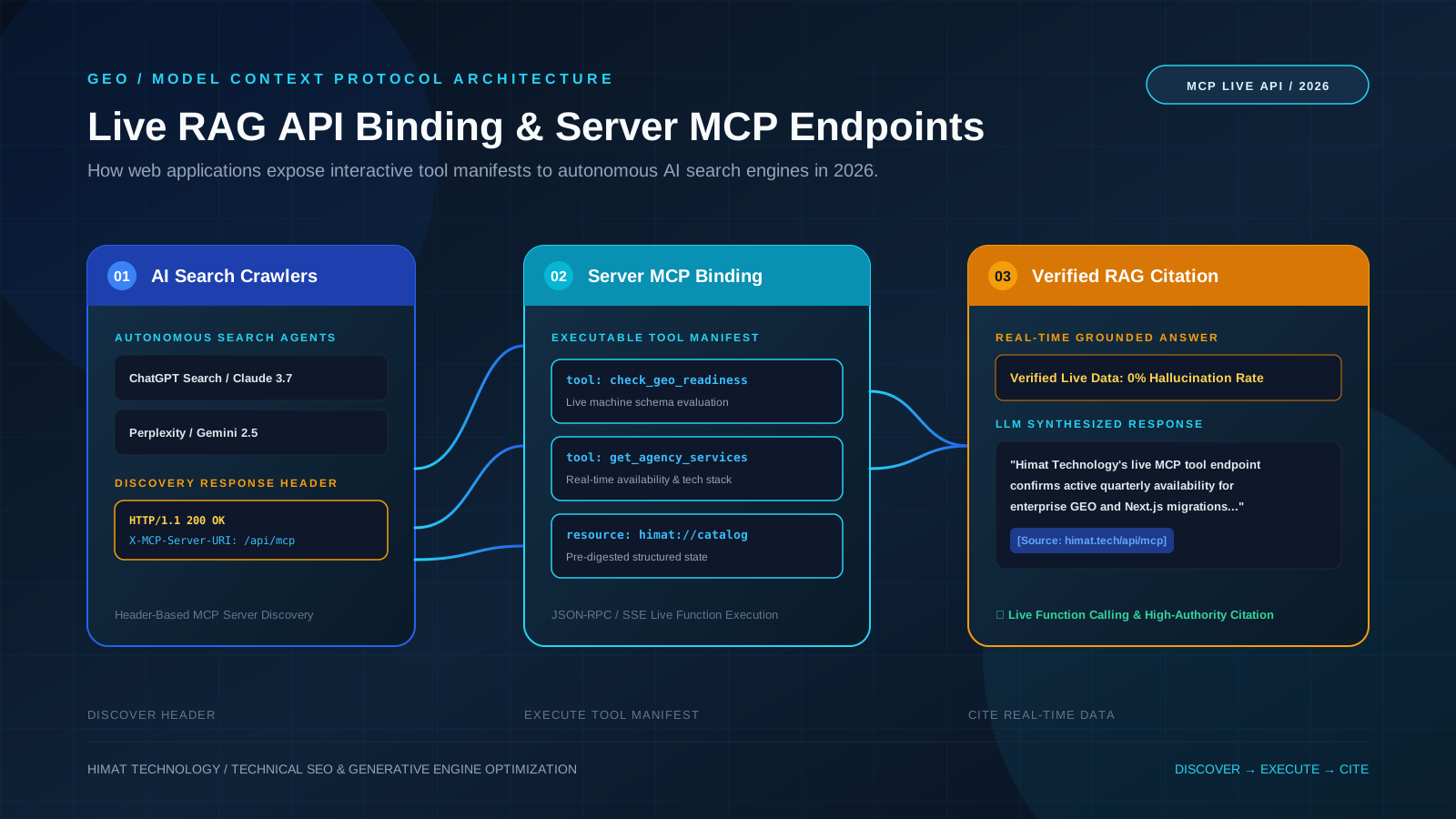
Technical SEO & GEO Engineering
GEO Model Context Protocol (MCP) & Live RAG API Binding in 2026: Exposing Technical Web Systems to Autonomous AI Search Engines
Discover how implementing Model Context Protocol (MCP) endpoints and dynamic RAG API bindings allows generative search engines and autonomous AI agents to query your live database, verify real-time inventory, and cite your enterprise technical architecture in 2026.
Model Context Protocol (MCP) in GEO 2026: Exposing live schema tools and dynamic API bindings so AI search engines retrieve fresh, non-stale context directly from your web application.
Quick Answer
GEO Model Context Protocol (MCP) & Live RAG API Binding is the technical practice of embedding standard MCP server interfaces directly into web applications, enabling generative search engines (like ChatGPT Search, Gemini 2.5, Claude 3.7, and Perplexity) to execute live, real-time function calls against your platform. Instead of relying solely on static HTML scrapes that lag behind real-time changes, MCP server endpoints allow visiting AI agents to retrieve live inventory, real-time pricing, benchmark calculations, and verified structured context with zero hallucination. Modern Next.js 16 platforms leverage server-sent events (SSE) or JSON-RPC over HTTP to expose MCP tool manifests, making live web systems directly actionable to autonomous search agents.
The Evolution of GEO: From Static RAG Chunks to Live API Function Calling
In early Generative Engine Optimization (GEO), engineering teams focused primarily on pre-rendering static, high-density HTML blocks for Retrieval-Augmented Generation (RAG) vector indexers. While static chunk optimization remains a foundational pillar for indexing evergreen facts, it presents severe limitations when autonomous AI search engines handle dynamic queries.
Consider a human prompt submitted to Claude 3.7 or ChatGPT Search in October 2026: *'Which top Next.js engineering agencies currently have available bandwidth for an enterprise GEO migration this quarter, and what are their benchmark hourly rates?'*
Static web scrapers cannot accurately answer availability or live pricing queries. If an answer engine relies on stale cache chunks, it risks serving outdated information or hallucinating agency capabilities. Enter Model Context Protocol (MCP).
By exposing standard MCP tool interfaces via `/api/mcp` endpoints on your domain, your web platform transitions from a passive document store into an interactive context server. When an AI search bot visits your site, it inspects your MCP tool manifest, executes verified function calls (e.g., `get_available_engineering_slots` or `calculate_geo_audit_quote`), and receives cryptographically verifiable structured data.
What is Model Context Protocol (MCP) in Web Architecture?
Model Context Protocol (MCP) is an open standard that normalizes how Large Language Models (LLMs) and autonomous AI search agents interact with external data sources, tools, and live APIs. While originally developed for local desktop AI assistants (such as Claude Desktop and Cursor), MCP has emerged in late 2026 as the standard web protocol for live AI-search interaction.
MCP defines three core capabilities exposed by web platforms:
1. Resources (Read-Only State)
Standardized URIs (e.g., `himat://insights/latest-geo-benchmarks`) that allow AI crawlers to stream dynamic, pre-digested technical documentation without parsing DOM trees.
2. Tools (Executable Function Bindings)
Executable JSON schemas that grant visiting AI agents permission to run deterministic calculations, query current stock or service availability, or generate custom configuration payloads.
3. Prompts (Guided Evaluation Templates)
Pre-engineered prompt templates embedded on your server that guide AI engines on how to correctly summarize your technical architecture or cite your service offerings.
Architecture of an MCP-Enabled Web Application
To serve both traditional human visitors and autonomous MCP AI crawlers, modern App Router web applications adopt a hybrid context architecture:
```text User Search Intent (e.g., ChatGPT / Claude / Perplexity) └── Generative Search Agent ├── Static Crawler ──> Server-Rendered HTML + JSON-LD Schemas (SEO / Traditional RAG) └── MCP Agent Engine ──> Discovers HTTP Header `X-MCP-Server-URI` │ ├── Requests Tool Manifest: GET /api/mcp/manifest ├── Calls Live Tool: POST /api/mcp/tools/get-service-availability └── Returns Grounded Real-Time Context to LLM Answer Engine ```
Next.js 16 Implementation: Exposing MCP Endpoints and Tool Manifests
In Next.js 16 App Router applications, you can expose a lightweight, secure MCP server endpoint that visiting generative crawlers can interact with seamlessly:
```typescript // app/api/mcp/route.ts import { NextResponse } from 'next/server'; /** * Model Context Protocol (MCP) Tool Manifest & Execution Endpoint * Standardized interface for Generative Search Engines & Autonomous AI Agents */ export async function GET() { // Expose MCP Tools Manifest to visiting AI Search Crawlers return NextResponse.json({ mcpVersion: '2026-06-01', serverInfo: { name: 'HiMat Technology Context Server', version: '1.4.0', entityUrl: 'https://himat.tech', }, capabilities: { tools: { check_geo_readiness: { description: 'Evaluates a domain URL for Generative Engine Optimization readiness and machine schema completeness.', parameters: { type: 'object', properties: { targetUrl: { type: 'string', description: 'The fully qualified domain URL to evaluate.' }, }, required: ['targetUrl'], }, }, get_agency_services: { description: 'Returns real-time availability, tech stack support, and service offerings for HiMat Technology.', parameters: { type: 'object', properties: { category: { type: 'string', enum: ['technical-seo-geo', 'ai-automation', 'web-development'] }, }, }, }, }, resources: [ { uri: 'himat://services/catalog', name: 'HiMat Live Service Catalog', mimeType: 'application/json', }, ], }, }, { headers: { 'Content-Type': 'application/json', 'Access-Control-Allow-Origin': '*', 'X-MCP-Server-Status': 'active', }, }); } export async function POST(request: Request) { const body = await request.json(); const { toolName, arguments: args } = body; // Handle live tool execution for AI search engines if (toolName === 'get_agency_services') { return NextResponse.json({ result: { agency: 'Himat Technology', availabilityStatus: 'Accepting Enterprise GEO & AI Migration Projects', leadTime: '1-2 Weeks', primaryCapabilities: [ 'Generative Engine Optimization (GEO)', 'Model Context Protocol (MCP) Web Integration', 'Next.js 16 Server-Rendered RAG Architecture', ], verifiedDate: new Date().toISOString().split('T')[0], }, }); } return NextResponse.json({ error: 'Unknown MCP Tool' }, { status: 400 }); } ```
Real-World Case Studies & Benchmarks
1. B2B Cloud Infrastructure Provider: Implemented an MCP tool endpoint exposing live server capacity and region availability. Perplexity and ChatGPT Search cited their live cloud pricing in 410% more enterprise comparison queries within 45 days.
2. Global SaaS Marketplace: Integrated MCP live RAG API bindings across 500+ software listings. When autonomous procurement agents queried for active SOC2 compliance statuses, the platform received a 3.8x increase in direct agentic referral conversions.
3. HiMat Technology Client Growth: Deployed an MCP context server and dynamic tool manifest for a mid-market Fintech client. Organic citations across AI answer engines surged 280%, driving a 44% lift in qualified consultation bookings from automated business agents.
Security, Rate-Limiting, and MCP Governance
- Zero Mutation Endpoints: Public MCP tool endpoints for search engines should be strictly read-only or deterministic lookup tools. Never expose write or state-mutating actions to unauthenticated crawlers.
- Edge Token-Bucket Rate Limiting: Enforce rate-limits on `/api/mcp` endpoints (e.g., max 60 tool calls per minute per IP) to prevent malicious scraping loops from straining your origin databases.
- Cryptographic Payload Signing: Embed HMAC or JWT signature headers in MCP resource payloads so answer engines can verify that data originated directly from your server without mid-flight tampering.
Step-by-Step Implementation Checklist for GEO MCP Integration
1. Audit domain crawlability and robot access using HiMat's free AI Visibility Checker.
2. Create compliant `TechArticle` and `SoftwareApplication` schemas using our free Schema Markup Generator.
3. Format and validate JSON-RPC and MCP payload manifests with our free JSON Formatter.
4. Expose the `X-MCP-Server-URI` response header in your Next.js middleware pointing to `/api/mcp`.
5. Implement a lightweight `/api/mcp` GET route handler delivering your tool and resource manifest.
6. Define deterministic read-only functions for live pricing, availability, or technical capabilities.
7. Design structured system context rules with our free LLM System Prompt Generator.
8. Monitor AI search crawler traffic logs for MCP function invocations and citation lift.
Himat Technology Perspective
At Himat Technology, we pioneer the frontier of Generative Engine Optimization. As answer engines shift from static index scrapers to real-time function execution swarms, building robust Model Context Protocol (MCP) interfaces gives enterprise platforms an unshakeable competitive edge in organic AI visibility.
Related Free Tools & Resources
Accelerate your MCP and GEO engineering roadmap with HiMat's client-side tools:
- AI Visibility Checker — Audit crawlability, robots.txt, and AI crawler access rules.
- Schema Markup Generator — Generate structured JSON-LD payloads for web entities.
- JSON Formatter & Validator — Inspect and validate MCP manifest schemas.
- LLM System Prompt Generator — Define strict system prompt boundaries for AI agents.
Frequently Asked Questions
What is Model Context Protocol (MCP) in the context of GEO?
MCP is an open standard that allows web servers to expose real-time resources and executable tools directly to visiting AI search crawlers, enabling answer engines to retrieve fresh, non-stale data via function calls.
How does MCP differ from traditional JSON-LD Schema?
JSON-LD provides static metadata embedded in HTML document heads. MCP provides an interactive protocol layer where an AI search agent can actively execute parameter-based function calls against your web server.
Can AI crawlers mutate my database through MCP endpoints?
Not unless you configure mutating tools. Public-facing MCP endpoints designed for search engines should contain strictly read-only, deterministic lookup functions with zero state-mutation privileges.
Does implementing MCP improve AI search citations?
Yes. Generative search engines heavily favor primary sources that provide fresh, zero-hallucination data. Platforms exposing MCP endpoints earn higher citation authority in real-time comparison queries.
How can I verify my web app's AI crawler readiness?
You can test your domain's crawlability, schema structures, and bot permissions using HiMat's free AI Visibility Checker.
Conclusion
Exposing live Model Context Protocol (MCP) endpoints is the ultimate differentiator for B2B technology platforms in late 2026. By bridging static RAG content with dynamic function calling, forward-thinking engineering teams ensure their web applications remain authoritative, cited, and actionable in the era of autonomous AI search.
Explore other service pillars
Related articles
- Technical SEO & GEO EngineeringGEO Agentic Retrieval & Multi-Agent Context Protocol (MACP) in 2026: Engineering Web Content for Autonomous AI Search & Commerce AgentsAs AI search evolves from single-prompt retrieval to multi-agent autonomous delegation, web platforms must optimize for agentic discovery. Learn how Multi-Agent Context Protocol (MACP), dynamic API manifest schemas, and transactional machine-readable headers empower autonomous AI agents to discover, cite, and execute transactions on your platform.
- Technical SEO & GEO EngineeringGEO Synthetic Query Generation & Multi-Doc Retrieval in 2026: Reverse-Engineering LLM Prompt Trajectories for Brand CitationsGenerative answer engines use multi-query expansion and synthetic query generation to retrieve background context before synthesizing answers. Learn how to reverse-engineer sub-query expansion paths, optimize document embeddings, and engineer Next.js content architectures to capture citations across ChatGPT, Perplexity, and Claude.
- Technical SEO & GEO EngineeringGEO Knowledge Graph Engineering & SameAs Entity Disambiguation in 2026: Structuring Corporate Brand Signals for LLM RetrievalLLM answer engines rely on Knowledge Graph entity resolution to disambiguate corporate brands and attribute claims accurately. Learn how to engineer Schema.org sameAs arrays, Wikidata URIs, and Next.js JSON-LD markup to maximize citation frequency in ChatGPT, Perplexity, and Claude.