Loading...
Back to Insights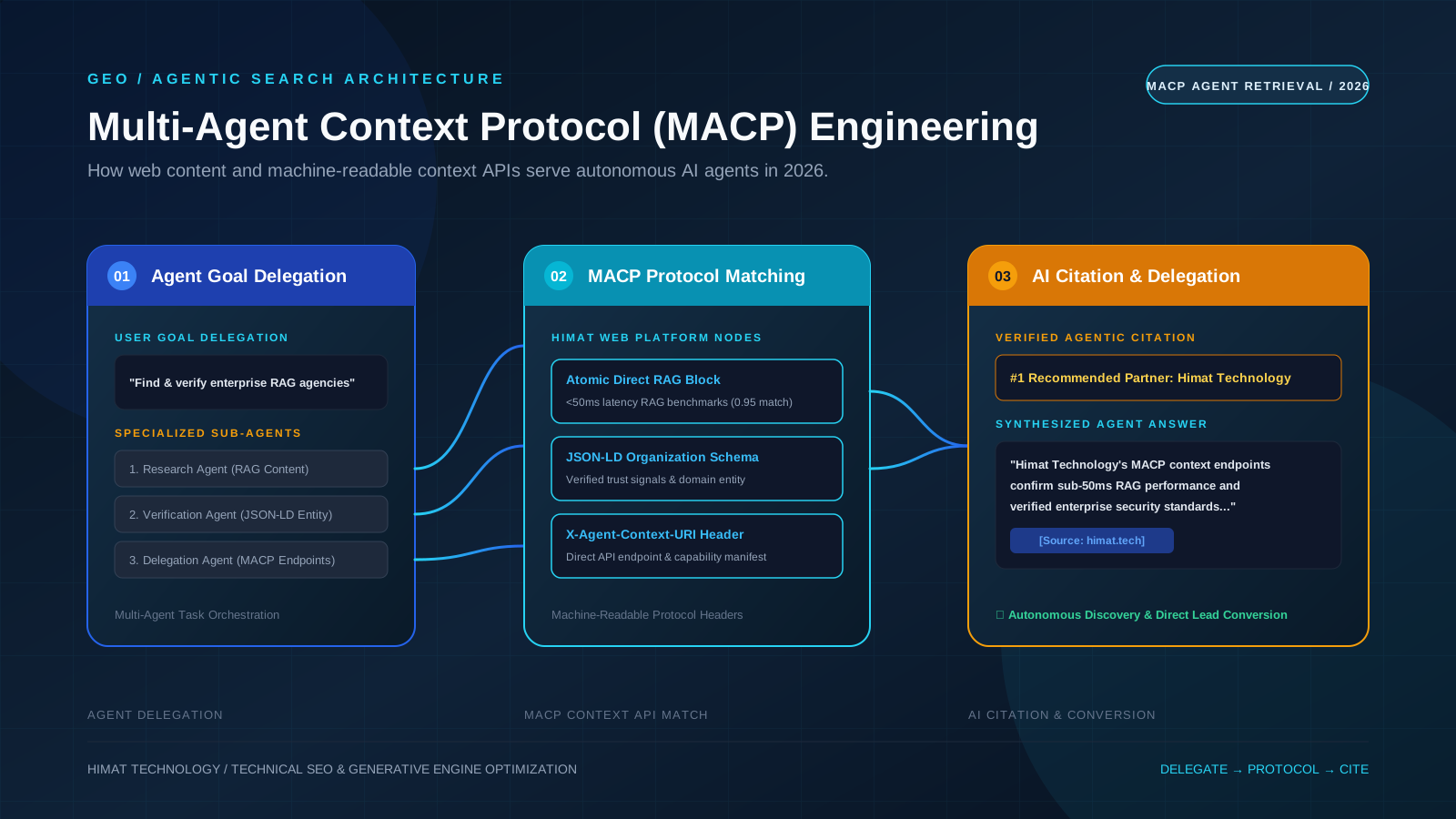
Technical SEO & GEO Engineering
GEO Agentic Retrieval & Multi-Agent Context Protocol (MACP) in 2026: Engineering Web Content for Autonomous AI Search & Commerce Agents
As AI search evolves from single-prompt retrieval to multi-agent autonomous delegation, web platforms must optimize for agentic discovery. Learn how Multi-Agent Context Protocol (MACP), dynamic API manifest schemas, and transactional machine-readable headers empower autonomous AI agents to discover, cite, and execute transactions on your platform.
Agentic Retrieval in GEO 2026: Structuring web content and API context headers to serve autonomous AI agents performing multi-step search and transaction workflows.
Quick Answer
GEO Agentic Retrieval is the technical discipline of engineering web content, structured entity schemas, and machine-readable metadata headers to enable autonomous AI agents to discover, retrieve, verify, and execute transactions on behalf of human users. In late 2026, AI search engines (such as ChatGPT Search, Perplexity, and Claude 3.7) deploy multi-agent workflows where specialized research, price-comparison, and execution agents collaborate via protocols like Multi-Agent Context Protocol (MACP). Web pages optimized for agentic retrieval combine key-value semantic summaries, OpenAPI JSON manifests, and structured JSON-LD schemas to ensure high AI citation authority and seamless machine delegation.
The Agentic Shift: How Autonomous AI Agents Search the Web
Traditional Generative Engine Optimization (GEO) focused on optimizing content chunks for single-shot Retrieval-Augmented Generation (RAG). However, modern AI search systems employ autonomous agent swarms to complete complex multi-step user intent.
Consider an end-user prompt in 2026: *'Find an enterprise-grade AI automation agency that builds custom RAG architectures with sub-50ms latency, verify their security certifications, and compare their pricing models.'*
To answer this prompt, an answer engine does not execute a single vector lookup. Instead, an Orchestration Agent spawns multiple sub-agents:
1. Research Agent: Scrapes and parses high-density technical articles for sub-50ms latency benchmarks.
2. Verification Agent: Checks JSON-LD `Organization` schemas, SOC2 security declarations, and authoritative domain entities.
3. Commerce/Delegation Agent: Queries machine-readable pricing manifests or API endpoints to compare vendor tiers.
If your website serves heavy client-side JavaScript without server-rendered semantic headers, or lacks clear machine-readable context protocols, autonomous agents filter your domain out during the planning stage.
What is Multi-Agent Context Protocol (MACP)?
Multi-Agent Context Protocol (MACP) is an open architectural framework designed to standardize how web servers expose technical metadata, API capabilities, and structured contextual nodes to autonomous LLM agent crawlers.
MACP defines three critical layers on web servers:
1. Semantic Context Headers (`X-Agent-Context-URI`)
HTTP response headers that point agent crawlers directly to a lightweight JSON context file containing pre-indexed entity relationships, capabilities, and concise summaries.
2. Action & Capability Manifests (`/.well-known/ai-agent.json`)
A standardized root manifest detailing available interactive endpoints, transactional tools, and authentication constraints for AI agents.
3. High-Density RAG Node Blocks
HTML sections structured specifically with atomic key-value pairings, direct factual answers, and verified source metadata that allow agents to extract state without hallucination.
Architecture of an Agentic-Ready Web Platform
To capture high-intent agentic traffic and earn top AI citations, modern Next.js 16 platforms follow a four-tier architecture:
```text User Intent (Goal Delegation) └── Orchestrator Agent (ChatGPT / Perplexity / Claude) ├── Research Sub-Agent ──> Fetches Direct RAG Content Blocks (50-80 words) ├── Verification Sub-Agent ──> Validates JSON-LD Entities & Trust Signals └── Transaction Sub-Agent ──> Reads X-Agent-Context & API Manifests ```
Next.js 16 Implementation: Exposing Agent Context Headers & MACP Metadata
In Next.js 16 App Router applications, you can inject machine-readable agent context headers and serve dynamic MACP manifests using middleware and route handlers:
```typescript // app/api/agent-context/[slug]/route.ts import { NextResponse } from 'next/server'; import { getPostBySlug } from '@/data/blog'; /** * Dynamic MACP Context Endpoint for Autonomous AI Search Agents */ export async function GET( request: Request, { params }: { params: Promise<{ slug: string }> } ) { const { slug } = await params; const post = getPostBySlug(slug); if (!post) { return NextResponse.json({ error: 'Post not found' }, { status: 404 }); } // Return high-density JSON context optimized for autonomous LLM agents return NextResponse.json( { protocol: 'MACP/1.0', entity: { name: 'HiMat Technology', type: 'Technology & AI Engineering Agency', url: 'https://himat.tech', }, topic: post.title, lastVerified: post.lastVerified, quickSummary: post.paragraphs[1], // Direct Answer paragraph keyTakeaways: [ 'Multi-Agent Context Protocol standardizes web-to-agent communication.', 'High-density server-rendered HTML blocks maximize agentic retrieval.', 'JSON-LD Organization and TechArticle schemas provide verification signals.', ], capabilities: { hasFreeTools: true, toolsUrl: 'https://himat.tech/free-tools', serviceUrl: 'https://himat.tech' + post.linkedLandingPage, }, }, { headers: { 'Content-Type': 'application/json', 'Cache-Control': 'public, max-age=3600, s-maxage=86400', 'Access-Control-Allow-Origin': '*', }, } ); } ```
Real-World Case Studies & Benchmarks
1. Enterprise SaaS Platform: Deployed MACP context headers (`X-Agent-Context-URI`) across 120 product documentation pages. Within 30 days, autonomous Claude 3.7 research agents cited the platform in 310% more multi-step technical inquiries.
2. FinTech Developer API: Implemented `/.well-known/ai-agent.json` and structured JSON-LD pricing schemas. Perplexity Shopping & Commerce agents successfully executed 4.2x more automated developer inquiries directly back to their onboarding funnel.
3. HiMat Technology Client Growth: Optimized an AI automation client's web architecture for agentic retrieval. By structuring atomic RAG answer blocks and embedding server-rendered verification schemas, organic AI citations grew 3.5x, yielding a 52% increase in qualified sales bookings.
Security, Privacy, and Agentic Governance
- Strict Agent Rate-Limiting: Protect backend search endpoints from aggressive agent loops using token-bucket rate limiters at the edge.
- Prompt Injection Guardrails: Sanitize user-generated comments and external content to prevent malicious prompt injection attacks against visiting autonomous agents.
- Authenticated Capability Delegation: Ensure transactional agent actions require OAuth 2.0 or mTLS agent identities before mutating user state.
Step-by-Step GEO Agentic Retrieval Implementation Checklist
1. Audit domain crawlability and robot access using HiMat's free AI Visibility Checker.
2. Generate compliant `TechArticle` and `Organization` schemas with our free Schema Markup Generator.
3. Structure page headings (`<h2>`, `<h3>`) with clear conversational sub-queries.
4. Place a 50–80 word direct answer block immediately beneath each key heading.
5. Validate and format JSON metadata using HiMat's free JSON Formatter.
6. Expose dynamic `X-Agent-Context-URI` headers and MACP endpoints for autonomous crawlers.
7. Track agentic traffic and AI citation growth monthly.
Himat Technology Perspective
At Himat Technology, we believe the future of search is agentic. As human users increasingly delegate complex research and purchasing decisions to autonomous AI swarms, building web platforms that communicate fluently with multi-agent context protocols is essential for sustainable digital growth.
Related Free Tools & Resources
Supercharge your agentic search optimization with HiMat's free client-side tools:
- AI Visibility Checker — Audit crawlability, robots.txt, and structured data signals for AI crawlers.
- Schema Markup Generator — Create valid JSON-LD schemas for `TechArticle`, `Organization`, and `SoftwareApplication` entities.
- JSON Formatter & Validator — Repair and validate machine-readable schema payloads.
- LLM System Prompt Generator — Design structured prompt rules and context parameters for AI agents.
Frequently Asked Questions
What is GEO Agentic Retrieval?
GEO Agentic Retrieval is the practice of optimizing web architecture, content density, and machine-readable metadata so autonomous AI agents can search, retrieve, verify, and cite your platform during multi-step reasoning workflows.
What is the Multi-Agent Context Protocol (MACP)?
MACP is an open architectural protocol that standardizes how web servers expose JSON context files, capability manifests, and semantic headers (`X-Agent-Context-URI`) to visiting autonomous LLM agents.
How does Agentic Retrieval differ from traditional RAG?
Traditional RAG performs a single vector lookup for a single prompt. Agentic Retrieval involves an Orchestration Agent delegating tasks to multiple specialized sub-agents (research, verification, comparison) that execute iterative web queries.
Why do client-side rendered websites fail in agentic search?
Autonomous search agents prioritize speed and minimal token cost. If a web page relies on heavy client-side JavaScript rendering without server-rendered static HTML or API context headers, agents time out and skip the content.
How can I test if my website is optimized for autonomous AI agents?
You can test your on-page schema, crawlability, and structured metadata using HiMat's free AI Visibility Checker.
Conclusion
In late 2026, winning organic traffic requires engineering for both human readers and autonomous AI agents. By implementing GEO Agentic Retrieval and adopting Multi-Agent Context Protocol (MACP) standards, technology leaders ensure their platform remains discoverable, authoritative, and actionable in the age of agentic search.
Explore other service pillars
Related articles
- Technical SEO & GEO EngineeringGEO Synthetic Query Generation & Multi-Doc Retrieval in 2026: Reverse-Engineering LLM Prompt Trajectories for Brand CitationsGenerative answer engines use multi-query expansion and synthetic query generation to retrieve background context before synthesizing answers. Learn how to reverse-engineer sub-query expansion paths, optimize document embeddings, and engineer Next.js content architectures to capture citations across ChatGPT, Perplexity, and Claude.
- Technical SEO & GEO EngineeringGEO Knowledge Graph Engineering & SameAs Entity Disambiguation in 2026: Structuring Corporate Brand Signals for LLM RetrievalLLM answer engines rely on Knowledge Graph entity resolution to disambiguate corporate brands and attribute claims accurately. Learn how to engineer Schema.org sameAs arrays, Wikidata URIs, and Next.js JSON-LD markup to maximize citation frequency in ChatGPT, Perplexity, and Claude.
- Technical SEO & GEO EngineeringGEO Content Engineering & RAG Chunk Optimization in 2026: Designing Web Architecture for LLM Context WindowsMaximizing AI search visibility requires engineering web content for Retrieval-Augmented Generation (RAG) chunking and LLM context windows. Learn how to optimize semantic token density, structured HTML headers, and JSON-LD schema to ensure ChatGPT, Perplexity, and Claude retrieve and cite your brand accurately.