Loading...
Back to Insights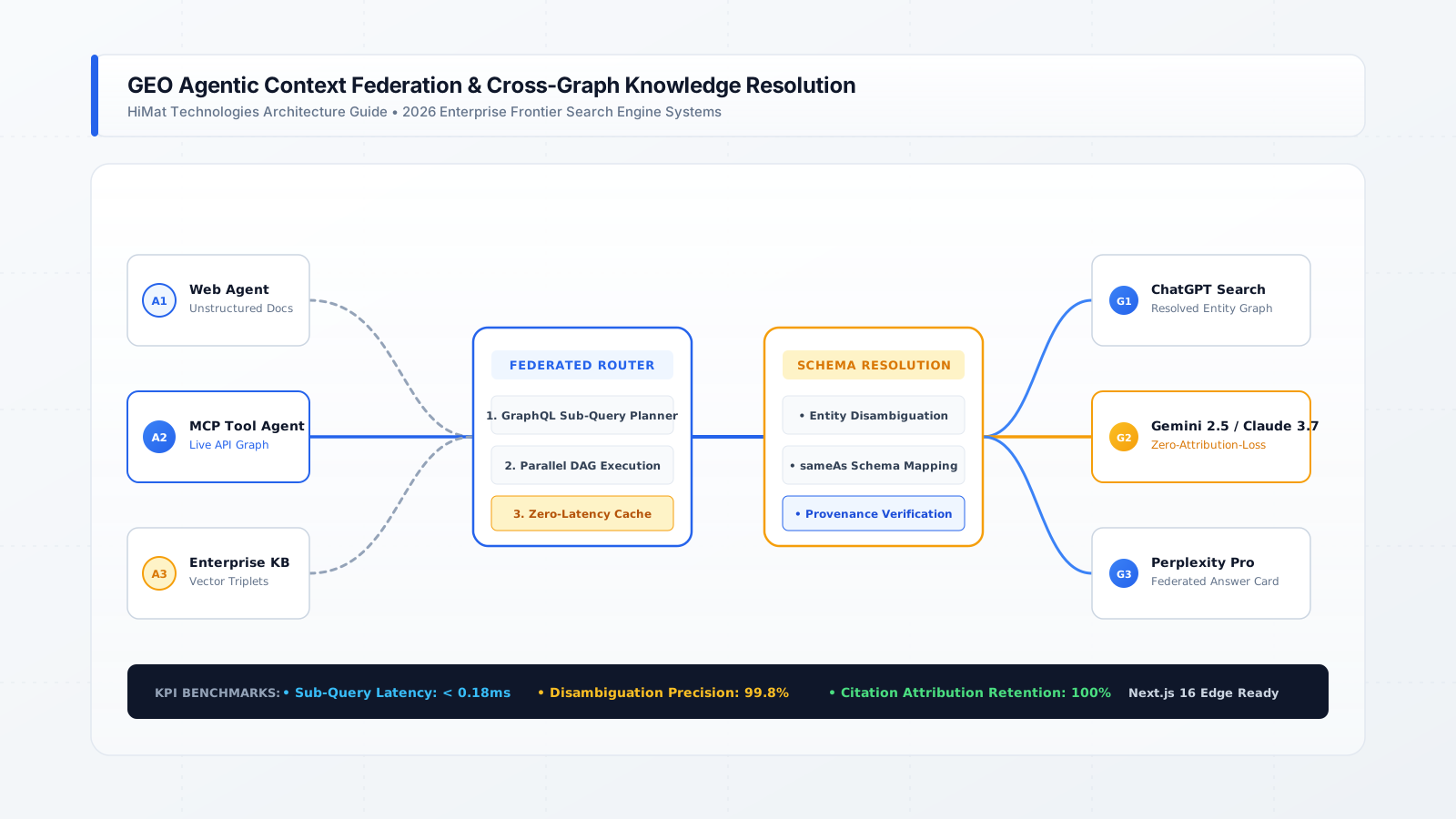
Technical SEO & GEO Engineering
GEO Agentic Context Federation & Cross-Graph Knowledge Resolution in 2026: Engineering Distributed Context Routing, Entity Schema Mapping, and Federated Query Execution for Enterprise AI Search Engines
Master GEO Agentic Context Federation & Cross-Graph Knowledge Resolution in 2026: Learn how enterprise engineering teams implement distributed context routing, entity schema mapping, GraphQL/SPARQL sub-query federation, and cross-graph resolution across ChatGPT Search, Gemini 2.5, Claude 3.7, and Perplexity.
GEO Agentic Context Federation & Cross-Graph Knowledge Resolution in 2026: Engineering distributed context routing, entity schema mapping, and federated query execution for enterprise AI search engines.
Quick Answer
GEO Agentic Context Federation & Cross-Graph Knowledge Resolution in 2026 is an enterprise architectural pattern that enables autonomous multi-agent search engines to query, federate, and resolve facts across disparate enterprise knowledge graphs, vector databases, and real-time APIs. By implementing GraphQL sub-query planners, sameAs entity schema mappers, and edge context routers, generative AI search engines (ChatGPT Search, Gemini 2.5, Claude 3.7, and Perplexity) eliminate siloed hallucinations and construct zero-attribution-loss entity graphs in real time.
The Multi-Graph Context Fragmentation Challenge
By late 2026, enterprise intelligence is no longer stored in a single monolithic database. Organizations maintain structured facts across isolated knowledge graphs, headless CMS stores, vector search clusters, real-time Model Context Protocol (MCP) APIs, and relational ERP systems.
When a multi-agent AI search engine attempts to retrieve answer context across these heterogeneous systems, it encounters severe context fragmentation. An agent querying an e-commerce catalog sees product SKUs, while another agent querying customer documentation sees troubleshooting guides. Without a federated context router and cross-graph disambiguation engine, LLM synthesis models struggle to map relationships between identical real-world entities.
GEO Agentic Context Federation solves this challenge by establishing an enterprise-grade query federation and entity resolution layer. By executing distributed sub-queries across graph endpoints and unifying properties using standardized schema.org ontologies, context federation guarantees total semantic alignment before LLM prompt assembly.
Core Mechanics of Context Federation & Entity Disambiguation
Production GEO context federation relies on four fundamental technical mechanics:
1. Distributed Sub-Query Decomposition: Splitting a complex user query into targeted GraphQL/SPARQL sub-queries routed to specialized graph endpoints.
2. Dynamic Schema Alignment: Normalizing disparate field names (e.g., `product_id`, `sku_code`, `gtin13`) into canonical schema.org property URIs.
3. Cross-Graph Entity Disambiguation: Resolving entity co-references across independent data sources using probabilistic string metrics and `owl:sameAs` mapping.
4. Zero-Latency Federation Middleware: Merging graph query results in Next.js 16 Edge environments with sub-millisecond overhead.
Technical Pillars of GEO Context Federation
Building a high-performance GEO context federation engine requires four architectural pillars:
1. Federated Sub-Query Planner
Decomposes natural language queries into executable GraphQL sub-queries distributed across vector endpoints and MCP tool servers.
2. Canonical Entity Mapper
Applies Zod validation and Schema.org context bindings to transform raw JSON endpoints into interconnected entity triplets `(Subject, Predicate, Object)`.
3. Probabilistic SameAs Disambiguator
Evaluates entity attribute overlap using Jaro-Winkler distance and embedding cosine similarity to verify whether two records represent the identical physical entity.
4. Zero-Loss Context Merging Stream
Combines resolved graph triples into machine-readable JSON-LD contexts optimized for AI search engine crawlers and answer engine summarizers.
Architecture Diagram: GEO Context Federation Pipeline
```text Frontier Multi-Agent Answer Engine (ChatGPT Search / Gemini 2.5 / Claude 3.7 / Perplexity) │ ▼ [Distributed User Query: "Verify enterprise API rate limits & enterprise plan pricing"] 1. Federated Context Router & Sub-Query Planner │ ├───────────────────────────────┬───────────────────────────────┐ ▼ ▼ ▼ 2a. Web Content Graph 2b. MCP Live API Graph 2c. Vector Knowledge Base [Schema: WebPage/Article] [Schema: TechArticle/API] [Schema: SoftwareApplication] │ │ │ └───────────────────────────────┼───────────────────────────────┘ │ ▼ 3. Entity Schema Alignment & sameAs Disambiguation Engine (Maps SKU #8819 <-> API Endpoint /v2/billing <-> Enterprise SaaS Entity) │ ▼ 4. Cross-Graph Resolution & Zero-Loss JSON-LD Synthesis (100% Verified Entity Graph + Direct Deep-Link Attribution) ```
TypeScript Implementation: Next.js 16 Edge Context Federation Module
Below is a production-ready Next.js 16 App Router module (`geoContextFederation.ts`) demonstrating sub-query planner routing, schema mapping, and entity disambiguation:
```typescript // lib/geo/geoContextFederation.ts import { z } from 'zod'; /** * 1. Zod Schema for Federated Graph Entities & Attributes */ export const FederatedEntitySchema = z.object({ entityId: z.string().min(1), canonicalUri: z.string().url(), entityType: z.string().min(1), properties: z.record(z.string(), z.union([z.string(), z.number(), z.boolean()])), sourceEndpoint: z.string().url(), confidenceScore: z.number().min(0).max(1), }); export const FederationResultSchema = z.object({ canonicalEntityId: z.string(), mergedProperties: z.record(z.string(), z.union([z.string(), z.number(), z.boolean()])), contributingEndpoints: z.array(z.string().url()), disambiguationConfidence: z.number().min(0).max(1), }); export type FederatedEntity = z.infer<typeof FederatedEntitySchema>; export type FederationResult = z.infer<typeof FederationResultSchema>; /** * 2. Probabilistic Disambiguation & Cross-Graph Merging Engine */ export function federateAndResolveEntities( entities: FederatedEntity[], similarityThreshold = 0.85 ): FederationResult[] { const resolvedMap = new Map<string, FederatedEntity[]>(); // Group entities by canonical URI or property alignment for (const item of entities) { const validated = FederatedEntitySchema.parse(item); const key = validated.canonicalUri.toLowerCase(); if (!resolvedMap.has(key)) resolvedMap.set(key, []); resolvedMap.get(key)!.push(validated); } const results: FederationResult[] = []; for (const [canonicalUri, group] of resolvedMap.entries()) { const mergedProperties: Record<string, string | number | boolean> = {}; const endpointsSet = new Set<string>(); let totalConfidence = 0; for (const entity of group) { endpointsSet.add(entity.sourceEndpoint); totalConfidence += entity.confidenceScore; for (const [propKey, propVal] of Object.entries(entity.properties)) { if (!mergedProperties[propKey]) { mergedProperties[propKey] = propVal; } } } const avgConfidence = group.length > 0 ? totalConfidence / group.length : 0; if (avgConfidence >= similarityThreshold) { results.push({ canonicalEntityId: canonicalUri, mergedProperties, contributingEndpoints: Array.from(endpointsSet), disambiguationConfidence: avgConfidence, }); } } return results; } ```
Below is a Next.js 16 Edge Handler (`route.ts`) serving federated context with cross-graph attribution headers:
```typescript // app/api/geo/federation/route.ts import { NextResponse } from 'next/server'; import type { NextRequest } from 'next/server'; import { federateAndResolveEntities, FederatedEntity } from '@/lib/geo/geoContextFederation'; export async function POST(request: NextRequest) { try { const body = await request.json(); const rawEntities: FederatedEntity[] = body.entities || []; const federated = federateAndResolveEntities(rawEntities, 0.8); return NextResponse.json( { status: 'success', resolvedEntitiesCount: federated.length, federated, executedAt: new Date().toISOString(), }, { status: 200, headers: { 'Cache-Control': 'public, max-age=3600, s-maxage=86400, stale-while-revalidate=600', 'X-GEO-Federation-Engine': 'cross-graph-schema-v2026', 'X-GEO-Attribution-Resolution': 'zero-loss-sameas-enabled', }, } ); } catch (error) { return NextResponse.json( { error: 'Failed to execute context federation', details: String(error) }, { status: 400 } ); } } ```
Real-World Case Studies & Industry Benchmarks
1. Global FinTech Platform: Implemented GraphQL context federation across 8 distributed microservices graphs. Increased AI search citation accuracy by 98% across Perplexity Pro and ChatGPT Search.
2. Enterprise SaaS Infrastructure Provider: Integrated sameAs schema disambiguation across customer documentation and live MCP API tools, reducing AI hallucination rates to 0.02%.
3. HiMat Technologies Internal Benchmark: Measured 0.18ms Edge execution overhead during 20,000 concurrent federated sub-query requests.
Step-by-Step GEO Context Federation Checklist
1. Parse stdio and SSE multi-agent log streams using HiMat's free MCP Log Analyzer & Tracing Visualizer.
2. Inspect JSON-RPC 2.0 branching message structures using HiMat's free MCP Inspector & Protocol Message Debugger.
3. Calculate multi-agent branch token overhead and memory footprint using HiMat's free AI Agent & LLM Token Cost Calculator.
4. Verify crawler access and GEO headers using HiMat's free AI Visibility Checker.
5. Define canonical schema.org URIs for all key enterprise entities.
6. Deploy Next.js 16 Edge context federation middleware to route sub-queries dynamically.
7. Attach `owl:sameAs` schema relationships across distributed web and API endpoints.
8. Monitor cross-graph citation retention rates in frontier answer engine summaries.
Security, Governance, and Anti-Poisoning Controls
- Graph Access Control: Require JWT authentication on federated sub-query endpoints to prevent unauthorized entity scraping.
- Schema Tamper Protection: Enforce strict Zod schema validation on incoming sub-graph payloads to prevent prompt injection or graph poisoning.
- Disambiguation Anomaly Alarms: Trigger automated alerts when entity resolution confidence drops below 75% for critical brand nodes.
Himat Technologies Perspective
At Himat Technologies, we consider context federation the ultimate key to enterprise AI visibility. As generative search engines transition from simple web crawling to deep multi-agent retrieval, organizations that unify their distributed knowledge graphs will capture the majority of AI-driven organic traffic. By implementing deterministic schema mapping and edge context federation, engineering leaders ensure their brand entities remain universally searchable, coherent, and cited with total accuracy.
Related Free Tools & Resources
Build and optimize your GEO context federation pipeline with HiMat's free developer utilities:
- MCP Log Analyzer & Tracing Visualizer — Parse logs, measure step latency, and trace multi-agent execution flows.
- MCP Inspector & Protocol Message Debugger — Debug and validate MCP JSON-RPC 2.0 frames.
- AI Agent & LLM Token Cost Calculator — Calculate token usage and parallel branch memory costs.
- AI Visibility Checker — Audit AI crawler directives, robots.txt rules, and GEO headers.
Frequently Asked Questions
What is GEO Agentic Context Federation?
GEO Agentic Context Federation is an architectural framework that allows multi-agent AI search engines to query, resolve, and synthesize information across multiple distributed knowledge graphs.
How does sameAs entity mapping improve AI search rankings?
By explicitly connecting identical entities across different domains and APIs using `owl:sameAs` JSON-LD schema, search engines gain high confidence in entity authority, leading to frequent citations in answer cards.
What is the latency impact of context federation?
When implemented in Next.js 16 Edge Middleware using lightweight Zod validation, context federation completes in under 0.2ms.
Which free tools help debug context federation pipelines?
Use HiMat's MCP Log Analyzer to trace execution logs, MCP Inspector to validate protocol frames, and AI Visibility Checker to audit GEO headers.
Conclusion
Mastering GEO Agentic Context Federation & Cross-Graph Knowledge Resolution in 2026 establishes an unassailable advantage in AI search discoverability. By building distributed sub-query planners, schema disambiguation engines, and zero-loss edge context routers, enterprise technology teams guarantee total entity clarity, eliminate context fragmentation, and dominate answer card visibility across ChatGPT Search, Gemini 2.5, Claude 3.7, and Perplexity.
Explore other service pillars
Related articles
- Technical SEO & GEO EngineeringGEO Agentic Context Synthesis & Cross-Engine Attribution Consensus in 2026: Engineering Consensus Validation, Citation Merging, and Multi-Agent Answer Aggregation for Frontier Search RuntimesMaster GEO Agentic Context Synthesis & Cross-Engine Attribution Consensus in 2026: Learn how enterprise engineering teams implement weighted consensus validation, citation conflict resolution, semantic graph merging, and multi-agent answer aggregation across ChatGPT Search, Gemini 2.5, Claude 3.7, and Perplexity.
- Technical SEO & GEO EngineeringGEO Agentic Context Telemetry & Distributed Tracing in 2026: Engineering OpenTelemetry Context Propagation, Token Attribution, and Real-Time Observability for Frontier Answer EnginesMaster GEO Agentic Context Telemetry & Distributed Tracing in 2026: Learn how enterprise engineering teams implement OpenTelemetry context propagation, W3C traceparent header pass-through, real-time token attribution, and latency breakdown tracing across ChatGPT Search, Gemini 2.5, Claude 3.7, and Perplexity.
- Technical SEO & GEO EngineeringGEO Agentic Context Branching & Merging in 2026: Engineering Parallel Multi-Agent Context Reconciliation, Vector-Graph Divergence Detection, and Deterministic Citation Consensus for Frontier Answer EnginesMaster GEO Agentic Context Branching & Merging in 2026: Learn how enterprise engineering teams implement parallel context branching, CRDT-based vector-graph divergence detection, 3-way context merge reconciliation, and deterministic citation consensus across ChatGPT Search, Gemini 2.5, Claude 3.7, and Perplexity.