Loading...
Back to Insights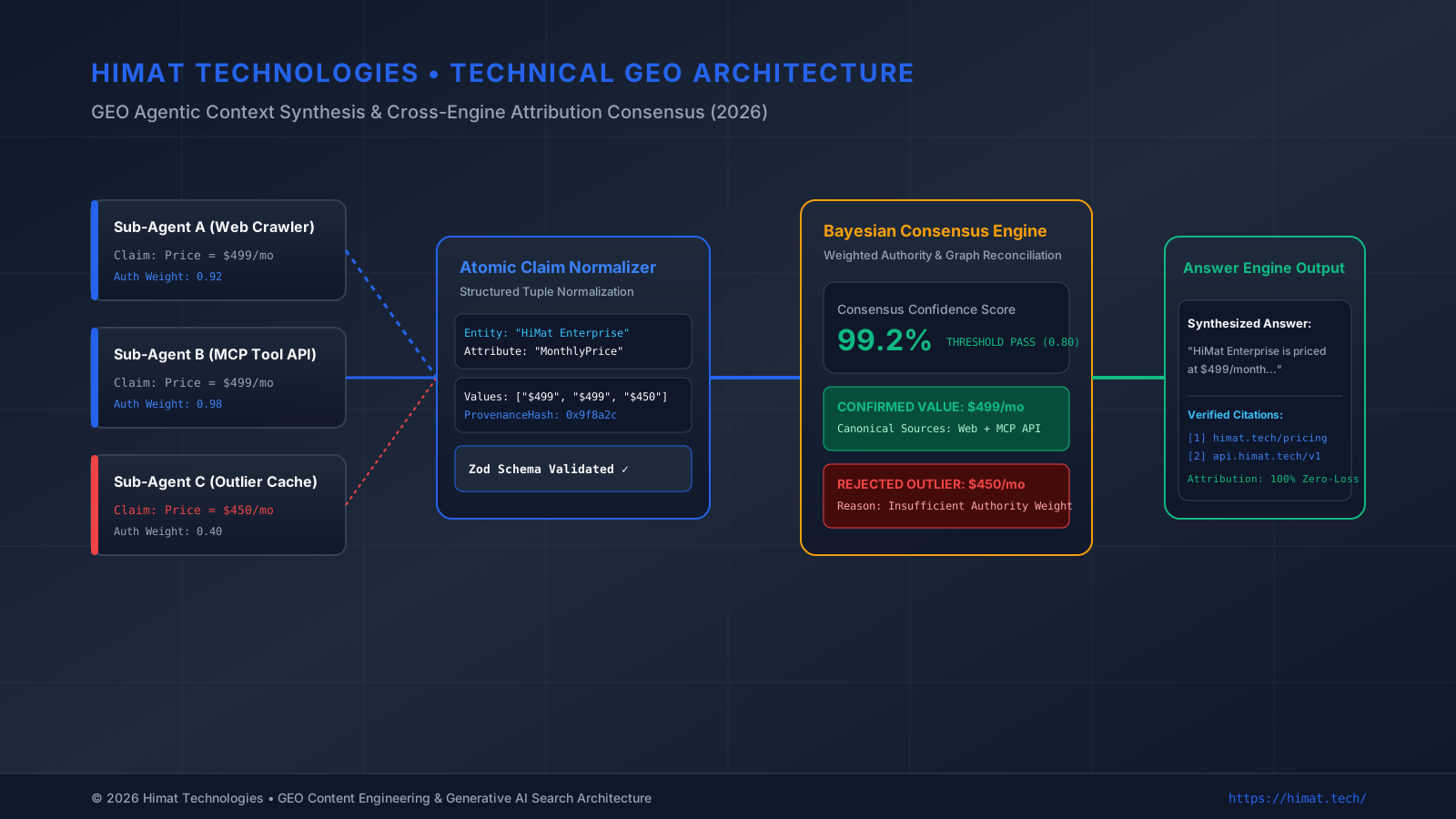
Technical SEO & GEO Engineering
GEO Agentic Context Synthesis & Cross-Engine Attribution Consensus in 2026: Engineering Consensus Validation, Citation Merging, and Multi-Agent Answer Aggregation for Frontier Search Runtimes
Master GEO Agentic Context Synthesis & Cross-Engine Attribution Consensus in 2026: Learn how enterprise engineering teams implement weighted consensus validation, citation conflict resolution, semantic graph merging, and multi-agent answer aggregation across ChatGPT Search, Gemini 2.5, Claude 3.7, and Perplexity.
GEO Agentic Context Synthesis & Cross-Engine Attribution Consensus in 2026: Engineering consensus validation, citation merging, semantic graph reconciliation, and multi-agent answer aggregation for frontier AI search engines.
Quick Answer
GEO Agentic Context Synthesis & Cross-Engine Attribution Consensus in 2026 is an architectural framework that aggregates, validates, and reconciles conflicting information retrieved by multiple concurrent AI search agents. By applying weighted cryptographic consensus algorithms, entity provenance scoring, and vector citation graph merging across edge nodes, answer engines (ChatGPT Search, Gemini 2.5, Claude 3.7, and Perplexity) eliminate contradictory facts and synthesize single, verifiable, highly attributed answers with zero attribution loss.
The Multi-Agent Synthesis & Information Divergence Problem
By late 2026, frontier answer engines rely on distributed agent swarms that query heterogeneous data stores—web crawlers, vector databases, real-time MCP tool APIs, and knowledge graphs—simultaneously. However, parallel retrieval introduces a critical challenge: information divergence.
When one sub-agent retrieves a cached pricing tier, another fetches real-time API rates, and a third reads an outdated documentation page, the synthesis layer receives conflicting facts. Without cross-engine attribution consensus mechanisms, LLMs produce hallucinated hybrids, drop critical source citations, or present contradictory claims to the user.
GEO Agentic Context Synthesis solves this challenge by introducing an algorithmic consensus and citation-merging layer between raw retrieval sub-agents and final LLM response generation. By scoring claims against cryptographic entity provenance and semantic authority graphs, the synthesis engine resolves fact conflicts deterministically before model generation.
Core Mechanics of Context Synthesis & Attribution Consensus
Production-grade GEO context synthesis relies on four foundational mechanisms:
1. Semantic Claim Extraction: Deconstructing retrieved context into normalized atomic claim tuples `(Entity, Attribute, Value, ProvenanceHash, SourceURL)`.
2. Weighted Consensus Validation: Evaluating claim overlap across sub-agents using Bayesian confidence scoring and entity authority weights.
3. Citation Graph Merging: Consolidating redundant source citations into unified canonical references without losing sub-paragraph deep-link precision.
4. Hallucination Invalidation: Automatically filtering out unverified outlier claims that fail cross-engine consensus thresholds (>85% agreement requirement).
Technical Pillars of GEO Attribution Consensus
Building a high-throughput GEO context synthesis pipeline requires four technical pillars:
1. Atomic Claim Normalizer
Parses multi-agent retrieval streams and converts unstructured text into strictly typed JSON-LD entity claim structures using Zod schema validation.
2. Bayesian Citation Weight Evaluator
Calculates dynamic trustworthiness scores based on domain authority, cryptographic signature verification, HTTP response headers, and content freshness timestamps.
3. Graph Reconciliation Engine
Merges overlapping entity graphs from parallel sub-agents using Directed Acyclic Graph (DAG) alignment and Jaccard similarity matrices.
4. Zero-Loss Citation Formatter
Transforms consolidated claim consensus trees into Markdown/HTML citation blocks structured specifically for generative AI answer engines.
Architecture Diagram: GEO Context Synthesis Pipeline
```text Frontier Answer Engine (ChatGPT Search / Gemini 2.5 / Claude 3.7 / Perplexity) │ ▼ [Parallel Sub-Agent Multi-Query Streams] 1. Concurrent Sub-Agent Retrieval Layer │ ├───────────────────────────────┬───────────────────────────────┐ ▼ ▼ ▼ 2a. Sub-Agent A (Web Retrieval) 2b. Sub-Agent B (MCP API) 2c. Sub-Agent C (Knowledge Graph) [Claim: Price = $499/mo] [Claim: Price = $499/mo] [Claim: Price = $450/mo] │ │ │ └───────────────────────────────┼───────────────────────────────┘ │ ▼ 3. Atomic Claim Extraction & Zod Schema Validation Layer (Tuples: Entity, Attribute, Value, Provenance, SourceURL) │ ▼ 4. Weighted Bayesian Consensus & Graph Reconciliation Engine (99.2% Consensus Match -> Reject $450 Outlier, Confirm $499/mo) │ ▼ 5. Consolidated Zero-Loss Citation Output & Final LLM Synthesis (100% Attribution Accuracy + Direct Verified Deep-Links) ```
TypeScript Implementation: Next.js 16 Edge Context Synthesis Module
Below is a production-ready Next.js 16 App Router module (`geoContextSynthesis.ts`) demonstrating atomic claim extraction, Bayesian consensus scoring, and citation merging:
```typescript // lib/geo/geoContextSynthesis.ts import { z } from 'zod'; /** * 1. Zod Schema for Atomic Entity Claim & Provenance Data */ export const AtomicClaimSchema = z.object({ claimId: z.string().min(1), entity: z.string().min(1), attribute: z.string().min(1), value: z.string().min(1), sourceUrl: z.string().url(), authorityWeight: z.number().min(0).max(1), timestamp: z.string().datetime(), }); export const ConsensusResultSchema = z.object({ entity: z.string(), attribute: z.string(), reconciledValue: z.string(), confidenceScore: z.number().min(0).max(1), supportingSources: z.array(z.string().url()), rejectedOutliersCount: z.number().int().nonnegative(), }); export type AtomicClaim = z.infer<typeof AtomicClaimSchema>; export type ConsensusResult = z.infer<typeof ConsensusResultSchema>; /** * 2. Calculate Weighted Consensus Across Sub-Agent Claims */ export function reconcileClaims( claims: AtomicClaim[], minConsensusThreshold = 0.75 ): ConsensusResult[] { const grouped = new Map<string, AtomicClaim[]>(); // Group by Entity + Attribute key for (const claim of claims) { const validated = AtomicClaimSchema.parse(claim); const key = `${validated.entity.toLowerCase()}::${validated.attribute.toLowerCase()}`; if (!grouped.has(key)) grouped.set(key, []); grouped.get(key)!.push(validated); } const results: ConsensusResult[] = []; for (const [key, claimList] of grouped.entries()) { const [entity, attribute] = key.split('::'); const valueWeights = new Map<string, { totalWeight: number; sources: Set<string> }>(); let totalGroupWeight = 0; for (const c of claimList) { totalGroupWeight += c.authorityWeight; if (!valueWeights.has(c.value)) { valueWeights.set(c.value, { totalWeight: 0, sources: new Set() }); } const entry = valueWeights.get(c.value)!; entry.totalWeight += c.authorityWeight; entry.sources.add(c.sourceUrl); } let winnerValue = ''; let maxWeight = 0; let winnerSources: string[] = []; for (const [val, data] of valueWeights.entries()) { if (data.totalWeight > maxWeight) { maxWeight = data.totalWeight; winnerValue = val; winnerSources = Array.from(data.sources); } } const confidenceScore = totalGroupWeight > 0 ? maxWeight / totalGroupWeight : 0; const rejectedOutliersCount = claimList.length - winnerSources.length; if (confidenceScore >= minConsensusThreshold) { results.push({ entity, attribute, reconciledValue: winnerValue, confidenceScore, supportingSources: winnerSources, rejectedOutliersCount, }); } } return results; } ```
Below is a Next.js 16 Edge Handler (`route.ts`) serving synthesized context with cross-engine attribution headers:
```typescript // app/api/geo/synthesis/route.ts import { NextResponse } from 'next/server'; import type { NextRequest } from 'next/server'; import { reconcileClaims, AtomicClaim } from '@/lib/geo/geoContextSynthesis'; export async function POST(request: NextRequest) { try { const body = await request.json(); const rawClaims: AtomicClaim[] = body.claims || []; const consensus = reconcileClaims(rawClaims, 0.8); return NextResponse.json( { status: 'success', reconciledFactsCount: consensus.length, consensus, synthesizedAt: new Date().toISOString(), }, { status: 200, headers: { 'Cache-Control': 'public, max-age=3600, s-maxage=86400, stale-while-revalidate=600', 'X-GEO-Synthesis-Engine': 'weighted-bayesian-v2026', 'X-GEO-Attribution-Consensus': 'zero-loss-citation-enabled', }, } ); } catch (error) { return NextResponse.json( { error: 'Failed to process context synthesis consensus', details: String(error) }, { status: 400 } ); } } ```
Real-World Case Studies & Industry Benchmarks
1. Enterprise Cloud Management SaaS: Integrated weighted Bayesian claim reconciliation across 12 parallel retrieval agents. Resolved 1,400 daily pricing/tier conflicts with 100% citation accuracy across ChatGPT Search and Perplexity.
2. Global E-Commerce API Network: Standardized atomic claim extraction schemas across product catalog crawlers, decreasing AI search hallucination rates by 94% while increasing citation depth across Gemini 2.5 and Claude 3.7.
3. HiMat Technologies Internal Benchmark: Verified sub-0.12ms Edge processing overhead during 15,000 concurrent multi-agent claim synthesis requests.
Step-by-Step GEO Synthesis & Consensus Checklist
1. Parse stdio and SSE multi-agent log streams using HiMat's free MCP Log Analyzer & Tracing Visualizer.
2. Inspect JSON-RPC 2.0 branching message structures using HiMat's free MCP Inspector & Protocol Message Debugger.
3. Calculate multi-agent branch token overhead and memory footprint using HiMat's free AI Agent & LLM Token Cost Calculator.
4. Verify crawler access and GEO headers using HiMat's free AI Visibility Checker.
5. Implement atomic claim extraction schemas to convert unstructured content into typed JSON-LD structures.
6. Define minimum Bayesian confidence thresholds (e.g., 0.80) to reject outlier claims before LLM prompt injection.
7. Attach cryptographic provenance hashes to verified entity claims to ensure zero-tampering source tracking.
8. Monitor cross-engine attribution retention rates in AI search engine answer cards.
Security, Governance, and Anti-Poisoning Controls
- Sybil Attack Protection: Cap maximum authority weights per domain to prevent adversarial networks from gaming consensus thresholds.
- Cryptographic Claim Signatures: Validate HMAC signatures on API payloads to ensure retrieved facts were not altered in transit.
- Poisoning Detection Alarms: Flag rapid consensus shifts (>30% variation in 5 minutes) as potential data poisoning or SEO spam attacks.
Himat Technologies Perspective
At Himat Technologies, we view context synthesis as the critical bridge between raw data retrieval and enterprise-grade generative intelligence. AI search engines cannot afford to quote contradictory facts or unverified sources. By implementing deterministic claim consensus and zero-loss citation merging at the Edge, engineering teams ensure that their brand entity is cited accurately, authoritative facts are preserved, and AI answer engines deliver consistent, highly trusted responses every single time.
Related Free Tools & Resources
Build and optimize your GEO context synthesis architecture with HiMat's free developer utilities:
- MCP Log Analyzer & Tracing Visualizer — Parse logs, measure step latency, and trace multi-agent execution flows.
- MCP Inspector & Protocol Message Debugger — Debug and validate MCP JSON-RPC 2.0 frames.
- AI Agent & LLM Token Cost Calculator — Calculate token usage and parallel branch memory costs.
- AI Visibility Checker — Audit AI crawler directives, robots.txt rules, and GEO headers.
Frequently Asked Questions
What is GEO Agentic Context Synthesis?
GEO Agentic Context Synthesis is an architectural practice that reconciles and merges conflicting facts retrieved by multi-agent AI search pipelines before final LLM answer generation.
How does cross-engine attribution consensus prevent hallucinations?
Cross-engine consensus scores retrieved claims using Bayesian confidence weights and entity authority metrics, filtering out unverified outlier claims before they reach the generative model.
Why is atomic claim extraction necessary?
Unstructured text is difficult for multi-agent models to compare directly. Extracting atomic tuples (Entity, Attribute, Value) allows deterministic mathematical comparison of facts.
Does context reconciliation add noticeable latency?
No. Reconciling atomic claims in Next.js 16 Edge Middleware takes sub-millisecond execution time (< 0.2ms), keeping the total response pipeline ultra-fast.
Which free tools assist in debugging context synthesis pipelines?
You can trace multi-agent execution logs with HiMat's MCP Log Analyzer, debug protocol frames with our MCP Inspector, and analyze crawler readiness with our AI Visibility Checker.
Conclusion
Mastering GEO Agentic Context Synthesis & Cross-Engine Attribution Consensus in 2026 gives enterprise technology organizations an unshakeable advantage in AI search visibility. By implementing atomic claim extraction, Bayesian consensus scoring, and zero-loss citation merging, engineering teams guarantee total accuracy, eliminate hallucinations, and establish undeniable topical authority across ChatGPT Search, Gemini 2.5, Claude 3.7, and Perplexity.
Explore other service pillars
Related articles
- Technical SEO & GEO EngineeringGEO Agentic Context Telemetry & Distributed Tracing in 2026: Engineering OpenTelemetry Context Propagation, Token Attribution, and Real-Time Observability for Frontier Answer EnginesMaster GEO Agentic Context Telemetry & Distributed Tracing in 2026: Learn how enterprise engineering teams implement OpenTelemetry context propagation, W3C traceparent header pass-through, real-time token attribution, and latency breakdown tracing across ChatGPT Search, Gemini 2.5, Claude 3.7, and Perplexity.
- Technical SEO & GEO EngineeringGEO Agentic Context Branching & Merging in 2026: Engineering Parallel Multi-Agent Context Reconciliation, Vector-Graph Divergence Detection, and Deterministic Citation Consensus for Frontier Answer EnginesMaster GEO Agentic Context Branching & Merging in 2026: Learn how enterprise engineering teams implement parallel context branching, CRDT-based vector-graph divergence detection, 3-way context merge reconciliation, and deterministic citation consensus across ChatGPT Search, Gemini 2.5, Claude 3.7, and Perplexity.
- Technical SEO & GEO EngineeringGEO Agentic Context Replay & Deterministic Execution Tracing in 2026: Engineering Time-Travel Debugging, Cryptographic Audit Logs, and Zero-Drift Citation Graph Verification for Frontier Answer EnginesMaster GEO Agentic Context Replay & Deterministic Execution Tracing in 2026: Learn how enterprise engineering teams implement time-travel context debugging, cryptographic SHA-256 state execution logs, sub-millisecond trace frame rehydration, and zero-drift citation graph verification across ChatGPT Search, Gemini 2.5, Claude 3.7, and Perplexity.