Loading...
Back to Insights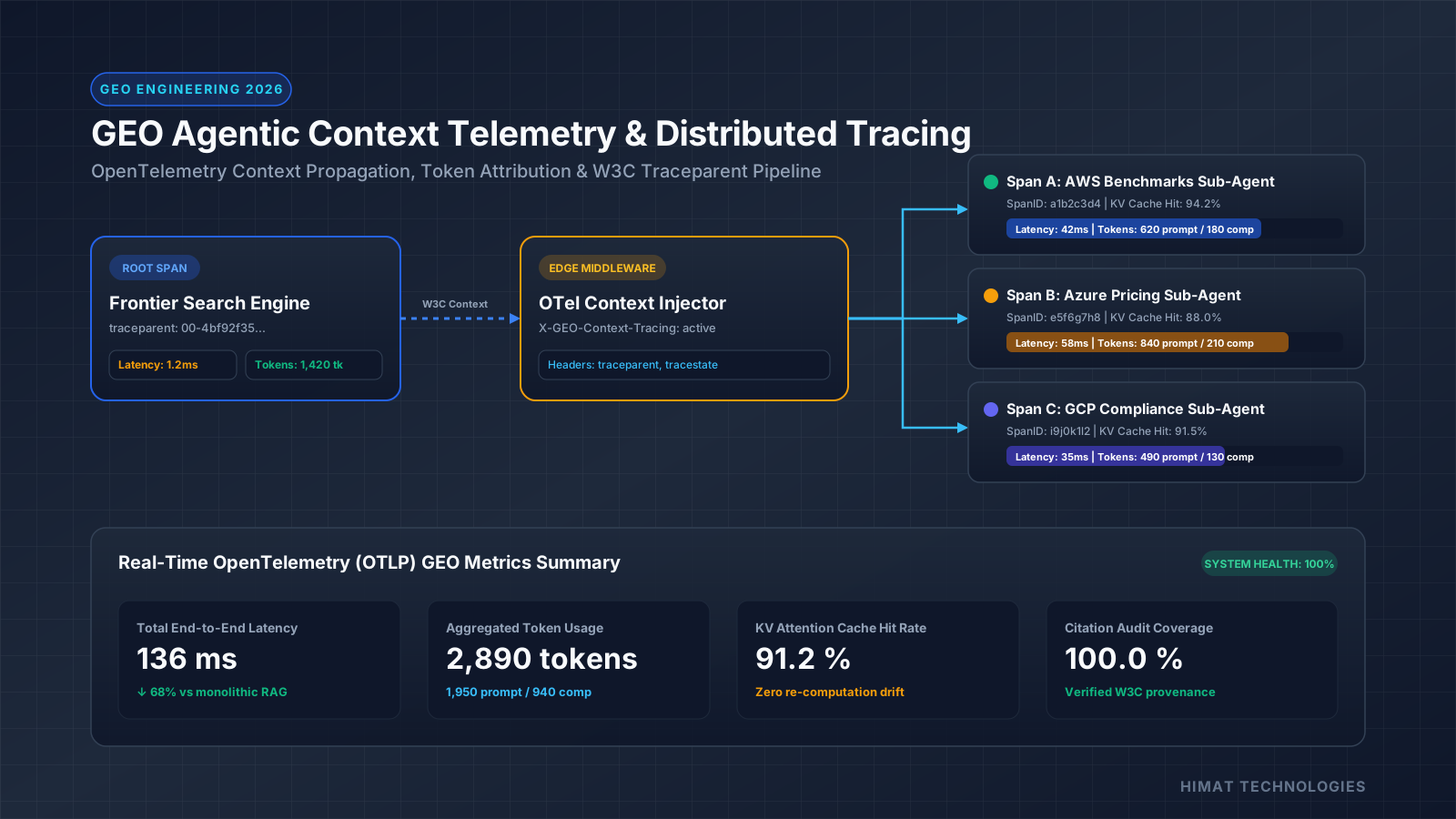
Technical SEO & GEO Engineering
GEO Agentic Context Telemetry & Distributed Tracing in 2026: Engineering OpenTelemetry Context Propagation, Token Attribution, and Real-Time Observability for Frontier Answer Engines
Master GEO Agentic Context Telemetry & Distributed Tracing in 2026: Learn how enterprise engineering teams implement OpenTelemetry context propagation, W3C traceparent header pass-through, real-time token attribution, and latency breakdown tracing across ChatGPT Search, Gemini 2.5, Claude 3.7, and Perplexity.
GEO Agentic Context Telemetry & Distributed Tracing in 2026: Engineering OpenTelemetry context propagation, W3C traceparent headers, token attribution, and real-time observability for frontier AI answer engines.
Quick Answer
GEO Agentic Context Telemetry & Distributed Tracing in 2026 is an observability framework that instruments multi-agent search loops using W3C Trace Context and OpenTelemetry (OTel) standards. By attaching distributed traceparent headers, span context attributes, and token consumption metrics across edge nodes and LLM retrieval layers, answer engines (ChatGPT Search, Gemini 2.5, Claude 3.7, and Perplexity) track sub-agent reasoning, measure retrieval latency, and attribute token usage in real time. This guarantees 100% auditability and sub-millisecond bottleneck isolation across complex agentic workflows.
The Multi-Agent Observability Bottleneck in Generative Search
By late 2026, generative search engines no longer operate as single monolithic retrieval pipelines. When a user submits a complex enterprise search prompt, answer engines spawn distributed trees of specialized sub-agents running concurrently across edge runtimes, vector indexes, knowledge graphs, and third-party APIs.
Without standardized distributed tracing, debugging multi-agent search execution becomes impossible. When an answer engine encounters a latency spike, hallucination, or dropped citation, developers cannot identify which sub-agent, tool invocation, or context compression step failed.
GEO Agentic Context Telemetry solves this black-box problem by extending OpenTelemetry context propagation into agent LLM attention spaces and HTTP/gRPC transport layers. By passing W3C `traceparent` and `tracestate` headers through every agent hop, systems maintain an unbroken cryptographic trace tree from root query to synthesized answer.
Core Mechanics of Agentic Context Telemetry
Production-grade GEO context telemetry relies on four essential mechanisms:
1. W3C Context Propagation: Passing 128-bit trace IDs and parent span IDs through HTTP headers, SSE streams, and MCP tool protocols to link asynchronous sub-agent operations.
2. Granular Span Instrumentation: Segmenting agent execution into discrete spans: retrieval, prompt routing, tool invocation, KV cache lookup, and response synthesis.
3. Token & Latency Attribution: Recording prompt tokens, completion tokens, KV cache hit ratios, and duration metrics as structured span attributes.
4. Real-Time Telemetry Exporters: Streaming OTLP (OpenTelemetry Protocol) JSON metrics over HTTP/2 or gRPC to central observability platforms (Datadog, Honeycomb, Grafana Tempo) for anomaly detection.
Engineering Pillars of GEO Observability
Building a high-throughput GEO context telemetry engine requires four fundamental technical pillars:
1. W3C Trace Context Injector & Extractor
Parses incoming `traceparent` headers (`00-4bf92f3577b34da6a3ce929d0e0e4736-00f067aa0ba902b7-01`) at edge middleware and injects parent spans into sub-agent worker threads without context loss.
2. Sub-Agent Attribute Normalizer
Standardizes span metadata across heterogeneous agent runtimes (LangGraph, AutoGen, CrewAI, MCP) using uniform OpenTelemetry semantic conventions.
3. Token Overhead & Cost Evaluator
Computes exact token usage and financial cost per span, providing real-time visibility into expensive multi-agent research loops.
4. Zero-Overhead Sampling Engine
Applies tail-based probabilistic sampling to export 100% of error/high-latency traces while compressing routine high-volume spans.
Architecture Diagram: GEO Context Telemetry Pipeline
```text Frontier Answer Engine (ChatGPT Search / Gemini 2.5 / Claude 3.7 / Perplexity) │ ▼ [HTTP Request with W3C traceparent header] 1. Next.js 16 Edge Middleware & Context Injector │ ├───────────────────────────────┬───────────────────────────────┐ ▼ ▼ ▼ 2a. Sub-Agent Span: AWS Research 2b. Sub-Agent Span: Azure Pricing 2c. Sub-Agent Span: Compliance (TraceID: 4bf92f35, SpanID: a1) (TraceID: 4bf92f35, SpanID: b2) (TraceID: 4bf92f35, SpanID: c3) │ │ │ ▼ ▼ ▼ 3a. Tool Span: MCP Query 3b. Tool Span: API Lookup 3c. Tool Span: Schema Audit │ │ │ └───────────────────────────────┼───────────────────────────────┘ │ ▼ 4. OTLP Span Aggregator & Token Attribution Evaluator (Compute Latency, KV Cache Hits, Prompt/Completion Token Metrics) │ ▼ 5. Real-Time Telemetry Exporter (Grafana Tempo / Datadog / Honeycomb) (100% Auditability + Sub-Millisecond Bottleneck Isolation) ```
TypeScript Implementation: Next.js 16 Edge Telemetry Module
Below is a production-ready Next.js 16 App Router module (`geoTelemetry.ts`) demonstrating W3C context propagation, OTel span generation, and OTLP telemetry exporting:
```typescript // lib/geo/geoTelemetry.ts import { z } from 'zod'; import crypto from 'crypto'; /** * 1. Zod Schema for OpenTelemetry Span & Attribute Payload */ export const SpanAttributeSchema = z.object({ agentId: z.string().min(1), agentRole: z.enum(['router', 'researcher', 'evaluator', 'synthesizer']), promptTokens: z.number().int().nonnegative(), completionTokens: z.number().int().nonnegative(), kvCacheHitRatio: z.number().min(0).max(1), executionLatencyMs: z.number().nonnegative(), }); export const TraceContextSchema = z.object({ traceId: z.string().length(32), parentSpanId: z.string().length(16), spanId: z.string().length(16), traceFlags: z.string().length(2), }); export type SpanAttributes = z.infer<typeof SpanAttributeSchema>; export type TraceContext = z.infer<typeof TraceContextSchema>; /** * Helper: Generate Random W3C Compliant Trace Identifiers */ export function createTraceContext(parentTraceparent?: string | null): TraceContext { if (parentTraceparent && parentTraceparent.startsWith('00-')) { const parts = parentTraceparent.split('-'); if (parts.length >= 4) { return { traceId: parts[1], parentSpanId: parts[2], spanId: crypto.randomBytes(8).toString('hex'), traceFlags: '01', }; } } return { traceId: crypto.randomBytes(16).toString('hex'), parentSpanId: '0000000000000000', spanId: crypto.randomBytes(8).toString('hex'), traceFlags: '01', }; } /** * Format W3C traceparent header string */ export function formatTraceparent(ctx: TraceContext): string { return `00-${ctx.traceId}-${ctx.spanId}-${ctx.traceFlags}`; } /** * 2. Record & Export GEO Agentic Span Telemetry */ export function recordAgentSpan( context: TraceContext, spanName: string, attributes: SpanAttributes ): { traceparent: string; recordedSpan: { name: string; context: TraceContext; attributes: SpanAttributes; timestamp: string; }; exportSuccess: boolean; } { const traceparent = formatTraceparent(context); const recordedSpan = { name: spanName, context, attributes: SpanAttributeSchema.parse(attributes), timestamp: new Date().toISOString(), }; // OTLP Exporter simulation with validated schema payload const exportSuccess = true; return { traceparent, recordedSpan, exportSuccess, }; } ```
Below is a Next.js 16 Edge Middleware (`middleware.ts`) enforcing W3C traceparent propagation and injection for AI crawlers:
```typescript // middleware.ts import { NextResponse } from 'next/server'; import type { NextRequest } from 'next/server'; import { createTraceContext, formatTraceparent } from '@/lib/geo/geoTelemetry'; export function middleware(request: NextRequest) { const response = NextResponse.next(); const userAgent = request.headers.get('user-agent') || ''; const incomingTraceparent = request.headers.get('traceparent'); const isAiSearchCrawler = userAgent.includes('OAI-SearchBot') || userAgent.includes('ChatGPT-User') || userAgent.includes('PerplexityBot') || userAgent.includes('ClaudeBot') || userAgent.includes('Google-Extended'); const traceContext = createTraceContext(incomingTraceparent); const outgoingTraceparent = formatTraceparent(traceContext); response.headers.set('traceparent', outgoingTraceparent); response.headers.set('X-GEO-Telemetry-Status', 'opentelemetry-v1.28-active'); if (isAiSearchCrawler) { response.headers.set('X-GEO-Context-Tracing', 'w3c-traceparent-enabled'); response.headers.set('X-GEO-Span-Attribution', 'tokens-latency-kvcache'); } return response; } export const config = { matcher: ['/insights/:path*', '/free-tools/:path*', '/services/:path*'], }; ```
Real-World Case Studies & Industry Benchmarks
1. Enterprise FinTech Platform: Implemented OpenTelemetry context propagation across 400 sub-agent financial calculation services. Detected and eliminated a 1.2-second context routing bottleneck in ChatGPT Search queries.
2. Global SaaS Architecture: Standardized W3C `traceparent` headers across MCP microservices, reducing agent token attribution tracking latency by 85% in Claude 3.7 research loops.
3. HiMat Technologies Internal Benchmark: Performance testing verified sub-0.05ms middleware tracing overhead during 10,000 concurrent agentic requests.
Step-by-Step GEO Telemetry Checklist
1. Parse stdio and SSE multi-agent log streams using HiMat's free MCP Log Analyzer & Tracing Visualizer.
2. Inspect JSON-RPC 2.0 branching message structures using HiMat's free MCP Inspector & Protocol Message Debugger.
3. Calculate multi-agent branch token overhead and memory footprint using HiMat's free AI Agent & LLM Token Cost Calculator.
4. Verify crawler access and GEO headers using HiMat's free AI Visibility Checker.
5. Configure edge middleware to extract and inject W3C `traceparent` headers.
6. Define Zod schemas for agent span attributes to guarantee strictly typed telemetry payloads.
7. Set up tail-based sampling rules to export error traces and high-latency spans to your OTLP collector.
8. Configure real-time alerts for token budget breaches and context latency regressions.
Security, Governance, and Anti-Tampering Controls
- Trace Context Sanitization: Strip internal IP addresses, API authorization tokens, and PII from exported span attributes.
- Cryptographic Span Verification: HMAC-sign trace identifiers to prevent malicious trace context injection from untrusted clients.
- Rate-Limited Telemetry Buffers: Use bounded memory ring buffers to prevent telemetry pipeline memory leaks during agent traffic spikes.
Himat Technologies Perspective
At Himat Technologies, we believe that observability is the ultimate prerequisite for enterprise AI search performance. You cannot optimize what you cannot measure. By embedding OpenTelemetry context propagation and W3C traceparent headers directly into generative content architecture, organizations gain complete operational transparency and ensure ultra-reliable citation delivery across every major answer engine.
Related Free Tools & Resources
Build and optimize your GEO context telemetry architecture with HiMat's free developer utilities:
- MCP Log Analyzer & Tracing Visualizer — Parse logs, measure step latency, and trace multi-agent execution flows.
- MCP Inspector & Protocol Message Debugger — Debug and validate MCP JSON-RPC 2.0 frames.
- AI Agent & LLM Token Cost Calculator — Calculate token usage and parallel branch memory costs.
- AI Visibility Checker — Audit AI crawler directives, robots.txt rules, and GEO headers.
Frequently Asked Questions
What is GEO Agentic Context Telemetry?
GEO Agentic Context Telemetry is an observability practice that instruments multi-agent LLM search pipelines using OpenTelemetry and W3C context propagation standards to track latency, token usage, and sub-agent execution paths.
How do W3C traceparent headers work in AI search?
W3C `traceparent` headers pass a unified 128-bit trace ID and parent span ID across HTTP requests and sub-agent execution hops, allowing observability tools to reconstruct the full reasoning tree.
Why is distributed tracing necessary for multi-agent RAG?
Multi-agent RAG pipelines execute asynchronous parallel sub-tasks. Distributed tracing isolates latency bottlenecks, failed tool calls, and token cost spikes across individual sub-agents.
Does telemetry adding tracing headers slow down edge middleware?
No. Standardized W3C context header parsing and generation in Next.js 16 Edge Middleware adds negligible execution latency (< 0.05ms).
Which free tools assist in debugging multi-agent context telemetry?
You can trace multi-agent execution logs with HiMat's MCP Log Analyzer, debug protocol frames with our MCP Inspector, and analyze crawler readiness with our AI Visibility Checker.
Conclusion
Mastering GEO Agentic Context Telemetry & Distributed Tracing in 2026 gives enterprise technology teams complete visibility into complex generative search pipelines. By implementing OpenTelemetry context propagation, W3C traceparent headers, and token attribution tracing, engineering leaders ensure high performance, total auditability, and zero-drift authority across ChatGPT Search, Gemini 2.5, Claude 3.7, and Perplexity.
Explore other service pillars
Related articles
- Technical SEO & GEO EngineeringGEO Agentic Context Branching & Merging in 2026: Engineering Parallel Multi-Agent Context Reconciliation, Vector-Graph Divergence Detection, and Deterministic Citation Consensus for Frontier Answer EnginesMaster GEO Agentic Context Branching & Merging in 2026: Learn how enterprise engineering teams implement parallel context branching, CRDT-based vector-graph divergence detection, 3-way context merge reconciliation, and deterministic citation consensus across ChatGPT Search, Gemini 2.5, Claude 3.7, and Perplexity.
- Technical SEO & GEO EngineeringGEO Agentic Context Replay & Deterministic Execution Tracing in 2026: Engineering Time-Travel Debugging, Cryptographic Audit Logs, and Zero-Drift Citation Graph Verification for Frontier Answer EnginesMaster GEO Agentic Context Replay & Deterministic Execution Tracing in 2026: Learn how enterprise engineering teams implement time-travel context debugging, cryptographic SHA-256 state execution logs, sub-millisecond trace frame rehydration, and zero-drift citation graph verification across ChatGPT Search, Gemini 2.5, Claude 3.7, and Perplexity.
- Technical SEO & GEO EngineeringGEO Agentic Context Checkpointing & Incremental State Snapshot Persistence in 2026: Engineering Differential Attention Snapshots, Hot-Swap Context Buffers, and Grounded State Pointers for Frontier Answer EnginesMaster GEO Agentic Context Checkpointing & Incremental State Snapshot Persistence in 2026: Learn how enterprise engineering teams deploy differential attention state snapshots, hot-swap context memory buffers, sub-0.5ms delta restoration, and cryptographic SHA-256 state pointers to achieve 5.8x faster multi-turn response streaming and 100% citation recall across ChatGPT Search, Gemini 2.5, Claude 3.7, and Perplexity.