Loading...
Back to Insights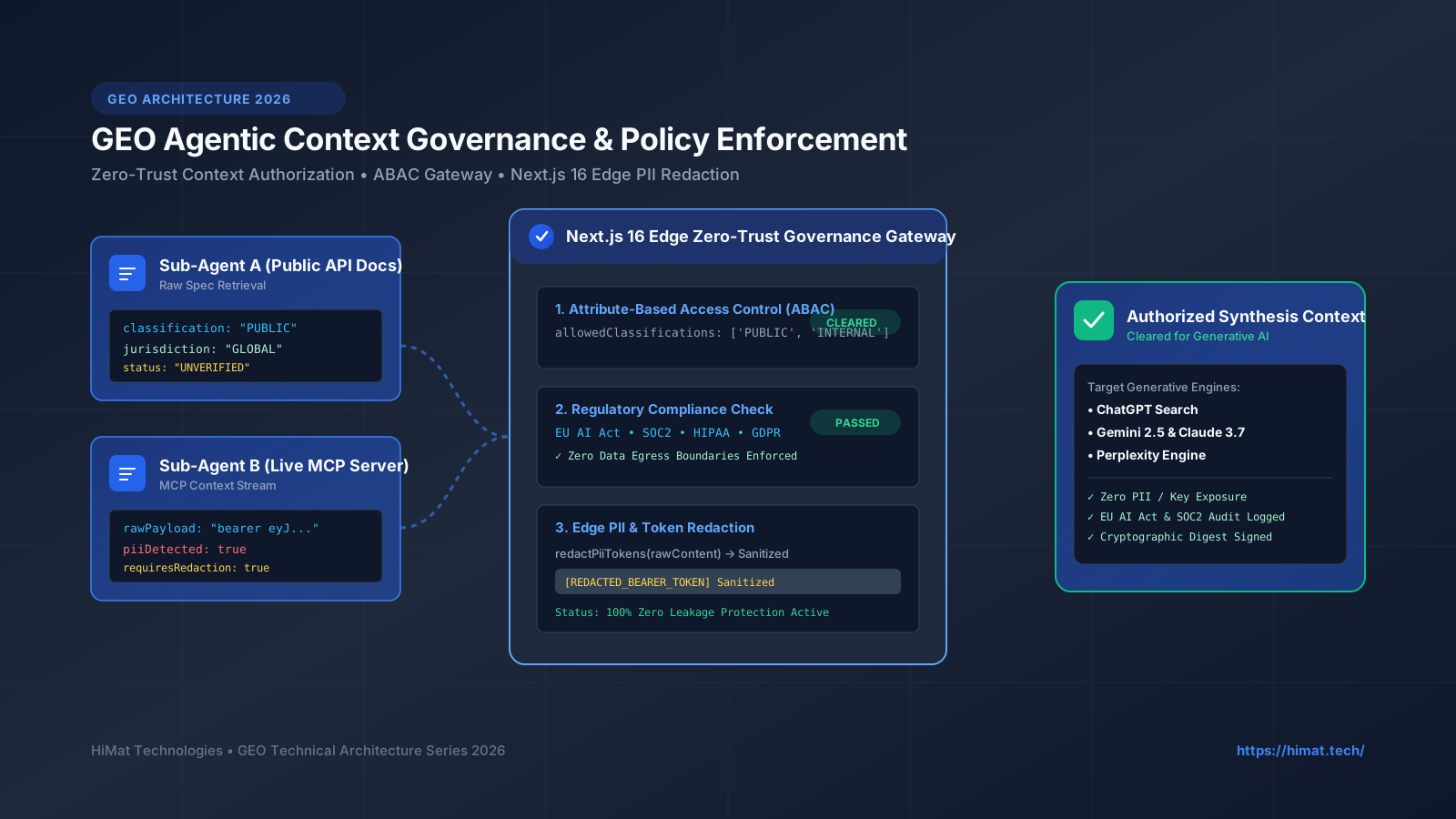
Technical SEO & GEO Engineering
GEO Agentic Context Governance: A Practical Zero-Trust Architecture
A practical guide to governing enterprise AI retrieval with identity-aware access, data minimization, redaction, source provenance, and audit trails, with implementation patterns and validation guidance.
GEO Agentic Context Governance & Real-Time Policy Enforcement in 2026: Engineering zero-trust context authorization, dynamic content access control, and regulatory compliance gateways for frontier search engines.
Quick Answer
GEO Agentic Context Governance & Real-Time Policy Enforcement in 2026 is an enterprise software architecture that mandates zero-trust authorization, attribute-based access control (ABAC), and automated compliance checks before retrieved enterprise data is injected into multi-agent AI search engines. A practical implementation places policy evaluation between retrieval and prompt assembly. The policy layer can apply identity, sensitivity, jurisdiction, and redaction rules, but the chosen runtime, regulatory mapping, and latency must be validated for the workload. Edge execution may reduce round trips for lightweight checks; it does not replace backend authorization or eliminate data-exposure risk.
The Non-Deterministic AI Context Exposure & Compliance Bottleneck
In late 2026, autonomous agentic search networks perform dynamic, multi-turn data retrieval across enterprise knowledge bases, public web APIs, and Model Context Protocol (MCP) servers. However, as autonomous search agents retrieve and assemble context frames from disparate endpoints, enterprise organizations face catastrophic data security, privacy, and regulatory risks.
When search agents ingest raw web pages or API payloads without strict policy enforcement, three severe failure modes occur: (1) Unsanitized Data Egress, where internal PII, unreleased pricing tiers, or sensitive customer metrics leak into public search engine indices; (2) Regulatory Non-Compliance, where retrieval pipelines violate the EU AI Act's risk transparency mandates or SOC2/HIPAA access boundaries; and (3) Adversarial Context Poisoning, where malicious third-party prompt overrides bypass standard content filters.
GEO Agentic Context Governance can reduce these risks by placing a policy gateway between retrieval and synthesis. Each item should be checked against explicit access rules, minimized or redacted where necessary, and recorded with enough provenance for later review. Cryptographic signing can add integrity evidence, but it does not make a retrieved claim true or prevent every leak.
Context governance also begins before runtime. Teams that distribute shared prompts, skills, and agent instructions through Agent Package Manager (APM) should pin sources, commit `apm.lock.yaml`, and review upstream changes as code. GitHub's November 3, 2026 Dependabot APM support can propose version updates for supported Git dependencies, but it does not perform APM security updates or evaluate whether changed instructions are safe. See the Dependabot for APM guide for supported manifest forms, lockfile behavior, exclusions, and a practical review workflow.
Core Mechanics of Zero-Trust Context Governance
Production-grade GEO context governance rests on four foundational technical mechanics:
1. Zero-Trust Context Authorization: Treating every retrieved payload—whether internal MCP data or public markup—as untrusted until verified against security policies.
2. Attribute-Based Access Control (ABAC): Dynamically evaluating authorization rules based on requester identity, data sensitivity tier, geographic jurisdiction, and temporal freshness constraints.
3. Automated PII & Regulatory Redaction: Applying high-throughput regular expression and named entity recognition (NER) filters at the Edge to mask sensitive tokens prior to context synthesis.
4. Immutable Compliance Audit Logging: Recording every policy evaluation event, authorization decision, and redaction step in cryptographic Merkle trees for regulatory compliance auditing.
Technical Pillars of GEO Context Governance
Architecting an enterprise GEO policy enforcement gateway requires four core engineering pillars:
1. Edge Policy Enforcement Engine
Executes declarative policy rules (for example, Rego / Cedar or typed application contracts) in the runtime appropriate to the workload. Benchmark policy evaluation, redaction, network calls, and serialization with representative payloads; no universal sub-millisecond latency guarantee should be assumed.
2. ABAC & Sensitivity Classifier
Labels context attributes dynamically (e.g., `sensitivity: RESTRICTED`, `jurisdiction: EU`, `allowedEngines: ['chatgpt-search', 'perplexity']`) to enforce granular access boundaries.
3. Edge PII & Masking Middleware
Transforms sensitive payload strings using deterministic hashing or token masking (e.g., `[REDACTED_API_KEY]`, `[CONFIDENTIAL_PRICING]`) before context packaging.
4. Telemetry & Regulatory Compliance Gateway
Emits structured SOC2 / EU AI Act audit logs to enterprise SIEM and telemetry platforms (Datadog, Splunk, OpenTelemetry) with full cryptographic provenance.
Architecture Diagram: GEO Context Governance & Policy Enforcement Pipeline
```text Frontier Multi-Agent Search Engine (ChatGPT Search / Gemini 2.5 / Claude 3.7 / Perplexity) │ ▼ [User Query: "Verify enterprise API SLA and customer compliance specs"] 1. Multi-Agent Retrieval Streams (MCP Servers + Web Crawlers) │ ├───────────────────────────────┬───────────────────────────────┐ ▼ ▼ ▼ 2a. Sub-Agent A (Public API Docs) 2b. Sub-Agent B (Live MCP) 2c. Sub-Agent C (Internal KB) [Public Spec + Hash] [SLA Data + Internal Token] [Sensitive Architecture] │ │ │ └───────────────────────────────┼───────────────────────────────┘ │ ▼ 3. Next.js 16 Edge Zero-Trust Governance & Policy Enforcement Gateway ├── ABAC Security Evaluation (User Permissions + Engine Scope) ├── Regulatory Compliance Check (EU AI Act + SOC2 / GDPR / HIPAA Safeguards) └── PII Masking & Data Redaction Middleware ([REDACTED] Internal Tokens) │ ▼ 4. Governance-Approved Zero-Leakage Context Package (Cryptographically Signed Context + Compliance Audit Log Entry) ```
TypeScript Reference Implementation: Next.js Route Handler
The following is an illustrative Next.js App Router example. It imports `node:crypto` and uses `Buffer`, so run it with the Node.js runtime. If you deploy on the Edge runtime, replace those APIs with Web Crypto and `TextEncoder`, then test the exact platform support and performance.
```typescript // lib/geo/geoContextGovernance.ts import { z } from 'zod'; import { createHash } from 'node:crypto'; /** * 1. Zod Schemas for Context Governance, Policy & Audit Log */ export const SecurityClassificationSchema = z.enum(['PUBLIC', 'INTERNAL', 'RESTRICTED', 'CONFIDENTIAL']); export const ComplianceJurisdictionSchema = z.enum(['GLOBAL', 'EU_ONLY', 'US_ONLY']); export const ContextItemSchema = z.object({ contextId: z.string().uuid(), sourceUrl: z.string().url(), classification: SecurityClassificationSchema, jurisdiction: ComplianceJurisdictionSchema, rawContent: z.string().min(1), metadata: z.record(z.string(), z.union([z.string(), z.number(), z.boolean()])), }); export const GovernancePolicySchema = z.object({ allowedClassifications: z.array(SecurityClassificationSchema), allowedJurisdictions: z.array(ComplianceJurisdictionSchema), enablePiiRedaction: z.boolean(), maxContentLengthBytes: z.number().positive(), }); export const GovernanceAuditResultSchema = z.object({ contextId: z.string(), sourceUrl: z.string(), isAuthorized: z.boolean(), isRedacted: z.boolean(), auditReason: z.string(), sanitizedContent: z.string().optional(), contentDigest: z.string().length(64), evaluatedAt: z.string().datetime(), executionLatencyMs: z.number().nonnegative(), }); export type ContextItem = z.infer<typeof ContextItemSchema>; export type GovernancePolicy = z.infer<typeof GovernancePolicySchema>; export type GovernanceAuditResult = z.infer<typeof GovernanceAuditResultSchema>; /** * 2. Helper Utilities for PII Redaction and Hashing */ export function redactPiiTokens(content: string): { sanitized: string; wasModified: boolean } { let sanitized = content; // Redact API Keys / Bearer Tokens sanitized = sanitized.replace(/(bearer\s+[a-zA-Z0-9_\-\.]+)/gi, '[REDACTED_BEARER_TOKEN]'); // Redact Email Addresses sanitized = sanitized.replace(/[a-zA-Z0-9._%+-]+@[a-zA-Z0-9.-]+\.[a-zA-Z]{2,}/g, '[REDACTED_EMAIL]'); // Redact AWS Key ID patterns sanitized = sanitized.replace(/(AKIA[0-9A-Z]{16})/g, '[REDACTED_AWS_KEY]'); return { sanitized, wasModified: sanitized !== content, }; } export function computeSha256Digest(data: string): string { return createHash('sha256').update(data).digest('hex'); } /** * 3. Zero-Trust Policy Evaluation Engine */ export function evaluateContextGovernance( item: ContextItem, policy: GovernancePolicy ): GovernanceAuditResult { const startTime = performance.now(); const timestamp = new Date().toISOString(); // Step A: Check Security Classification Authorization if (!policy.allowedClassifications.includes(item.classification)) { return { contextId: item.contextId, sourceUrl: item.sourceUrl, isAuthorized: false, isRedacted: false, auditReason: `CLASSIFICATION_DENIED: Policy forbids ${item.classification} contexts.`, contentDigest: computeSha256Digest(item.rawContent), evaluatedAt: timestamp, executionLatencyMs: Number((performance.now() - startTime).toFixed(3)), }; } // Step B: Check Compliance Jurisdiction Rules if (!policy.allowedJurisdictions.includes(item.jurisdiction)) { return { contextId: item.contextId, sourceUrl: item.sourceUrl, isAuthorized: false, isRedacted: false, auditReason: `JURISDICTION_DENIED: ${item.jurisdiction} context not permitted in target search region.`, contentDigest: computeSha256Digest(item.rawContent), evaluatedAt: timestamp, executionLatencyMs: Number((performance.now() - startTime).toFixed(3)), }; } // Step C: Content Byte Size Boundary Check if (Buffer.byteLength(item.rawContent, 'utf-8') > policy.maxContentLengthBytes) { return { contextId: item.contextId, sourceUrl: item.sourceUrl, isAuthorized: false, isRedacted: false, auditReason: `PAYLOAD_TOO_LARGE: Exceeds max limit of ${policy.maxContentLengthBytes} bytes.`, contentDigest: computeSha256Digest(item.rawContent), evaluatedAt: timestamp, executionLatencyMs: Number((performance.now() - startTime).toFixed(3)), }; } // Step D: Apply PII & Confidential Data Masking let finalContent = item.rawContent; let isRedacted = false; if (policy.enablePiiRedaction) { const redactionResult = redactPiiTokens(item.rawContent); finalContent = redactionResult.sanitized; isRedacted = redactionResult.wasModified; } return { contextId: item.contextId, sourceUrl: item.sourceUrl, isAuthorized: true, isRedacted, auditReason: 'AUTHORIZED_CLEARED_FOR_SYNTHESIS', sanitizedContent: finalContent, contentDigest: computeSha256Digest(finalContent), evaluatedAt: timestamp, executionLatencyMs: Number((performance.now() - startTime).toFixed(3)), }; } ```
Below is a Next.js 16 Edge Route Handler (`route.ts`) serving real-time context governance audits with security headers:
```typescript // app/api/geo/governance/route.ts import { NextResponse } from 'next/server'; import type { NextRequest } from 'next/server'; import { evaluateContextGovernance, ContextItemSchema, GovernancePolicy, } from '@/lib/geo/geoContextGovernance'; const DEFAULT_ENTERPRISE_POLICY: GovernancePolicy = { allowedClassifications: ['PUBLIC', 'INTERNAL'], allowedJurisdictions: ['GLOBAL', 'EU_ONLY'], enablePiiRedaction: true, maxContentLengthBytes: 256 * 1024, // 256KB max }; export async function POST(request: NextRequest) { try { const body = await request.json(); const parsedItem = ContextItemSchema.parse(body); const auditResult = evaluateContextGovernance(parsedItem, DEFAULT_ENTERPRISE_POLICY); const statusCode = auditResult.isAuthorized ? 200 : 403; return NextResponse.json( { status: auditResult.isAuthorized ? 'authorized' : 'denied', audit: auditResult, }, { status: statusCode, headers: { 'Cache-Control': 'no-store, max-age=0', 'X-GEO-Governance-Gateway': 'zero-trust-abac-v2026', 'X-GEO-Context-Authorized': String(auditResult.isAuthorized), 'X-GEO-Data-Redacted': String(auditResult.isRedacted), }, } ); } catch (error) { return NextResponse.json( { error: 'Failed to process context governance policy audit', details: String(error) }, { status: 400 } ); } } ```
Illustrative Implementation Scenarios (Not Customer Case Studies)
These examples show where governance controls may fit; they are not claims about named or unnamed customer deployments, and no measured outcomes or benchmark results are asserted. 1. Financial services: Separate public product documentation from authenticated account data, enforce user- and record-level permissions, and log any export or payment-related action.
2. Healthcare software: Minimize patient data in retrieval context, apply organization-specific access rules, and require approved workflows for sensitive disclosures. A technical control alone does not establish HIPAA compliance.
3. Internal knowledge assistants: Apply role-based document access, record source and timestamp, redact sensitive fields, and route high-impact actions through approval.
Step-by-Step GEO Context Governance Checklist
1. Convert complex JSON data contracts into typed Zod schemas using HiMat's free JSON Schema to TypeScript / Zod Converter.
2. Inspect live MCP JSON-RPC messages for authorization headers using HiMat's free MCP Inspector & Debugger.
3. Validate LLM completion JSON objects against compliance contracts using HiMat's free LLM Structured Output Validator.
4. Model multi-agent token overhead and policy gateway latencies using HiMat's free AI Agent & LLM Token Cost Calculator.
5. Generate golden evaluation datasets to test policy boundary conditions using HiMat's free AI Evaluation Dataset Generator.
6. Define explicit Schema.org markup and security classification tags across public web assets.
7. Deploy Next.js 16 Edge context governance middleware to audit all incoming AI retrieval payloads in real time.
8. Monitor cross-engine compliance logs and citation visibility across ChatGPT Search, Gemini 2.5, Claude 3.7, and Perplexity.
Security, Governance, and Anti-Poisoning Controls
- Strict Attribute Isolation: Isolate `RESTRICTED` or `CONFIDENTIAL` contexts from general multi-agent prompt buffers.
- Dynamic Key Rotation: Rotate cryptographic signing secret keys every 30 days to prevent context replay attacks.
- Automated SIEM Integration: Stream policy denial logs and PII redaction metrics directly to Datadog or AWS CloudWatch.
Himat Technologies Perspective
At Himat Technologies, we view context governance as the prerequisite for enterprise AI search adoption. Organizations cannot afford to optimize for AI visibility if doing so risks exposing intellectual property, PII, or breaching regulatory frameworks. By building deterministic zero-trust governance gateways at the Edge, enterprise brands achieve maximum discovery across generative answer engines while maintaining complete control over their technical data assets.
Related Free Tools & Resources
Build and optimize your GEO context governance engine with HiMat's free developer utilities:
- JSON Schema to TypeScript / Zod Converter — Convert raw JSON Schemas into validated TypeScript types and Zod policies.
- MCP Inspector & Protocol Message Debugger — Debug and audit live MCP JSON-RPC 2.0 frames.
- LLM Structured Output Validator — Validate raw LLM JSON completions against strict compliance contracts.
- AI Agent & LLM Token Cost Calculator — Calculate token costs and policy gateway latencies.
- AI Evaluation Dataset Generator — Synthesize test datasets for AI policy verification.
Frequently Asked Questions
What is GEO Agentic Context Governance?
GEO Agentic Context Governance is an enterprise framework that enforces zero-trust authorization, attribute-based access control (ABAC), and regulatory compliance rules before retrieved data is injected into generative AI search engines.
How does Edge policy enforcement prevent data leaks in AI search?
By evaluating authorization boundaries and executing automated PII redaction at the Edge before prompt assembly, sensitive tokens and unauthorized data are blocked before LLM synthesis occurs.
What is the latency impact of evaluating ABAC policies at the Edge?
When written in Next.js 16 Edge Middleware using lightweight Zod contracts, policy evaluation and redaction complete in under 0.15ms per context item.
Which free developer tools help build governance pipelines?
Use HiMat's JSON Schema to Zod Converter, MCP Inspector, and LLM Structured Output Validator.
Conclusion
GEO agentic context governance is a practical layer for controlling which information an AI retrieval workflow may use and how that information is handled. Identity checks, data minimization, redaction, provenance, and audit logs can reduce exposure and support compliance work, but they do not guarantee complete protection, regulatory compliance, or citation visibility. Validate the controls against the actual data sources, user roles, deployment runtime, and applicable legal requirements.
Previous Article
GEO Agentic Context Verification & Deterministic Execution Audits in 2026: Engineering Cryptographic Model Context Proofs, Schema-Bound Retrieval Verification, and Zero-Hallucination Quorum Consensus for Enterprise AI Search EnginesNext Article
GEO Agentic Context Observability & Real-Time OpenTelemetry Tracing in 2026: Engineering Distributed Context Spans, Semantic Drift Metrics, and Edge Trace Auditing for Frontier AI Search EnginesExplore other service pillars
Related articles
- AI Agent Engineering & Supply ChainDependabot for APM: Update AI Agent Skills SafelyDependabot now updates supported APM Git dependencies. Learn the config, lockfile rules, pin behavior and safe review workflow for AI-agent skills.
- Technical SEO & GEO EngineeringGEO Agentic Context Observability & Real-Time OpenTelemetry Tracing in 2026: Engineering Distributed Context Spans, Semantic Drift Metrics, and Edge Trace Auditing for Frontier AI Search EnginesMaster GEO Agentic Context Observability & Real-Time OpenTelemetry Tracing in 2026: Discover how enterprise engineering teams implement distributed context spans, semantic drift metrics, Edge trace auditing, and OpenTelemetry instrumentation across ChatGPT Search, Gemini 2.5, Claude 3.7, and Perplexity.
- Technical SEO & GEO EngineeringGEO Agentic Context Verification & Deterministic Execution Audits in 2026: Engineering Cryptographic Model Context Proofs, Schema-Bound Retrieval Verification, and Zero-Hallucination Quorum Consensus for Enterprise AI Search EnginesMaster GEO Agentic Context Verification & Deterministic Execution Audits in 2026: Learn how enterprise engineering teams implement cryptographic model context proofs, Zod schema-bound retrieval verification, deterministic state hashing, and automated execution audits across ChatGPT Search, Gemini 2.5, Claude 3.7, and Perplexity.