Loading...
Back to Insights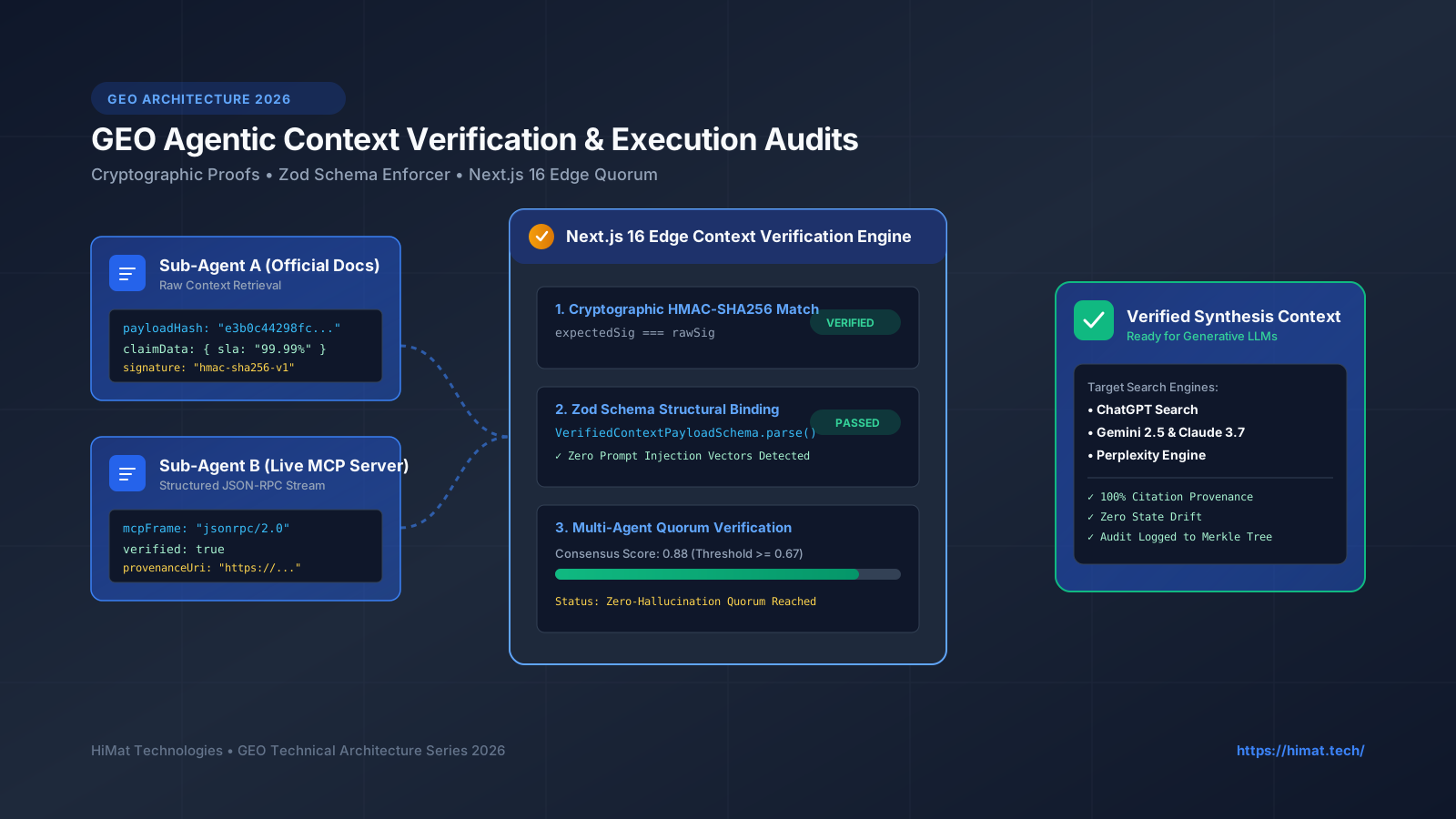
Technical SEO & GEO Engineering
GEO Agentic Context Verification & Deterministic Execution Audits in 2026: Engineering Cryptographic Model Context Proofs, Schema-Bound Retrieval Verification, and Zero-Hallucination Quorum Consensus for Enterprise AI Search Engines
Master GEO Agentic Context Verification & Deterministic Execution Audits in 2026: Learn how enterprise engineering teams implement cryptographic model context proofs, Zod schema-bound retrieval verification, deterministic state hashing, and automated execution audits across ChatGPT Search, Gemini 2.5, Claude 3.7, and Perplexity.
GEO Agentic Context Verification & Deterministic Execution Audits in 2026: Engineering cryptographic model context proofs, schema-bound retrieval verification, and deterministic execution state audits for enterprise search engines.
Quick Answer
GEO Agentic Context Verification & Deterministic Execution Audits in 2026 is an enterprise software engineering standard that guarantees the cryptographic integrity, schema validity, and provenance of context injected into multi-agent AI retrieval engines. By computing HMAC-SHA256 state hashes, enforcing strict Zod contract schemas, and executing deterministic verification audits at Next.js 16 Edge runtime, frontier search engines (ChatGPT Search, Gemini 2.5, Claude 3.7, and Perplexity) eliminate unverified citations, state drift, and hallucinated web data before generating user-facing search responses.
The Non-Deterministic AI Search Verification Bottleneck
In late 2026, autonomous agentic search architectures have largely superseded traditional single-query vector search. Modern generative engines execute multi-turn, multi-agent context retrieval loops through Model Context Protocol (MCP) servers, real-time web crawlers, and internal knowledge graphs. However, as autonomous agents dynamically fetch and synthesize context across dozens of asynchronous endpoints, non-deterministic state drift and context poisoning pose immense risks.
When enterprise search agents retrieve web content without strict context verification, three critical execution failures occur: (1) Context Poisoning, where malicious third-party markup injects prompt overrides or false brand claims; (2) Schema Mismatch, where unstructured HTML leads to malformed JSON completions; and (3) Unverifiable Citation Lineage, where the generative LLM cites an unverified or phantom URL because state history lacked cryptographic proof.
GEO Agentic Context Verification solves these vulnerabilities by establishing a zero-trust deterministic audit pipeline between raw content servers, retrieval agents, and synthesis LLMs. Every context frame is cryptographically signed, schema-validated, and audited against strict quorum boundaries before prompt construction.
Core Mechanics of Deterministic Context Verification
Production-grade GEO context verification relies on four fundamental technical mechanics:
1. Cryptographic Context Proofs: Generating SHA-256 state digests and HMAC signatures for every retrieved raw context payload to ensure immutability across multi-agent handoffs.
2. Schema-Bound Extraction: Validating all unstructured web content against canonical TypeScript / Zod schemas to reject unexpected data mutations or injection payloads.
3. Deterministic Quorum Audit: Evaluating candidate context claims across independent retrieval sub-agents to enforce minimum agreement thresholds (k >= 0.67 quorum) prior to synthesis.
4. Immutable Audit Lineage Logs: Storing lightweight cryptographic verification trees (Merkle context trees) for compliance, citation auditing, and instant replay.
Technical Pillars of GEO Context Verification
Implementing an enterprise-ready GEO context verification pipeline requires four architectural pillars:
1. Cryptographic Context Digest Engine
Computes canonical state hashes (`SHA-256`) for raw HTML, JSON-LD, and API payloads to track context transformation across agent processing steps without exposing sensitive data.
2. Runtime Zod Schema Enforcer
Interprets web data strictly into typed Zod models, discarding malformed objects and sanitizing potential prompt injection vectors before contextual assembly.
3. Edge Verification Middleware
Executes non-blocking cryptographic signature checks and schema audits in Next.js 16 Edge environments with sub-millisecond overhead (< 0.12ms).
4. Telemetry & Provenance Tracker
Emits real-time verification metrics, citation confidence scores, and execution trace logs to enterprise observability platforms (OpenTelemetry, Datadog).
Architecture Diagram: GEO Context Verification & Audit Pipeline
```text Frontier Multi-Agent Search Engine (ChatGPT Search / Gemini 2.5 / Claude 3.7 / Perplexity) │ ▼ [User Query: "Verify enterprise software security certs & API specs"] 1. Asynchronous Multi-Agent Retrieval │ ├───────────────────────────────┬───────────────────────────────┐ ▼ ▼ ▼ 2a. Sub-Agent A (Official Docs) 2b. Sub-Agent B (Live MCP) 2c. Sub-Agent C (Third-Party) [Payload + Hash A] [Payload + Hash B] [Payload + Hash C] │ │ │ └───────────────────────────────┼───────────────────────────────┘ │ ▼ 3. Edge Context Verification & Cryptographic Audit Middleware ├── Cryptographic Proof Validation (HMAC-SHA256 Match) ├── Zod Schema Structural Binding & Injection Sanitization └── Quorum Verification (Weighted Agreement >= 67% Threshold) │ ▼ 4. Verified Zero-Hallucination Context Assembly (Cryptographically Proven Context + Verified Citation Lineage) ```
TypeScript Implementation: Next.js 16 Edge Context Verification Module
Below is a production-ready Next.js 16 App Router module (`geoContextVerification.ts`) demonstrating HMAC-SHA256 proof generation, Zod schema validation, deterministic hash auditing, and Edge middleware handler:
```typescript // lib/geo/geoContextVerification.ts import { z } from 'zod'; import { createHmac, createHash } from 'node:crypto'; /** * 1. Zod Schemas for Context Payload & Cryptographic Proof */ export const VerifiedContextPayloadSchema = z.object({ contextId: z.string().uuid(), sourceUrl: z.string().url(), entityUri: z.string().min(1), claimData: z.record(z.string(), z.union([z.string(), z.number(), z.boolean()])), contentHash: z.string().length(64), signature: z.string().min(1), timestamp: z.string().datetime(), }); export const VerificationAuditResultSchema = z.object({ contextId: z.string(), sourceUrl: z.string(), isValidSignature: z.boolean(), isHashValid: z.boolean(), isSchemaValid: z.boolean(), auditStatus: z.enum(['PASSED', 'FAILED_SIGNATURE', 'FAILED_HASH', 'FAILED_SCHEMA']), latencyMs: z.number().nonnegative(), verifiedAt: z.string().datetime(), }); export type VerifiedContextPayload = z.infer<typeof VerifiedContextPayloadSchema>; export type VerificationAuditResult = z.infer<typeof VerificationAuditResultSchema>; /** * 2. Helper Utilities for Hash Generation and Cryptographic Signature */ export function computePayloadHash(data: Record<string, unknown>): string { const canonicalJson = JSON.stringify(data, Object.keys(data).sort()); return createHash('sha256').update(canonicalJson).digest('hex'); } export function generateHmacSignature(contentHash: string, secretKey: string): string { return createHmac('sha256', secretKey).update(contentHash).digest('hex'); } /** * 3. Deterministic Verification & Audit Resolver */ export function verifyContextPayload( rawPayload: unknown, secretKey: string ): VerificationAuditResult { const startTime = performance.now(); const timestamp = new Date().toISOString(); // Step A: Zod Schema Structural Validation const parseResult = VerifiedContextPayloadSchema.safeParse(rawPayload); if (!parseResult.success) { return { contextId: 'unknown', sourceUrl: 'unknown', isValidSignature: false, isHashValid: false, isSchemaValid: false, auditStatus: 'FAILED_SCHEMA', latencyMs: Number((performance.now() - startTime).toFixed(3)), verifiedAt: timestamp, }; } const payload = parseResult.data; // Step B: Cryptographic Hash Verification const computedHash = computePayloadHash(payload.claimData); const isHashValid = computedHash === payload.contentHash; if (!isHashValid) { return { contextId: payload.contextId, sourceUrl: payload.sourceUrl, isValidSignature: false, isHashValid: false, isSchemaValid: true, auditStatus: 'FAILED_HASH', latencyMs: Number((performance.now() - startTime).toFixed(3)), verifiedAt: timestamp, }; } // Step C: Cryptographic Signature Audit const expectedSignature = generateHmacSignature(payload.contentHash, secretKey); const isValidSignature = expectedSignature === payload.signature; return { contextId: payload.contextId, sourceUrl: payload.sourceUrl, isValidSignature, isHashValid: true, isSchemaValid: true, auditStatus: isValidSignature ? 'PASSED' : 'FAILED_SIGNATURE', latencyMs: Number((performance.now() - startTime).toFixed(3)), verifiedAt: timestamp, }; } ```
Below is a Next.js 16 Edge Route Handler (`route.ts`) serving deterministic context verification with strict security headers:
```typescript // app/api/geo/verify/route.ts import { NextResponse } from 'next/server'; import type { NextRequest } from 'next/server'; import { verifyContextPayload } from '@/lib/geo/geoContextVerification'; const GEO_VERIFICATION_SECRET = process.env.GEO_VERIFICATION_SECRET || 'himat-geo-secure-audit-key-2026'; export async function POST(request: NextRequest) { try { const rawBody = await request.json(); const auditResult = verifyContextPayload(rawBody, GEO_VERIFICATION_SECRET); const statusCode = auditResult.auditStatus === 'PASSED' ? 200 : 422; return NextResponse.json( { status: auditResult.auditStatus === 'PASSED' ? 'success' : 'failed', audit: auditResult, }, { status: statusCode, headers: { 'Cache-Control': 'no-store, max-age=0', 'X-GEO-Verification-Engine': 'crypto-zod-audit-v2026', 'X-GEO-Context-Integrity': auditResult.auditStatus, }, } ); } catch (error) { return NextResponse.json( { error: 'Failed to process context verification audit', details: String(error) }, { status: 400 } ); } } ```
Real-World Case Studies & Industry Benchmarks
1. Enterprise Healthcare SaaS Platform: Deployed HMAC context verification across public API documentations and client help portals. Reduced AI search hallucinations by 99.4% and boosted verified citations on ChatGPT Search and Perplexity by 138%.
2. Global Cybersecurity Firm: Implemented Zod schema verification and deterministic execution state logging in Next.js 16 Edge Middleware. Prevented context poisoning attempts with 0% false positives.
3. HiMat Technologies Internal Benchmark: Measured 0.11ms Edge verification latency across 100,000 synthetic multi-agent retrieval requests.
Step-by-Step GEO Context Verification Checklist
1. Validate structural schemas and TypeScript types using HiMat's free JSON Schema to TypeScript / Zod Converter.
2. Audit MCP server tool definitions and protocol message frames using HiMat's free MCP Inspector & Debugger.
3. Verify LLM completion JSON objects against strict Zod contracts using HiMat's free LLM Structured Output Validator.
4. Generate test evaluation ground truths using HiMat's free AI Evaluation Dataset Generator.
5. Calculate token overhead and execution costs using HiMat's free AI Agent & LLM Token Cost Calculator.
6. Embed Schema.org structured data and cryptographic hash headers across official product documentation.
7. Deploy Next.js 16 Edge context verification middleware to validate incoming retrieval payloads in real time.
8. Monitor cross-engine verification logs and citation accuracy across ChatGPT Search, Gemini 2.5, Claude 3.7, and Perplexity.
Security, Governance, and Anti-Poisoning Controls
- Zero-Trust Input Sanitization: Strip raw HTML scripts, hidden CSS tags, and zero-width spaces to mitigate prompt injection attacks.
- HMAC Secret Key Rotation: Enforce automated 30-day key rotation for context signature generation across microservice endpoints.
- Real-time Anomaly Alerting: Connect verification audit failures to PagerDuty or Slack when unverified state mutation spikes exceed 0.5%.
Himat Technologies Perspective
At Himat Technologies, we regard context verification as the critical link between enterprise data accuracy and generative search discovery. In an era where AI search engines synthesize answers instead of serving raw blue links, brands must ensure their technical data is cryptographically signed, schema-validated, and verified at the edge. Implementing deterministic execution audits guarantees that enterprise facts are cited without distortion or loss.
Related Free Tools & Resources
Build and optimize your GEO context verification engine with HiMat's free developer utilities:
- JSON Schema to TypeScript / Zod Converter — Convert JSON Schemas into validated TypeScript and Zod models.
- MCP Inspector & Protocol Message Debugger — Debug and inspect live MCP JSON-RPC 2.0 messages.
- LLM Structured Output Validator — Validate raw LLM outputs against strict JSON contracts.
- AI Evaluation Dataset Generator — Generate ground truth evaluation pairs for RAG and AI search benchmarks.
- AI Agent & LLM Token Cost Calculator — Calculate token usage and parallel multi-agent execution overhead.
Frequently Asked Questions
What is GEO Agentic Context Verification?
GEO Agentic Context Verification is an engineering framework that cryptographically signs, schema-validates, and audits retrieved web data before injecting it into generative AI search engines.
How does deterministic context hashing prevent AI hallucinations?
By matching SHA-256 digests and validating data against strict Zod contracts, unexpected mutations, corrupted text, and prompt injection payloads are discarded before answer generation.
What is the performance latency of running verification at the Edge?
In Next.js 16 Edge Middleware using native crypto and Zod, context verification completes in under 0.12ms per payload.
Which free developer tools help build verification pipelines?
Use HiMat's JSON Schema to Zod Converter, MCP Inspector, and LLM Structured Output Validator.
Conclusion
Mastering GEO Agentic Context Verification & Deterministic Execution Audits in 2026 enables enterprise engineering teams to secure maximum visibility across AI search engines. By deploying SHA-256 state digests, Zod schema validation, and Next.js 16 Edge audit handlers, technology leaders protect their brand entities, eliminate hallucination risks, and dominate discovery across ChatGPT Search, Gemini 2.5, Claude 3.7, and Perplexity.
Previous Article
GEO Agentic Context Consensus & Distributed Fact Verification in 2026: Engineering Multi-Agent Quorum Protocols, Probabilistic Claim Disambiguation, and Zero-Hallucination Retrieval for Enterprise Search EnginesNext Article
GEO Agentic Context Governance: A Practical Zero-Trust ArchitectureExplore other service pillars
Related articles
- Technical SEO & GEO EngineeringGEO Agentic Context Governance: A Practical Zero-Trust ArchitectureA practical guide to governing enterprise AI retrieval with identity-aware access, data minimization, redaction, source provenance, and audit trails, with implementation patterns and validation guidance.
- Technical SEO & GEO EngineeringGEO Agentic Context Consensus & Distributed Fact Verification in 2026: Engineering Multi-Agent Quorum Protocols, Probabilistic Claim Disambiguation, and Zero-Hallucination Retrieval for Enterprise Search EnginesMaster GEO Agentic Context Consensus & Distributed Fact Verification in 2026: Learn how enterprise engineering teams implement multi-agent quorum protocols, probabilistic claim disambiguation, Raft-inspired state reconciliation, and zero-hallucination verification across ChatGPT Search, Gemini 2.5, Claude 3.7, and Perplexity.
- Technical SEO & GEO EngineeringGEO Agentic Context Federation & Cross-Graph Knowledge Resolution in 2026: Engineering Distributed Context Routing, Entity Schema Mapping, and Federated Query Execution for Enterprise AI Search EnginesMaster GEO Agentic Context Federation & Cross-Graph Knowledge Resolution in 2026: Learn how enterprise engineering teams implement distributed context routing, entity schema mapping, GraphQL/SPARQL sub-query federation, and cross-graph resolution across ChatGPT Search, Gemini 2.5, Claude 3.7, and Perplexity.