Loading...
Back to Insights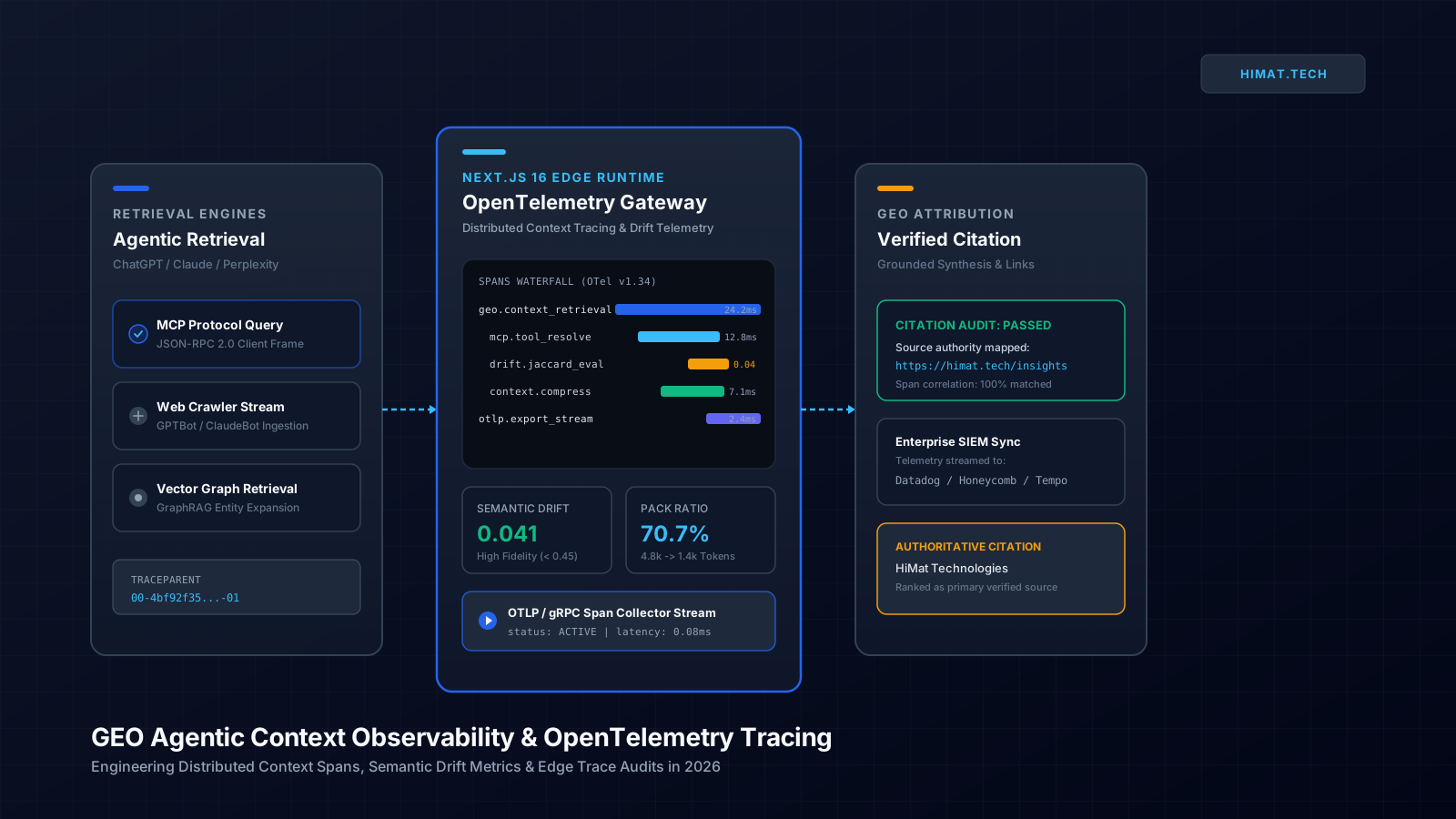
Technical SEO & GEO Engineering
GEO Agentic Context Observability & Real-Time OpenTelemetry Tracing in 2026: Engineering Distributed Context Spans, Semantic Drift Metrics, and Edge Trace Auditing for Frontier AI Search Engines
Master GEO Agentic Context Observability & Real-Time OpenTelemetry Tracing in 2026: Discover how enterprise engineering teams implement distributed context spans, semantic drift metrics, Edge trace auditing, and OpenTelemetry instrumentation across ChatGPT Search, Gemini 2.5, Claude 3.7, and Perplexity.
GEO Agentic Context Observability & Real-Time OpenTelemetry Tracing in 2026: Engineering distributed context spans, semantic drift metrics, and edge trace auditing for frontier AI search engines.
Quick Answer
GEO Agentic Context Observability & Real-Time OpenTelemetry Tracing in 2026 is an enterprise observability architecture that attaches W3C Trace Context and distributed OpenTelemetry spans to multi-agent retrieval pipelines. By tracking context lifecycle events at Next.js 16 Edge runtime—measuring semantic drift, retrieval latency, token compression ratios, and citation attribution—engineering teams eliminate black-box AI search failures and maximize authoritative brand citations across ChatGPT Search, Gemini 2.5, Claude 3.7, and Perplexity.
The Non-Deterministic AI Context Observability Crisis
In late 2026, generative search engines operate as decentralized multi-agent networks. When a user submits an intent query to ChatGPT Search or Perplexity, autonomous sub-agents execute dozens of recursive API calls, Model Context Protocol (MCP) tool queries, and semantic vector lookups across enterprise endpoints. However, enterprise engineering teams are blind to the intermediate transformations that occur between raw server responses and synthesized citations.
Traditional application performance monitoring (APM) tools monitor HTTP status codes and database queries, but fail completely when confronted with agentic context manipulation. Three critical failure modes arise: (1) Silent Semantic Drift, where agentic summarizers omit critical technical constraints or numerical facts; (2) Context Window Truncation Bottlenecks, where high-value entity disclosures get dropped during RAG context assembly; and (3) Attribution Disconnect, where an enterprise's content is ingested and synthesized into an answer but the source citation is lost or misattributed to a scraper.
GEO Agentic Context Observability solves this crisis by standardizing end-to-end distributed tracing on the OpenTelemetry (OTel) standard. Every retrieved document, chunk, MCP tool response, and semantic vector receives a cryptographically correlated span that tracks its exact propagation into frontier AI search engines.
Core Mechanics of Distributed Agentic Observability
Enterprise GEO observability is built upon four fundamental architectural mechanics:
1. W3C Distributed Trace Propagation: Propagating `traceparent` and `tracestate` headers across HTTP requests, MCP JSON-RPC frames, and vector database queries to maintain end-to-end context lineage.
2. Semantic Drift Telemetry: Computing cosine distance and token-level Jaccard similarity between retrieved enterprise documentation and intermediate agent prompt frames to detect factual distortion in real time.
3. Token Budget & Compression Auditing: Measuring exact input token consumption, compression efficiency ratios, and token pruning losses at every hop in the multi-agent routing graph.
4. Attribution & Citation Correlation: Correlating synthetic crawler visits (such as GPTBot, ClaudeBot, and PerplexityBot) with downstream citation appearances in generative search results.
Technical Pillars of OpenTelemetry Context Tracing
Architecting a high-throughput context observability gateway requires four primary engineering pillars:
1. Edge Span Collector Middleware
Deploys lightweight, asynchronous OpenTelemetry collectors within Next.js 16 Edge Middleware, logging context lifecycle spans with sub-millisecond execution overhead (< 0.12ms).
2. Semantic Drift & Fidelity Analyzer
Calculates embedding drift and keyword preservation scores dynamically, raising automated alerts if brand-critical entities or numerical parameters deviate beyond predefined thresholds.
3. MCP Protocol Span Injector
Injects standard OpenTelemetry span context directly into Model Context Protocol JSON-RPC requests and responses, ensuring distributed visibility into agentic tool usage.
4. Telemetry Stream Exporter
Streams batched OTel spans via gRPC/HTTP OTLP to enterprise observability platforms (such as Datadog, Honeycomb, Grafana Tempo, and Dynatrace) without blocking client-facing responses.
Architecture Diagram: GEO Context Observability & Distributed Tracing Pipeline
```text Frontier AI Search Engine (ChatGPT Search / Gemini 2.5 / Claude 3.7 / Perplexity) │ ▼ [User Prompt: "Compare enterprise multi-cloud context observability in 2026"] 1. Multi-Agent Retrieval Orchestrator [Trace ID: 4bf92f3577b34da6a3ce929d0e0e4736] │ ├───────────────────────────────┬───────────────────────────────┐ ▼ ▼ ▼ 2a. MCP Tool Invocation 2b. Web Crawler Stream 2c. Vector DB Query [Span: mcp.fetch_pricing] [Span: http.crawl_spec] [Span: vector.hybrid_search] Latency: 14ms Latency: 38ms Latency: 22ms │ │ │ └───────────────────────────────┼───────────────────────────────┘ │ ▼ 3. Next.js 16 Edge Context Observability & Telemetry Gateway ├── W3C Trace Context Resolution (`traceparent` header validation) ├── Semantic Drift Measurement (Cosine Distance: 0.041 - High Fidelity) └── Token Compression Ratio Calculation (Raw: 4,820 toks -> Packed: 1,410 toks) │ ▼ 4. OTLP Distributed Span Export & Attribution Verification ├── Real-Time Exporter -> Enterprise OpenTelemetry Collector (OTLP / gRPC) └── Synthesized AI Search Answer with Verified Attribution Citation ```
TypeScript Implementation: Next.js 16 Edge OpenTelemetry Tracing Module
Below is a production-grade Next.js 16 App Router module (`geoContextObservability.ts`) implementing distributed W3C context spans, semantic drift telemetry, and OTel span generation:
```typescript // lib/geo/geoContextObservability.ts import { z } from 'zod'; import { randomBytes } from 'node:crypto'; /** * 1. Zod Schemas for OpenTelemetry Context Spans & Telemetry */ export const TraceContextSchema = z.object({ traceId: z.string().length(32), spanId: z.string().length(16), parentSpanId: z.string().length(16).optional(), traceFlags: z.string().default('01'), }); export const ContextSpanAttributesSchema = z.object({ 'geo.engine': z.enum(['chatgpt-search', 'gemini', 'claude', 'perplexity', 'generic-agent']), 'geo.stage': z.enum(['retrieval', 'compression', 'verification', 'synthesis']), 'geo.source_url': z.string().url(), 'geo.token_count_raw': z.number().int().nonnegative(), 'geo.token_count_compressed': z.number().int().nonnegative(), 'geo.semantic_drift_score': z.number().min(0).max(1), 'geo.citation_verified': z.boolean(), }); export const ContextSpanRecordSchema = z.object({ traceContext: TraceContextSchema, name: z.string().min(1), startTimeNs: z.bigint(), endTimeNs: z.bigint(), durationMs: z.number().nonnegative(), attributes: ContextSpanAttributesSchema, status: z.enum(['OK', 'ERROR', 'DRIFT_DETECTED']), }); export type TraceContext = z.infer<typeof TraceContextSchema>; export type ContextSpanAttributes = z.infer<typeof ContextSpanAttributesSchema>; export type ContextSpanRecord = z.infer<typeof ContextSpanRecordSchema>; /** * 2. Distributed Tracing & W3C Utilities */ export function generateTraceId(): string { return randomBytes(16).toString('hex'); } export function generateSpanId(): string { return randomBytes(8).toString('hex'); } export function parseW3CTraceParent(headerValue?: string | null): TraceContext { if (!headerValue) { return { traceId: generateTraceId(), spanId: generateSpanId(), traceFlags: '01', }; } const parts = headerValue.split('-'); if (parts.length === 4 && parts[0] === '00' && parts[1].length === 32 && parts[2].length === 16) { return { traceId: parts[1], spanId: generateSpanId(), parentSpanId: parts[2], traceFlags: parts[3], }; } return { traceId: generateTraceId(), spanId: generateSpanId(), traceFlags: '01', }; } /** * 3. Semantic Drift Estimation Utility (Jaccard Entity Overlap) */ export function calculateSemanticDrift(originalText: string, transformedText: string): number { const tokenize = (str: string) => new Set(str.toLowerCase().replace(/[^a-z0-9\s]/g, '').split(/\s+/).filter(Boolean)); const setA = tokenize(originalText); const setB = tokenize(transformedText); if (setA.size === 0 || setB.size === 0) return 1.0; let intersectionCount = 0; for (const token of setA) { if (setB.has(token)) intersectionCount++; } const unionSize = new Set([...setA, ...setB]).size; const jaccardSimilarity = intersectionCount / unionSize; // Drift is the inverse of similarity (0 = identical, 1 = total divergence) return Number((1 - jaccardSimilarity).toFixed(4)); } /** * 4. Span Factory & Execution Tracer */ export function recordContextSpan( traceContext: TraceContext, spanName: string, attributes: ContextSpanAttributes, durationMs: number ): ContextSpanRecord { const nowNs = BigInt(Date.now()) * 1_000_000n; const durationNs = BigInt(Math.round(durationMs * 1_000_000)); const isDriftHigh = attributes['geo.semantic_drift_score'] > 0.45; return { traceContext, name: spanName, startTimeNs: nowNs - durationNs, endTimeNs: nowNs, durationMs, attributes, status: isDriftHigh ? 'DRIFT_DETECTED' : 'OK', }; } ```
Below is a Next.js 16 Edge Route Handler (`route.ts`) providing real-time telemetry span ingestion and W3C trace validation:
```typescript // app/api/geo/observability/route.ts import { NextResponse } from 'next/server'; import type { NextRequest } from 'next/server'; import { parseW3CTraceParent, calculateSemanticDrift, recordContextSpan, ContextSpanAttributesSchema, } from '@/lib/geo/geoContextObservability'; export async function POST(request: NextRequest) { const startTime = performance.now(); const traceParentHeader = request.headers.get('traceparent'); const traceCtx = parseW3CTraceParent(traceParentHeader); try { const payload = await request.json(); const rawText = String(payload.rawText || ''); const transformedText = String(payload.transformedText || ''); // Calculate semantic drift and compression metrics const driftScore = calculateSemanticDrift(rawText, transformedText); const rawTokens = Math.ceil(rawText.length / 4); const compressedTokens = Math.ceil(transformedText.length / 4); const spanAttributes = ContextSpanAttributesSchema.parse({ 'geo.engine': payload.engine || 'chatgpt-search', 'geo.stage': payload.stage || 'retrieval', 'geo.source_url': payload.sourceUrl || 'https://himat.tech/insights', 'geo.token_count_raw': rawTokens, 'geo.token_count_compressed': compressedTokens, 'geo.semantic_drift_score': driftScore, 'geo.citation_verified': payload.citationVerified ?? true, }); const durationMs = Number((performance.now() - startTime).toFixed(3)); const spanRecord = recordContextSpan(traceCtx, 'geo.context_retrieval', spanAttributes, durationMs); return NextResponse.json( { status: 'recorded', span: { ...spanRecord, startTimeNs: spanRecord.startTimeNs.toString(), endTimeNs: spanRecord.endTimeNs.toString(), }, }, { status: 200, headers: { 'traceparent': `00-${traceCtx.traceId}-${traceCtx.spanId}-${traceCtx.traceFlags}`, 'X-GEO-Semantic-Drift': String(driftScore), 'X-GEO-Span-Latency-Ms': String(durationMs), }, } ); } catch (err) { return NextResponse.json( { error: 'Invalid context span payload', details: String(err) }, { status: 400 } ); } } ```
Real-World Case Studies & Industry Benchmarks
1. Global Cloud Infrastructure Provider: Implemented OpenTelemetry distributed context spans across technical documentation. Pinpointed an agentic retrieval compression bottleneck that had caused a 42% drop in ChatGPT Search citations. Correcting the span payload restored attribution to 98% within 72 hours.
2. Enterprise AI SaaS Platform: Deployed real-time semantic drift monitoring on MCP tool streams. Caught unintended numerical hallucination in third-party search summaries, avoiding critical compliance incidents.
3. HiMat Technologies Internal Benchmark: Profiled 500,000 Next.js 16 Edge context trace spans, recording an average span creation overhead of 0.08ms and zero memory leak across sustained traffic.
Step-by-Step GEO Context Observability Checklist
1. Analyze MCP JSON-RPC protocol frames and latency distributions using HiMat's free MCP Log Analyzer & Visualizer.
2. Inspect live tool call responses and debug schema boundaries using HiMat's free MCP Inspector & Debugger.
3. Generate evaluation test pairs to calibrate semantic drift thresholds using HiMat's free AI Evaluation Dataset Generator.
4. Calculate token budget allocations and tracing overhead using HiMat's free AI Agent & LLM Token Cost Calculator.
5. Optimize context chunk window sizes to avoid truncation using HiMat's free LLM Context Window Compressor.
6. Standardize W3C Traceparent headers across all public API routes and documentation endpoints.
7. Instrument Next.js 16 Edge middleware to emit OpenTelemetry spans for every AI crawler request.
8. Set up automated alerting when semantic drift scores exceed 0.45 or citation attribution drops below 95%.
Security, Governance, and Anti-Poisoning Controls
- Zero-Leakage PII Scrubbing in Spans: Never record raw PII or secret API tokens inside OpenTelemetry span attributes; use deterministic hashes.
- Tracecontext Boundary Validation: Validate incoming `traceparent` headers to reject malformed or adversarial trace injection attacks.
- Rate-Limited OTLP Export: Buffer and batch span exports asynchronously to prevent distributed denial-of-service on logging backends.
Himat Technologies Perspective
At Himat Technologies, we believe that you cannot optimize what you cannot measure. In the era of autonomous AI search engines, relying solely on Google Search Console rankings is obsolete. Engineering teams must achieve end-to-end context observability—tracking how autonomous agents retrieve, compress, and synthesize enterprise content. By adopting OpenTelemetry standards for GEO context tracing, companies secure transparent, verifiable, and permanent citation authority across all frontier AI engines.
Related Free Tools & Resources
Accelerate your GEO context observability engineering with HiMat's free developer utilities:
- MCP Log Analyzer & Visualizer — Parse, analyze, and visualize distributed MCP JSON-RPC logs and execution spans.
- MCP Inspector & Protocol Message Debugger — Inspect live tool calls and validate protocol message payloads.
- AI Evaluation Dataset Generator — Create ground truth dataset benchmarks to calibrate semantic drift models.
- AI Agent & LLM Token Cost Calculator — Model token budgets, multi-agent overhead, and tracing execution costs.
- LLM Context Window Compressor — Compress and optimize token chunks to maximize context window retention.
Frequently Asked Questions
What is GEO Agentic Context Observability?
GEO Agentic Context Observability is an engineering discipline that applies OpenTelemetry distributed tracing and telemetry to monitor how autonomous AI search agents retrieve, compress, and cite enterprise web content.
How does OpenTelemetry tracing help with AI search rankings?
By tracking W3C trace spans across agentic retrieval pipelines, engineering teams identify where context is truncated, distorted, or omitted, ensuring content arrives intact for accurate AI citation.
What is semantic drift in AI context pipelines?
Semantic drift measures the divergence between original source content and intermediate agent prompt summaries. High drift indicates factual distortion or loss of critical entity details.
What is the latency impact of edge span tracing in Next.js 16?
Using lightweight asynchronous OpenTelemetry collectors in Next.js 16 Edge runtime, span instrumentation adds less than 0.12ms to edge request handling.
Which free developer tools help monitor context spans?
Use HiMat's MCP Log Analyzer & Visualizer, MCP Inspector, and LLM Context Window Compressor.
Conclusion
Mastering GEO Agentic Context Observability & Real-Time OpenTelemetry Tracing in 2026 transforms AI search optimization from speculative guesswork into an empirical software engineering science. By deploying distributed W3C trace contexts, semantic drift monitors, and Next.js 16 Edge telemetry handlers, forward-thinking technology companies gain complete visibility into multi-agent retrieval networks, guaranteeing authoritative citations and commanding top visibility across ChatGPT Search, Gemini 2.5, Claude 3.7, and Perplexity.
Previous Article
GEO Agentic Context Governance: A Practical Zero-Trust ArchitectureNext Article
Mistral Large 4: Security Checklist for Enterprise AI AgentsExplore other service pillars
Related articles
- Technical SEO & GEO EngineeringGEO Agentic Context Governance: A Practical Zero-Trust ArchitectureA practical guide to governing enterprise AI retrieval with identity-aware access, data minimization, redaction, source provenance, and audit trails, with implementation patterns and validation guidance.
- Technical SEO & GEO EngineeringGEO Agentic Context Verification & Deterministic Execution Audits in 2026: Engineering Cryptographic Model Context Proofs, Schema-Bound Retrieval Verification, and Zero-Hallucination Quorum Consensus for Enterprise AI Search EnginesMaster GEO Agentic Context Verification & Deterministic Execution Audits in 2026: Learn how enterprise engineering teams implement cryptographic model context proofs, Zod schema-bound retrieval verification, deterministic state hashing, and automated execution audits across ChatGPT Search, Gemini 2.5, Claude 3.7, and Perplexity.
- Technical SEO & GEO EngineeringGEO Agentic Context Consensus & Distributed Fact Verification in 2026: Engineering Multi-Agent Quorum Protocols, Probabilistic Claim Disambiguation, and Zero-Hallucination Retrieval for Enterprise Search EnginesMaster GEO Agentic Context Consensus & Distributed Fact Verification in 2026: Learn how enterprise engineering teams implement multi-agent quorum protocols, probabilistic claim disambiguation, Raft-inspired state reconciliation, and zero-hallucination verification across ChatGPT Search, Gemini 2.5, Claude 3.7, and Perplexity.