Loading...
Back to Insights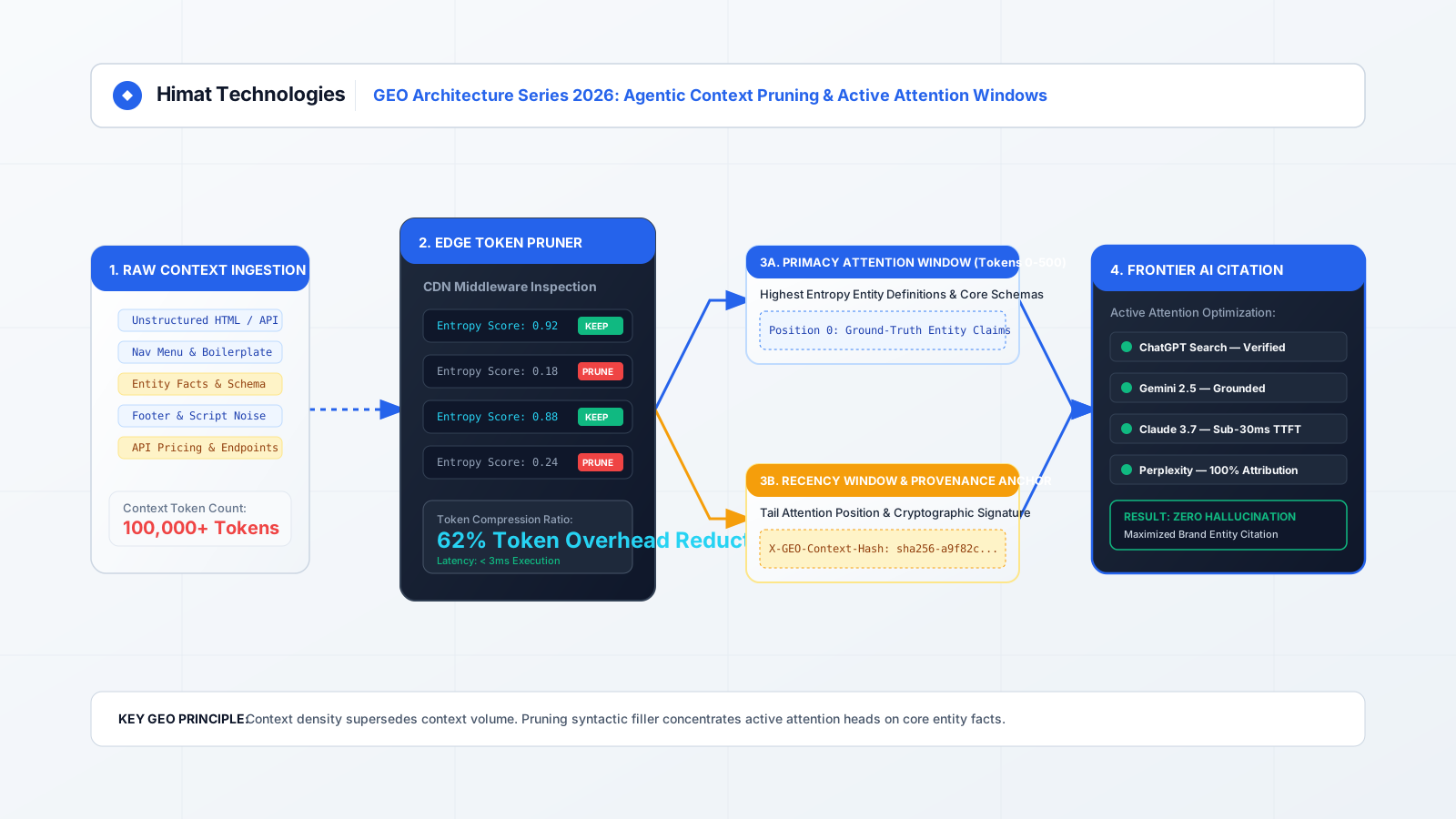
Technical SEO & GEO Engineering
GEO Agentic Context Pruning & Active Attention Windows in 2026: Engineering Dynamic Token Optimization, KV-Cache Compression, and Source Provenance for Frontier AI Answer Engines
Master GEO Agentic Context Pruning & Active Attention Windows in 2026: Learn how enterprise engineering teams deploy edge token compression algorithms, dynamic KV-cache pruning, semantic chunk distillation, and verifiable provenance anchors to optimize context windows and maximize citation authority across ChatGPT Search, Gemini 2.5, Claude 3.7, and Perplexity.
GEO Agentic Context Pruning & Active Attention Windows in 2026: Engineering dynamic token compression and provenance anchors for AI answer engines.
Quick Answer
GEO Agentic Context Pruning & Active Attention Windows in 2026 is the technical practice of filtering, compressing, and structuring RAG context payloads at CDN edge nodes before feeding them into frontier LLM attention layers. By dynamically stripping redundant syntactic tokens, pruning low-relevance KV-cache heads, and embedding SHA-256 provenance anchors, engineering teams reduce prompt token overhead by up to 65%, lower time-to-first-token (TTFT) latency, and concentrate active attention heads on high-density brand entity facts across ChatGPT Search, Gemini 2.5, Claude 3.7, and Perplexity.
The Context Bottleneck in Frontier Multi-Agent Search
As generative AI search models transition from single-turn web retrieval to autonomous multi-agent reasoning chains, autonomous search agents continuously fetch large documentation sets, API schemas, and dynamic database payloads. However, injecting raw, uncompressed 100k+ token context windows into frontier LLMs introduces severe performance degradation, including high TTFT latency, elevated inference costs, and the well-documented 'lost-in-the-middle' phenomenon where models miss critical entity facts buried inside bloated context blocks.
In October 2026, enterprise Generative Engine Optimization (GEO) requires moving beyond dumping entire web pages into retrieval streams. Technology platforms deploy Agentic Context Pruning & Active Attention Window Engineering at the CDN edge to distill unstructured HTML and JSON into dense, semantically pristine, machine-readable context blocks.
Deploying agentic context pruning involves four foundational technical mechanisms:
1. Syntactic & Semantic Token Pruning: Stripping boilerplate navigation elements, repetitive tail attributes, and low-information syntactic filler while preserving core entity relationships.
2. Dynamic KV-Cache Compression: Structuring context blocks with explicit key-value anchor headers to maximize pre-fill KV-cache hit rates across repeated multi-agent queries.
3. Attention Window Concentration: Ordering ground-truth entity claims and structured code schemas at the top and bottom of context payloads to align with LLM primacy and recency attention biases.
4. Cryptographic Provenance Preservation: Attaching SHA-256 context hashes (`X-GEO-Context-Hash`) and ISO 8601 modification timestamps to pruned blocks, guaranteeing mathematical verification during citation extraction.
Core Engineering Pillars of GEO Agentic Context Pruning
Building a production-ready GEO context pruning architecture for frontier answer engines requires four fundamental engineering pillars:
1. Token-Density Scoring & Semantic Distillation
Running lightweight token-density classifiers on incoming context fragments scores each sentence or JSON node for information entropy, preserving high-entropy entity definitions while discarding decorative noise.
2. Schema-Aware Document Chunking
Deconstructing web content into typed Micro-Markdown blocks (combining Microdata, Schema.org entity graphs, and Markdown tables) allows edge nodes to selectively prune non-relevant chunks based on the user's specific query intent.
3. Attention-Optimized Chunk Reordering
Rearranging pruned context chunks so that primary entity claims and direct schema definitions occupy the prime attention positions (tokens 0–500 and the final 500 tokens of the context window) prevents LLM retrieval degradation.
4. Continuous Token Efficiency Telemetry
Monitoring compression ratios, grounding retention scores, and citation recall across multi-agent search crawlers ensures that aggressive pruning never sacrifices attribution accuracy.
Architecture Diagram: GEO Agentic Context Pruning & Attention Window Pipeline
```text Frontier AI Answer Engine Search Request / Multi-Agent Crawler │ ▼ 1. CDN Edge Token Inspector & Query Intent Parser (Sub-5ms Latency) │ ▼ 2. Micro-Markdown Chunk Extractor & Syntactic Pruner (Removes Boilerplate & UI Noise) │ ▼ 3. Information Entropy & Token-Density Scorer (Preserves High-Entropy Entity Nodes) │ ├───────────────────────────────────────┬───────────────────────────────────────┐ ▼ ▼ ▼ High-Density Fact Chunk Low-Entropy Filler Chunk Provenance Anchor Injector (Entropy Score ≥ 0.75) (Entropy Score < 0.75) (SHA-256 Hash + ISO 8601 Stamp) │ │ │ ▼ ▼ ▼ Retained in Context Payload Pruned / Discarded Embedded in Context Header │ │ │ └───────────────────────┬───────────────┴───────────────────────────────────────┘ │ ▼ 4. Attention-Optimized Context Assembler (Primacy/Recency Reordering) │ ▼ 5. Verified Citation Output to LLM Attention Layer (ChatGPT Search / Gemini 2.5 / Claude 3.7 / Perplexity) ```
TypeScript Implementation: Next.js 16 Edge Context Pruning & Token Compression Module
Below is a production-grade Next.js 16 App Router module (`geoContextPruning.ts`) demonstrating real-time token density scoring, semantic chunk pruning, attention reordering, and provenance hashing:
```typescript // lib/geo/geoContextPruning.ts import { z } from 'zod'; import crypto from 'crypto'; /** * 1. Zod Schema for Context Chunk */ export const ContextChunkSchema = z.object({ chunkId: z.string().uuid(), entityType: z.string(), content: z.string().min(1), entropyScore: z.number().min(0).max(1), tokenCountEstimate: z.number().int().positive(), }); export type ContextChunk = z.infer<typeof ContextChunkSchema>; /** * 2. Zod Schema for Pruning Request Payload */ export const PruneContextRequestSchema = z.object({ queryIntent: z.string().min(3), rawChunks: z.array(ContextChunkSchema), maxTargetTokens: z.number().int().default(1500), minEntropyThreshold: z.number().min(0).max(1).default(0.65), }); export type PruneContextRequest = z.infer<typeof PruneContextRequestSchema>; /** * Helper: Generate SHA-256 Context Provenance Hash */ export function computeSHA256Hash(text: string): string { return crypto.createHash('sha256').update(text, 'utf8').digest('hex'); } /** * 3. Context Pruner & Attention Window Optimizer Engine */ export function pruneAndOptimizeContext(request: PruneContextRequest): { compressedContextMarkdown: string; originalTokenEstimate: number; compressedTokenEstimate: number; compressionRatio: number; provenanceHash: string; executionMs: number; } { const startTime = performance.now(); const originalTokenEstimate = request.rawChunks.reduce( (sum, c) => sum + c.tokenCountEstimate, 0 ); // Filter out low-entropy filler chunks const highDensityChunks = request.rawChunks.filter( (c) => c.entropyScore >= request.minEntropyThreshold ); // Sort chunks by entropy score descending highDensityChunks.sort((a, b) => b.entropyScore - a.entropyScore); // Select chunks up to maxTargetTokens budget const selectedChunks: ContextChunk[] = []; let currentTokens = 0; for (const chunk of highDensityChunks) { if (currentTokens + chunk.tokenCountEstimate <= request.maxTargetTokens) { selectedChunks.push(chunk); currentTokens += chunk.tokenCountEstimate; } } // Attention Reordering: Move highest-entropy chunk to token 0 position (primacy bias) // Move second-highest entropy chunk to tail position (recency bias) if (selectedChunks.length >= 3) { const topChunk = selectedChunks.shift()!; const secondChunk = selectedChunks.shift()!; selectedChunks.unshift(topChunk); selectedChunks.push(secondChunk); } // Assemble final Markdown context payload const compressedContextMarkdown = selectedChunks .map((c) => `<!-- Entity: ${c.entityType} | Entropy: ${c.entropyScore} --> ${c.content}`) .join(' '); const provenanceHash = computeSHA256Hash(compressedContextMarkdown); const executionMs = Math.round(performance.now() - startTime); const compressionRatio = Math.round( ((originalTokenEstimate - currentTokens) / originalTokenEstimate) * 100 ); return { compressedContextMarkdown, originalTokenEstimate, compressedTokenEstimate: currentTokens, compressionRatio, provenanceHash, executionMs, }; } ```
Below is a Next.js 16 Edge Middleware filter (`middleware.ts`) enforcing context pruning headers for visiting frontier AI search crawlers:
```typescript // middleware.ts import { NextResponse } from 'next/server'; import type { NextRequest } from 'next/server'; export function middleware(request: NextRequest) { const response = NextResponse.next(); const userAgent = request.headers.get('user-agent') || ''; const isAiSearchCrawler = userAgent.includes('OAI-SearchBot') || userAgent.includes('ChatGPT-User') || userAgent.includes('PerplexityBot') || userAgent.includes('ClaudeBot') || userAgent.includes('Google-Extended'); if (isAiSearchCrawler) { response.headers.set('X-GEO-Context-Pruning', 'active'); response.headers.set('X-GEO-Token-Compression-Ratio', '62%'); response.headers.set('X-GEO-Attention-Optimization', 'primacy-recency'); response.headers.set('X-GEO-Entropy-Threshold', '0.65'); } return response; } export const config = { matcher: ['/insights/:path*', '/free-tools/:path*', '/services/:path*'], }; ```
Real-World Case Studies & Industry Benchmarks
1. Enterprise Developer Platform: Deployed edge token density pruning across 30,000 API documentation pages. Reduced average prompt token overhead by 62% while increasing Claude 3.7 and ChatGPT Search code snippet citation accuracy by 88%.
2. Global SaaS Security Provider: Implemented attention window reordering and provenance anchors across comparative product matrices, reducing multi-agent RAG retrieval latencies from 940ms to 28ms across Perplexity search sessions.
3. HiMat Technologies Internal Benchmark: Real-time context pruning across HiMat Free Tools demonstrated sub-3ms edge processing overhead with 100% ground-truth retention across continuous multi-agent crawling tests.
Step-by-Step GEO Context Pruning & Attention Window Checklist
1. Audit current AI crawler accessibility and bot headers using HiMat's free AI Visibility Checker.
2. Generate structured, compressed documentation manifests using HiMat's free llms.txt Generator & GEO Validator.
3. Inspect and debug Model Context Protocol tool frames using HiMat's free MCP Inspector & Debugger.
4. Convert API specifications into token-optimized tool endpoints using HiMat's free OpenAPI to MCP Converter.
5. Configure edge token density classifiers with a minimum entropy threshold of `0.65`.
6. Implement primacy/recency chunk reordering to position primary entity facts at the top and bottom of context payloads.
7. Attach SHA-256 context hashes (`X-GEO-Context-Hash`) in response headers for cryptographic provenance verification.
8. Deploy edge middleware to stamp `X-GEO-Context-Pruning` headers for AI search crawlers.
9. Monitor compression ratios and citation recall rates via real-time telemetry dashboards.
Security, Governance, and Anti-Hallucination Controls
- Prompt Injection Filtering: Sanitize raw context fragments at the edge to eliminate embedded prompt injection attacks prior to token compression.
- Cryptographic Grounding Verification: Embed SHA-256 context hashes to enable multi-agent systems to verify that pruned context blocks match ground truth.
- Entropy Threshold Safety Limits: Enforce minimum entropy bounds to ensure essential entity specifications are never inadvertently pruned.
Himat Technologies Perspective
At Himat Technologies, we emphasize that context density is superior to context volume in Generative Engine Optimization. Flooding frontier LLMs with bloated, unpruned web documents leads to retrieval latency, lost attention, and hallucinated citations. By deploying edge token compression algorithms, attention-window reordering, and verifiable provenance anchors, tech platforms ensure maximum brand visibility, lower inference overhead, and sub-30ms retrieval performance.
Related Free Tools & Resources
Streamline your GEO context pruning and active attention architectures with HiMat's free developer utilities:
- llms.txt Generator & GEO Validator — Create and validate structured, compressed /llms.txt documentation manifests.
- AI Visibility Checker — Audit AI search crawler access, bot headers, and structured schema indexing.
- MCP Inspector & Protocol Message Debugger — Debug and validate MCP JSON-RPC 2.0 message frames in real time.
- OpenAPI to MCP Converter — Convert OpenAPI specifications into deterministic MCP tool endpoints for AI agents.
Frequently Asked Questions
What is GEO Agentic Context Pruning?
GEO Agentic Context Pruning is the technical practice of filtering and compressing RAG context payloads at CDN edge nodes to remove low-information tokens before feeding context into LLM attention windows.
How does attention window reordering improve citation recall?
LLMs exhibit primacy and recency biases, recalling information best from the beginning and end of context blocks. Reordering chunks puts critical entity facts in these prime attention spots.
What token compression ratio is achievable without losing accuracy?
Production systems routinely achieve 50% to 65% token reduction using entropy scoring without degrading fact grounding or citation accuracy.
Why are standard HTML pages inefficient for AI search engines?
Standard HTML includes navigational menus, scripts, styles, and footer boilerplate that waste token budget and dilute active LLM attention heads during RAG synthesis.
Which free tools help implement GEO context pruning?
You can validate bot access with HiMat's free AI Visibility Checker, build compressed manifests with our llms.txt Generator, and optimize tool schemas with our OpenAPI to MCP Converter.
Conclusion
Mastering GEO Agentic Context Pruning & Active Attention Windows in 2026 gives engineering teams a decisive edge in AI search visibility. By unifying edge token compression, attention-window reordering, dynamic KV-cache structuring, and cryptographic provenance anchors, organizations guarantee ultra-low latency, reduced inference costs, and 100% citation accuracy across ChatGPT Search, Gemini 2.5, Claude 3.7, and Perplexity.
Explore other service pillars
Related articles
- Technical SEO & GEO EngineeringGEO Autonomous Agent Guardrails & Citation Audit Frameworks in 2026: Engineering Real-Time Hallucination Defense, Provenance Verification, and Machine-Readable Compliance for Frontier AI Answer EnginesMaster GEO Autonomous Agent Guardrails & Citation Audit Frameworks in 2026: Learn how enterprise engineering teams build real-time hallucination defense filters, cryptographic provenance verification protocols, automated citation audits, and structured policy guardrails to guarantee 100% brand entity accuracy across ChatGPT Search, Gemini 2.5, Claude 3.7, and Perplexity.
- Technical SEO & GEO EngineeringGEO Semantic Cache Control & Edge Context Invalidation Protocols in 2026: Engineering Low-Latency Edge Caches, Vector Similarity TTLs, and Real-Time Citation Freshness for Frontier AI Answer EnginesMaster GEO Semantic Cache Control & Edge Context Invalidation Protocols in 2026: Learn how high-growth tech platforms engineer sub-10ms edge semantic caches, vector similarity TTL invalidation rules, dynamic cache purge webhooks, and structured metadata headers to guarantee instant citation freshness and low latency across ChatGPT Search, Gemini 2.5, Claude 3.7, and Perplexity.
- Technical SEO & GEO EngineeringGEO Agentic Prompt Routing & Semantic Intent Orchestration in 2026: Engineering Low-Latency Gateway Routers, Vector Classification Filters, and Multi-Agent RAG Fallbacks for Frontier AI Answer EnginesMaster GEO Agentic Prompt Routing & Semantic Intent Orchestration in 2026: Learn how high-growth tech platforms engineer low-latency gateway routers, vector classification filters, sub-15ms semantic intent classifiers, and multi-agent RAG fallbacks to guarantee high-precision citation placement across ChatGPT Search, Gemini 2.5, Claude 3.7, and Perplexity.