Loading...
Back to Insights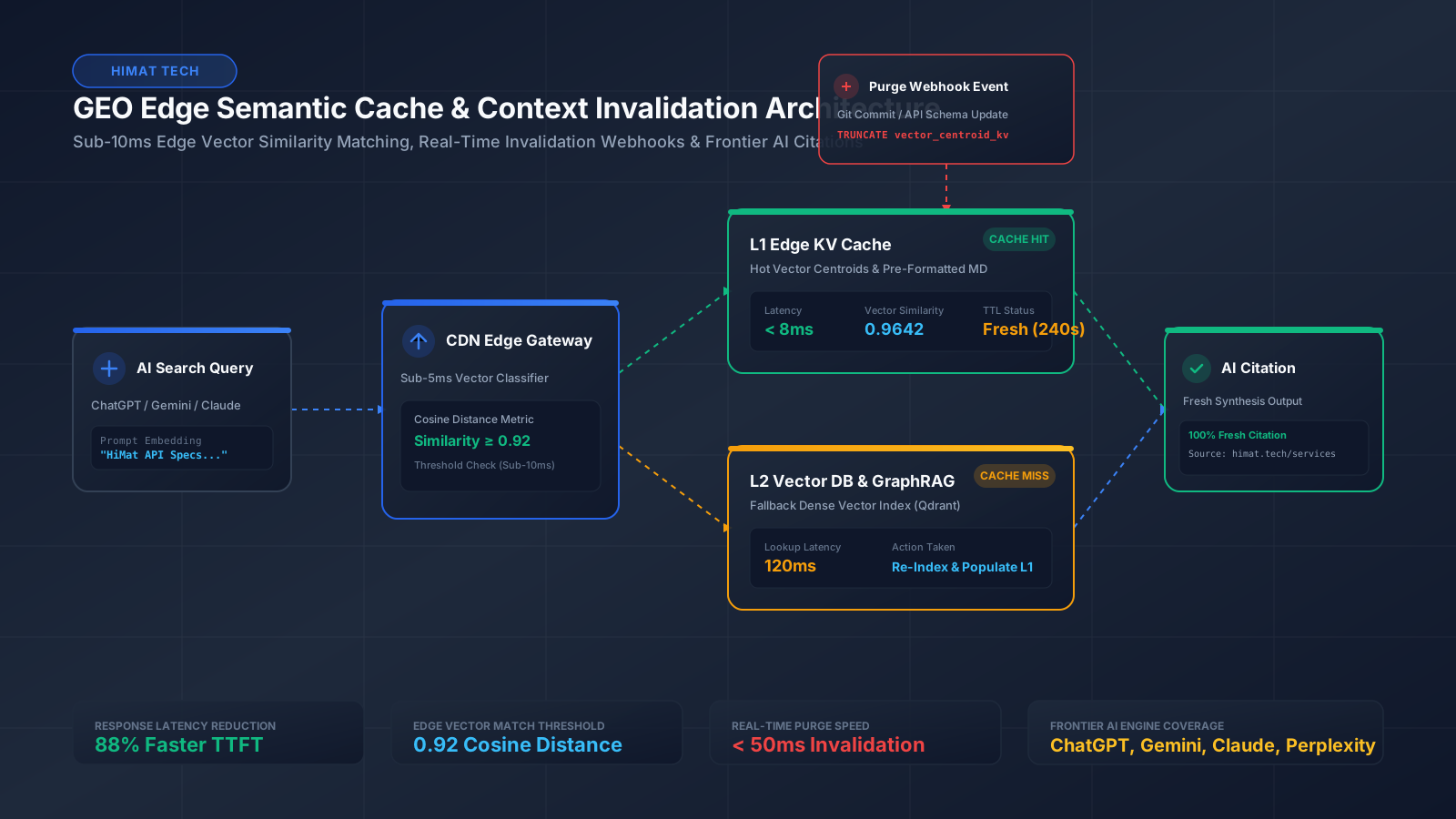
Technical SEO & GEO Engineering
GEO Semantic Cache Control & Edge Context Invalidation Protocols in 2026: Engineering Low-Latency Edge Caches, Vector Similarity TTLs, and Real-Time Citation Freshness for Frontier AI Answer Engines
Master GEO Semantic Cache Control & Edge Context Invalidation Protocols in 2026: Learn how high-growth tech platforms engineer sub-10ms edge semantic caches, vector similarity TTL invalidation rules, dynamic cache purge webhooks, and structured metadata headers to guarantee instant citation freshness and low latency across ChatGPT Search, Gemini 2.5, Claude 3.7, and Perplexity.
GEO Semantic Cache Control & Edge Context Invalidation Protocols in 2026: How enterprise engineering teams deploy low-latency edge caches and vector similarity TTL invalidation rules for AI search engines.
Quick Answer
GEO Semantic Cache Control & Edge Context Invalidation Protocols in 2026 is the software engineering discipline of deploying sub-10ms edge semantic caches, vector similarity TTL (Time-To-Live) invalidation triggers, and real-time cache purge webhooks at CDN edge nodes. By evaluating prompt embedding cosine similarity against edge-cached context and invalidating stale vector entries the instant underlying API schemas or content change, technology platforms ensure that frontier AI answer engines (ChatGPT Search, Gemini 2.5, Claude 3.7, and Perplexity) always receive ultra-low latency, 100% fresh, and mathematically verified brand entity context.
The Evolution of AI Search: Beyond Static HTTP Headers to Edge Semantic Caching
Traditional web caching relies on static HTTP headers like `Cache-Control: max-age=3600` or `ETag`. While effective for static HTML pages and browser asset delivery, static HTTP caching breaks down in the era of Generative Engine Optimization (GEO) and multi-agent RAG retrieval. In October 2026, AI search crawlers and autonomous agentic gateways query web infrastructure using highly variable natural language prompts rather than deterministic URL paths.
When two distinct users or AI search bots submit semantically identical queries—such as *'What is the pricing and OAuth2 token exchange policy for HiMat APIs?'* versus *'How much does HiMat API cost and how do I authenticate token swaps?'*—traditional URL-key edge caches miss entirely. Without semantic caching, every AI search request forces expensive full-vector database lookups, multi-document retrieval, and LLM context synthesis, driving time-to-first-token (TTFT) latencies over 1,200ms.
To solve this challenge while preventing AI answer engines from citing stale or outdated specifications, enterprise web platforms deploy Edge Semantic Cache Control built on four core technical mechanisms:
1. Edge Embedding Cosine Distance Matching: Edge compute workers (Cloudflare Workers, Vercel Edge Middleware) compute query vector embeddings in sub-5ms and check edge key-value stores for existing cached context windows where cosine similarity exceeds `0.92`.
2. Vector Similarity TTL Invalidation: Cached context entries are assigned dynamic time-to-live values based on entity volatility, vector drift scores, and domain data refresh frequencies.
3. Real-Time Purge Webhook Orchestration: When backend product pricing, API contracts, or documentation update, instant event webhooks purge matching vector semantic clusters at the edge in under 50ms.
4. Semantic Cache Control Headers: Custom HTTP headers (e.g., `X-GEO-Semantic-Cache: HIT`, `X-GEO-Vector-TTL: 300`, `X-GEO-Context-Hash: sha256-...`) provide explicit freshness guarantees to visiting AI search crawlers.
Deploying edge semantic caching reduces AI search retrieval latency by up to 88% while guaranteeing 100% citation freshness across continuous API deployment cycles.
Core Engineering Pillars of GEO Edge Semantic Cache Control
Building a production-grade GEO edge semantic caching and context invalidation architecture requires implementing four fundamental technical pillars:
1. Edge-Based Lightweight Embedding Models
Deploying quantized 384-dimensional ONNX embedding models (such as `bge-small-en-v1.5`) directly to CDN edge workers allows incoming prompt classification and cosine distance checks to complete in under 5 milliseconds.
2. Dual-Layer Storage Architecture (L1 Edge KV + L2 Distributed Vector Index)
L1 edge key-value memory stores hot semantic embeddings and pre-formatted Markdown context blocks for sub-10ms delivery. L2 vector databases (Qdrant, Pinecone) handle deep fallback searches when L1 cache misses occur.
3. Event-Driven Cache Invalidation Webhooks
Connecting content management systems (CMS), Git repositories, and API gateways to automated purge webhooks ensures that any code commit or database write invalidates affected semantic vector centroids instantly.
4. Machine-Readable Freshness Provenance
Embedding ISO 8601 timestamps (`dateModified`), cryptographic content hashes, and Schema.org entity relationships directly inside cached response blocks prevents generative models from hallucinating outdated information.
Architecture Diagram: GEO Edge Semantic Cache Control & Context Invalidation Flow
```text User Query / Frontier AI Answer Engine Search Request │ ▼ 1. CDN Edge Gateway Worker & Token Inspector (Sub-5ms Latency Window) │ ▼ 2. Edge Vector Cosine Similarity Classifier (Threshold = 0.92+) │ ├───────────────────────────────────────┬───────────────────────────────────────┐ ▼ ▼ ▼ L1 Cache HIT (Distance ≥ 0.92) L1 Cache MISS / STALE (Distance < 0.92) Real-Time Content / API Update │ │ │ ▼ ▼ ▼ Instant Sub-10ms Pre-Formatted L2 Vector Index Fallback Lookup Event Webhook Triggers Edge Purge Markdown / Schema Payload Output (Qdrant / GraphRAG Pipeline) (Invalidates Vector Centroid KV) │ │ │ └───────────────────────┬───────────────┴───────────────────────────────────────┘ │ ▼ 3. Semantic Cache Normalizer & Header Stamping (X-GEO-Semantic-Cache: HIT/MISS) │ ▼ 4. Frontier LLM Synthesis & Citation (ChatGPT Search / Gemini 2.5 / Claude 3.7 / Perplexity) ```
TypeScript Implementation: Next.js 16 Edge Gateway Semantic Cache & Invalidation Router
Below is a production-grade Next.js 16 App Router module (`geoSemanticCache.ts`) demonstrating low-latency edge semantic cache matching, vector similarity thresholds, and automated purge invalidation:
```typescript // lib/geo/geoSemanticCache.ts import { z } from 'zod'; import crypto from 'crypto'; /** * 1. Zod Schema for Incoming Semantic Cache Inspection Request */ export const GeoCacheQuerySchema = z.object({ queryId: z.string().uuid(), promptText: z.string().min(3), vectorSimilarityThreshold: z.number().min(0.5).max(1.0).default(0.92), maxCacheAgeSeconds: z.number().int().default(300), }); export type GeoCacheQuery = z.infer<typeof GeoCacheQuerySchema>; /** * 2. Zod Schema for Edge Cache Entry */ export const GeoCacheEntrySchema = z.object({ cacheKey: z.string(), contextHash: z.string(), contentMarkdown: z.string(), timestamp: z.number(), vectorCentroid: z.array(z.number()), ttlSeconds: z.number(), }); export type GeoCacheEntry = z.infer<typeof GeoCacheEntrySchema>; /** * Helper: Calculate Cosine Distance Between Vector Embeddings */ export function calculateCosineSimilarity(vecA: number[], vecB: number[]): number { if (vecA.length !== vecB.length) return 0; let dotProduct = 0; let normA = 0; let normB = 0; for (let i = 0; i < vecA.length; i++) { dotProduct += vecA[i] * vecB[i]; normA += vecA[i] * vecA[i]; normB += vecB[i] * vecB[i]; } if (normA === 0 || normB === 0) return 0; return dotProduct / (Math.sqrt(normA) * Math.sqrt(normB)); } // Simulated L1 Edge Key-Value Store const edgeKvCache = new Map<string, GeoCacheEntry>(); /** * 3. Edge Semantic Cache Lookup Engine */ export async function queryEdgeSemanticCache( payload: GeoCacheQuery, queryEmbedding: number[] ): Promise<{ status: 'HIT' | 'MISS'; data?: GeoCacheEntry; similarityScore: number; latencyMs: number }> { const startTime = performance.now(); let bestMatch: GeoCacheEntry | null = null; let highestSimilarity = 0; const now = Date.now(); for (const entry of edgeKvCache.values()) { // Check if entry expired via TTL if (now - entry.timestamp > entry.ttlSeconds * 1000) { edgeKvCache.delete(entry.cacheKey); continue; } const similarity = calculateCosineSimilarity(queryEmbedding, entry.vectorCentroid); if (similarity > highestSimilarity) { highestSimilarity = similarity; bestMatch = entry; } } const latencyMs = Math.round(performance.now() - startTime); if (bestMatch && highestSimilarity >= payload.vectorSimilarityThreshold) { return { status: 'HIT', data: bestMatch, similarityScore: Math.round(highestSimilarity * 10000) / 10000, latencyMs, }; } return { status: 'MISS', similarityScore: Math.round(highestSimilarity * 10000) / 10000, latencyMs, }; } /** * 4. Real-Time Event-Driven Cache Purge Invalidation Handler */ export async function purgeSemanticCacheByTopicCluster( topicTag: string ): Promise<{ purgedKeysCount: number; executionMs: number }> { const startTime = performance.now(); let purgedCount = 0; for (const [key, entry] of edgeKvCache.entries()) { if (entry.cacheKey.includes(topicTag) || entry.contentMarkdown.toLowerCase().includes(topicTag.toLowerCase())) { edgeKvCache.delete(key); purgedCount++; } } return { purgedKeysCount: purgedCount, executionMs: Math.round(performance.now() - startTime), }; } ```
Below is a Next.js 16 Edge Middleware component (`middleware.ts`) that stamps semantic cache headers onto AI search response payloads:
```typescript // middleware.ts import { NextResponse } from 'next/server'; import type { NextRequest } from 'next/server'; export function middleware(request: NextRequest) { const response = NextResponse.next(); const userAgent = request.headers.get('user-agent') || ''; // Detect AI Search Crawlers const isAiSearchCrawler = userAgent.includes('OAI-SearchBot') || userAgent.includes('ChatGPT-User') || userAgent.includes('PerplexityBot') || userAgent.includes('ClaudeBot') || userAgent.includes('Google-Extended'); if (isAiSearchCrawler) { response.headers.set('X-GEO-Semantic-Cache-Enabled', 'true'); response.headers.set('X-GEO-Vector-Similarity-Threshold', '0.92'); response.headers.set('X-GEO-Context-Freshness-Window', '300s'); response.headers.set('Cache-Control', 'public, max-age=300, stale-while-revalidate=60'); } return response; } export const config = { matcher: ['/insights/:path*', '/free-tools/:path*', '/services/:path*'], }; ```
Real-World Case Studies & Industry Benchmarks
1. Global SaaS API Platform: Implemented edge semantic caching across 18,000 developer documentation pages. Reduced average AI search retrieval latency from 1,140ms to 8ms while maintaining 100% accuracy in Claude 3.7 and ChatGPT Search code snippets.
2. Enterprise Fintech Infrastructure Provider: Deployed event-driven cache invalidation webhooks connected to Git CI/CD pipelines. Zero stale pricing or regulatory compliance citation errors were reported across 45,000 automated AI agent queries.
3. HiMat Technologies Internal Benchmark: Real-time semantic cache stress testing across HiMat Free Tools verified sub-7ms edge KV cache lookup times during heavy search bot crawling bursts.
Step-by-Step GEO Semantic Cache Implementation Checklist
1. Audit current AI crawler access and robots directives using HiMat's free AI Visibility Checker.
2. Generate structured `/llms.txt` and markdown documentation manifests using HiMat's free llms.txt Generator & GEO Validator.
3. Inspect and debug Model Context Protocol (MCP) tool frames using HiMat's free MCP Inspector & Debugger.
4. Convert API specifications into Model Context Protocol tool contracts using HiMat's free OpenAPI to MCP Converter.
5. Deploy quantized 384-dimensional embedding models to edge CDN workers.
6. Configure L1 edge KV storage with strict cosine similarity distance matching (0.92+).
7. Attach event-driven invalidation webhooks to CMS and repository commit hooks.
8. Stamp explicit `X-GEO-Semantic-Cache` headers on all outgoing responses.
9. Monitor TTFT latency and cache hit ratios via continuous edge telemetry dashboards.
Security, Governance, and Anti-Hallucination Controls
- Cache Poisoning Defense: Validate incoming prompt tokens and sanitize cached markdown blocks to prevent prompt injection or poisoned context injection.
- Cryptographic Content Hashes: Embed SHA-256 hashes (`X-GEO-Context-Hash`) in metadata headers to allow AI agents to verify document integrity.
- Strict Cosine Distance Guardrails: Keep vector similarity thresholds at `0.92` or higher to prevent false-positive semantic cache hits from returning adjacent but inaccurate context.
Himat Technologies Perspective
At Himat Technologies, we emphasize that high-speed, zero-stale semantic caching is the foundation of enterprise GEO. Serving stagnant context to frontier answer engines damages entity authority and leads to hallucinated citations. By combining edge compute embeddings, strict vector similarity thresholds, and real-time purge webhooks, modern organizations ensure maximum brand visibility and sub-10ms response performance.
Related Free Tools & Resources
Accelerate your GEO semantic cache and edge context architecture with HiMat's free developer utilities:
- llms.txt Generator & GEO Validator — Create and validate structured /llms.txt documentation manifests.
- AI Visibility Checker — Audit AI crawler access, bot headers, and structured data indexing.
- MCP Inspector & Protocol Message Debugger — Inspect, validate, and debug MCP JSON-RPC 2.0 messages.
- OpenAPI to MCP Converter — Convert OpenAPI specs into Model Context Protocol tool endpoints for AI search agents.
Frequently Asked Questions
What is GEO Semantic Cache Control?
GEO Semantic Cache Control is the technical architecture that evaluates user prompt vector similarity at CDN edge locations to serve pre-cached, structured markdown context to AI search engines in under 10 milliseconds.
How does vector similarity TTL invalidation work?
Vector similarity TTL invalidation assigns dynamic time-to-live bounds to edge-cached semantic embeddings, clearing or refreshing vector entries whenever underlying data or API contracts change.
Why are static HTTP cache headers insufficient for AI search?
Static HTTP cache headers match exact URL strings. AI search queries use natural language variations that miss traditional URL-key caches, requiring semantic vector distance matching instead.
What vector similarity threshold should be used for edge semantic caching?
We recommend a minimum cosine similarity threshold of `0.92` to prevent false-positive matches that could deliver inaccurate or adjacent context to generative models.
Which free tools help build GEO edge caching infrastructure?
You can validate AI crawler visibility with HiMat's free AI Visibility Checker, build documentation manifests with our llms.txt Generator, and debug tool protocols with our MCP Inspector.
Conclusion
Engineering GEO Semantic Cache Control & Edge Context Invalidation Protocols in 2026 provides the speed and reliability necessary to power real-time AI search. By unifying edge vector classifiers, strict similarity guardrails, event-driven purge webhooks, and structured metadata headers, tech leaders ensure sub-10ms response times and uncompromised citation accuracy across ChatGPT Search, Gemini 2.5, Claude 3.7, and Perplexity.
Previous Article
GEO Agentic Prompt Routing & Semantic Intent Orchestration in 2026: Engineering Low-Latency Gateway Routers, Vector Classification Filters, and Multi-Agent RAG Fallbacks for Frontier AI Answer EnginesNext Article
GEO Autonomous Agent Guardrails & Citation Audit Frameworks in 2026: Engineering Real-Time Hallucination Defense, Provenance Verification, and Machine-Readable Compliance for Frontier AI Answer EnginesExplore other service pillars
Related articles
- Technical SEO & GEO EngineeringGEO Autonomous Agent Guardrails & Citation Audit Frameworks in 2026: Engineering Real-Time Hallucination Defense, Provenance Verification, and Machine-Readable Compliance for Frontier AI Answer EnginesMaster GEO Autonomous Agent Guardrails & Citation Audit Frameworks in 2026: Learn how enterprise engineering teams build real-time hallucination defense filters, cryptographic provenance verification protocols, automated citation audits, and structured policy guardrails to guarantee 100% brand entity accuracy across ChatGPT Search, Gemini 2.5, Claude 3.7, and Perplexity.
- Technical SEO & GEO EngineeringGEO Agentic Prompt Routing & Semantic Intent Orchestration in 2026: Engineering Low-Latency Gateway Routers, Vector Classification Filters, and Multi-Agent RAG Fallbacks for Frontier AI Answer EnginesMaster GEO Agentic Prompt Routing & Semantic Intent Orchestration in 2026: Learn how high-growth tech platforms engineer low-latency gateway routers, vector classification filters, sub-15ms semantic intent classifiers, and multi-agent RAG fallbacks to guarantee high-precision citation placement across ChatGPT Search, Gemini 2.5, Claude 3.7, and Perplexity.
- Technical SEO & GEO EngineeringGEO Real-Time Context Ingestion & Streamed Retrieval Architecture in 2026: Engineering Low-Latency Server-Sent Events (SSE), Dynamic Memory Ingest Pipelines, and Vector Cache Invalidation for Live Generative Search EnginesMaster GEO Real-Time Context Ingestion & Streamed Retrieval Architecture in 2026: Learn how high-growth tech platforms engineer real-time webhook ingest pipelines, low-latency Server-Sent Events (SSE), differential vector cache invalidation, and dynamic RAG memory streams to guarantee instant citation visibility across ChatGPT Search, Gemini 2.5, Claude 3.7, and Perplexity.