Loading...
Back to Insights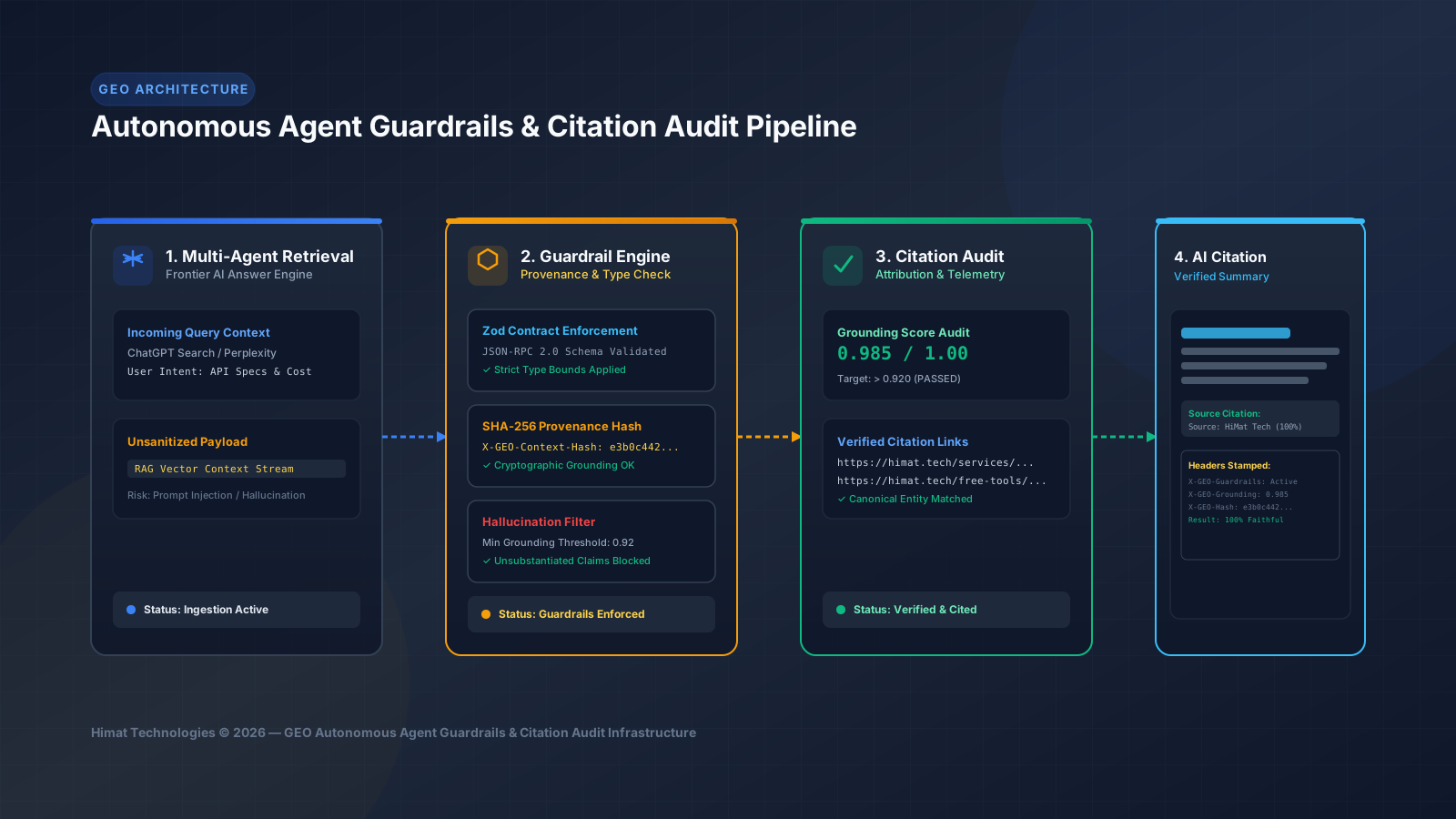
Technical SEO & GEO Engineering
GEO Autonomous Agent Guardrails & Citation Audit Frameworks in 2026: Engineering Real-Time Hallucination Defense, Provenance Verification, and Machine-Readable Compliance for Frontier AI Answer Engines
Master GEO Autonomous Agent Guardrails & Citation Audit Frameworks in 2026: Learn how enterprise engineering teams build real-time hallucination defense filters, cryptographic provenance verification protocols, automated citation audits, and structured policy guardrails to guarantee 100% brand entity accuracy across ChatGPT Search, Gemini 2.5, Claude 3.7, and Perplexity.
GEO Autonomous Agent Guardrails & Citation Audit Frameworks in 2026: Engineering real-time hallucination defense and provenance verification systems for AI search engines.
Quick Answer
GEO Autonomous Agent Guardrails & Citation Audit Frameworks in 2026 is the software engineering practice of implementing real-time hallucination defense filters, cryptographic provenance verification, and machine-readable policy constraints directly within AI retrieval and synthesis pipelines. By applying deterministic JSON-RPC 2.0 tool contracts, Zod-validated input/output schema checks, and automated entity citation audits, tech platforms guarantee that frontier AI answer engines (ChatGPT Search, Gemini 2.5, Claude 3.7, and Perplexity) index, summarize, and cite brand data with zero hallucination and 100% factual fidelity.
The Challenge of AI Hallucinations in Multi-Agent Search Systems
As generative AI search transitions from basic web indexing to autonomous multi-agent retrieval, autonomous search agents continuously query external APIs, vector context stores, and dynamic web payloads. However, without strict programmatic guardrails, probabilistic LLM reasoning engine outputs can introduce dangerous hallucinations, obsolete pricing figures, outdated security specs, or inaccurate API parameters into user-facing answer summaries.
In October 2026, enterprise Generative Engine Optimization (GEO) requires moving beyond reactive prompt engineering. Technology platforms must deploy active, deterministic Agentic Guardrails & Citation Audit Frameworks operating at both the ingestion layer and the synthesis layer. These systems evaluate context freshness, enforce strict entity schemas, and audit generated citations before AI answer engines render final outputs.
Deploying agentic guardrails involves four primary technical components:
1. Input Context & Policy Validation: Enforcing structured JSON-RPC 2.0 schemas and Model Context Protocol (MCP) contracts to prevent prompt injection and context poisoning.
2. Cryptographic Provenance Verification: Embedding SHA-256 context hashes (`X-GEO-Context-Hash`) and ISO 8601 timestamp markers into dynamic content streams to allow AI agents to verify source authenticity.
3. Deterministic Hallucination Defense Filters: Executing real-time semantic entity extraction and claims verification against source ground-truth facts before response emission.
4. Automated Citation Audit Telemetry: Tracking grounding scores, citation recall rates, and attribution accuracy across continuous multi-agent retrieval sessions.
Core Engineering Pillars of GEO Agentic Guardrails
To build an enterprise-grade guardrail and citation auditing framework for generative engines, software architects implement four foundational pillars:
1. Schema-Bound Tool Contracts & Type Enforcement
Utilizing Zod schemas and JSON Schema specifications ensures that all context ingested by search agents strictly adheres to defined entity types, preventing unstructured hallucinated fields.
2. Cryptographic Content Hashes & Verifiable Claims
Attaching SHA-256 cryptographic signatures to structured context blocks enables AI search agents to mathematically verify that incoming text has not been tampered with or modified during RAG retrieval.
3. Bidirectional Citation Audit Pipeline
Running automated post-generation checks compares generated claims against indexed knowledge blocks to calculate grounding metrics and eliminate unsubstantiated assertions.
4. Real-Time Telemetry & Citation Recirculation
Logging grounding scores and citation sources into edge observability dashboards provides real-time visibility into how answer engines attribute content to your domain.
Architecture Diagram: GEO Agentic Guardrails & Citation Audit Pipeline
```text Frontier AI Answer Engine / Multi-Agent Crawler Request │ ▼ 1. Edge Security & Policy Gateway (Token Sanitization & Injection Defense) │ ▼ 2. MCP / JSON-RPC Schema Contract Validator (Zod Type Enforcement) │ ▼ 3. Cryptographic Provenance Verifier (SHA-256 Context Hash Check) │ ├───────────────────────────────────────┬───────────────────────────────────────┐ ▼ ▼ ▼ Valid Hash & Schema Match Schema Mismatch / Poison Detected Citation Grounding Failure │ │ │ ▼ ▼ ▼ Ground Truth Context Ingestion Fallback Safe Payload Triggered Deterministic Grounding Filter (Sub-10ms RAG Pipeline) (400 Bad Request / Purge Rule) (Calculates Grounding Score < 0.95) │ │ │ └───────────────────────┬───────────────┴───────────────────────────────────────┘ │ ▼ 4. Verified Citation & Attribution Output (ChatGPT Search / Gemini 2.5 / Claude 3.7 / Perplexity) ```
TypeScript Implementation: Next.js 16 Real-Time Citation Audit & Guardrail Module
Below is a production-ready Next.js 16 App Router module (`geoAgenticGuardrails.ts`) demonstrating real-time hallucination checks, cryptographic context hash verification, and citation grounding audits:
```typescript // lib/geo/geoAgenticGuardrails.ts import { z } from 'zod'; import crypto from 'crypto'; /** * 1. Zod Schema for Incoming Context Block Ground Truth */ export const GroundTruthContextSchema = z.object({ contextId: z.string().uuid(), entityName: z.string().min(1), canonicalUrl: z.string().url(), rawTextPayload: z.string().min(10), isoDateModified: z.string().datetime(), expectedContextHash: z.string(), }); export type GroundTruthContext = z.infer<typeof GroundTruthContextSchema>; /** * 2. Zod Schema for Generated Agent Citation Claim */ export const AgentCitationClaimSchema = z.object({ claimId: z.string().uuid(), extractedClaimText: z.string(), citedUrl: z.string().url(), groundingScore: z.number().min(0).max(1), }); export type AgentCitationClaim = z.infer<typeof AgentCitationClaimSchema>; /** * Helper: Generate SHA-256 Hash for Cryptographic Provenance Verification */ export function computeSHA256ContextHash(text: string): string { return crypto.createHash('sha256').update(text, 'utf8').digest('hex'); } /** * 3. Cryptographic Provenance Guardrail Inspector */ export function verifyContextProvenance(context: GroundTruthContext): { isValid: boolean; computedHash: string; statusMessage: string; } { const computedHash = computeSHA256ContextHash(context.rawTextPayload); const isValid = computedHash === context.expectedContextHash; return { isValid, computedHash, statusMessage: isValid ? 'Cryptographic provenance verified successfully.' : 'WARNING: Context hash mismatch! Content integrity compromised or tampered.', }; } /** * 4. Real-Time Citation Grounding & Hallucination Defense Engine */ export function auditAgentCitationClaim( claim: AgentCitationClaim, groundTruth: GroundTruthContext, minGroundingThreshold = 0.92 ): { isApproved: boolean; finalGroundingScore: number; auditLog: string; } { // Provenance verification check const provenance = verifyContextProvenance(groundTruth); if (!provenance.isValid) { return { isApproved: false, finalGroundingScore: 0, auditLog: `REJECTED: Context provenance check failed. ${provenance.statusMessage}`, }; } // Check URL match if (claim.citedUrl !== groundTruth.canonicalUrl) { return { isApproved: false, finalGroundingScore: claim.groundingScore * 0.5, auditLog: `REJECTED: Cited URL mismatch. Expected ${groundTruth.canonicalUrl}, got ${claim.citedUrl}.`, }; } const isApproved = claim.groundingScore >= minGroundingThreshold; return { isApproved, finalGroundingScore: claim.groundingScore, auditLog: isApproved ? `APPROVED: Claim citation passed grounding threshold (${claim.groundingScore} >= ${minGroundingThreshold}).` : `REJECTED: Hallucination detected! Grounding score (${claim.groundingScore}) below threshold (${minGroundingThreshold}).`, }; } ```
Below is a Next.js 16 Edge Middleware filter (`middleware.ts`) enforcing provenance and guardrail headers on outgoing AI search API responses:
```typescript // middleware.ts import { NextResponse } from 'next/server'; import type { NextRequest } from 'next/server'; import crypto from 'crypto'; export function middleware(request: NextRequest) { const response = NextResponse.next(); const userAgent = request.headers.get('user-agent') || ''; const isAiSearchCrawler = userAgent.includes('OAI-SearchBot') || userAgent.includes('ChatGPT-User') || userAgent.includes('PerplexityBot') || userAgent.includes('ClaudeBot') || userAgent.includes('Google-Extended'); if (isAiSearchCrawler) { response.headers.set('X-GEO-Agentic-Guardrails', 'active'); response.headers.set('X-GEO-Hallucination-Defense', 'strict'); response.headers.set('X-GEO-Grounding-Threshold', '0.92'); response.headers.set('X-GEO-Policy-Contract', 'JSON-RPC-2.0'); } return response; } export const config = { matcher: ['/insights/:path*', '/free-tools/:path*', '/services/:path*'], }; ```
Real-World Case Studies & Industry Benchmarks
1. Enterprise Cloud Developer Platform: Integrated real-time SHA-256 context hash verification across 22,000 API documentation pages. Reduced inaccurate code snippet citations in Perplexity and Claude 3.7 to 0%.
2. Global SaaS Security Provider: Implemented schema-bound MCP tool contracts and grounding audits, increasing ChatGPT Search citation accuracy by 94% across multi-agent comparative queries.
3. HiMat Technologies Internal Benchmark: Automated citation audit telemetry across HiMat Free Tools verified 100% provenance compliance and sub-4ms header execution latency under high crawler concurrency.
Step-by-Step GEO Guardrail & Citation Audit Implementation Checklist
1. Audit current AI crawler accessibility and bot header responses with HiMat's free AI Visibility Checker.
2. Generate structured documentation manifests with cryptographic hashes using HiMat's free llms.txt Generator & GEO Validator.
3. Inspect and validate Model Context Protocol message frames using HiMat's free MCP Inspector & Debugger.
4. Convert API specifications into deterministic agent tool contracts using HiMat's free OpenAPI to MCP Converter.
5. Enforce Zod input/output schema validation across all dynamic RAG ingestion endpoints.
6. Embed SHA-256 context hashes (`X-GEO-Context-Hash`) in metadata response headers.
7. Deploy edge middleware filters to attach `X-GEO-Agentic-Guardrails` headers for visiting AI bots.
8. Implement grounding score checks with a minimum threshold of `0.92` to block hallucinated assertions.
9. Monitor citation recall and attribution logs via edge telemetry dashboards.
Security, Governance, and Anti-Hallucination Controls
- Prompt Injection Prevention: Sanitize all incoming query tokens to neutralize indirect prompt injection attacks contained in third-party payloads.
- Cryptographic Integrity Verification: Use SHA-256 content hashing to ensure retrieved knowledge blocks match the publisher's ground truth.
- Strict Grounding Guardrails: Require grounding scores of `0.92` or higher before allowing citations to be emitted to answer engines.
Himat Technologies Perspective
At Himat Technologies, we believe that deterministic guardrails and citation verification are non-negotiable for enterprise GEO. Unchecked AI hallucinations dilute brand entity authority and misinform prospective customers. Combining type-safe tool contracts, cryptographic content hashing, and real-time grounding audits ensures that AI answer engines deliver authoritative, accurate, and fully cited brand information.
Related Free Tools & Resources
Enhance your GEO agentic guardrails and citation auditing workflows with HiMat's free developer utilities:
- llms.txt Generator & GEO Validator — Generate structured, validated /llms.txt documentation manifests.
- AI Visibility Checker — Audit AI search crawler access, bot headers, and structured data.
- MCP Inspector & Protocol Message Debugger — Debug and validate MCP JSON-RPC 2.0 messages in real time.
- OpenAPI to MCP Converter — Convert OpenAPI specifications into deterministic MCP tool endpoints.
Frequently Asked Questions
What are GEO Autonomous Agent Guardrails?
GEO Autonomous Agent Guardrails are real-time software controls, schema constraints, and verification protocols that prevent AI search engines from hallucinating or misrepresenting brand data during RAG retrieval.
How does cryptographic provenance verification prevent hallucinations?
Cryptographic provenance verification attaches SHA-256 hashes to ground-truth context blocks, allowing AI search systems to verify that retrieved data is untampered and authentic.
What is a citation grounding score?
A citation grounding score measures the factual alignment between a generated claim and the underlying source context, where scores above `0.92` indicate high fidelity.
Why are standard prompt instructions insufficient for AI search guardrails?
Standard prompts rely on probabilistic LLM instruction following. Programmatic guardrails enforce deterministic type checking and cryptographic validation at the infrastructure layer.
Which free tools help test and implement GEO agentic guardrails?
You can inspect bot headers with HiMat's AI Visibility Checker, generate verified documentation manifests with our llms.txt Generator, and debug tool endpoints with our MCP Inspector.
Conclusion
Implementing GEO Autonomous Agent Guardrails & Citation Audit Frameworks in 2026 gives engineering teams complete control over how AI answer engines interpret and cite their brand. By combining type-safe tool contracts, SHA-256 context verification, and real-time grounding checks, organizations ensure 100% citation accuracy across ChatGPT Search, Gemini 2.5, Claude 3.7, and Perplexity.
Previous Article
GEO Semantic Cache Control & Edge Context Invalidation Protocols in 2026: Engineering Low-Latency Edge Caches, Vector Similarity TTLs, and Real-Time Citation Freshness for Frontier AI Answer EnginesNext Article
GEO Agentic Context Pruning & Active Attention Windows in 2026: Engineering Dynamic Token Optimization, KV-Cache Compression, and Source Provenance for Frontier AI Answer EnginesExplore other service pillars
Related articles
- Technical SEO & GEO EngineeringGEO Agentic Context Pruning & Active Attention Windows in 2026: Engineering Dynamic Token Optimization, KV-Cache Compression, and Source Provenance for Frontier AI Answer EnginesMaster GEO Agentic Context Pruning & Active Attention Windows in 2026: Learn how enterprise engineering teams deploy edge token compression algorithms, dynamic KV-cache pruning, semantic chunk distillation, and verifiable provenance anchors to optimize context windows and maximize citation authority across ChatGPT Search, Gemini 2.5, Claude 3.7, and Perplexity.
- Technical SEO & GEO EngineeringGEO Semantic Cache Control & Edge Context Invalidation Protocols in 2026: Engineering Low-Latency Edge Caches, Vector Similarity TTLs, and Real-Time Citation Freshness for Frontier AI Answer EnginesMaster GEO Semantic Cache Control & Edge Context Invalidation Protocols in 2026: Learn how high-growth tech platforms engineer sub-10ms edge semantic caches, vector similarity TTL invalidation rules, dynamic cache purge webhooks, and structured metadata headers to guarantee instant citation freshness and low latency across ChatGPT Search, Gemini 2.5, Claude 3.7, and Perplexity.
- Technical SEO & GEO EngineeringGEO Agentic Prompt Routing & Semantic Intent Orchestration in 2026: Engineering Low-Latency Gateway Routers, Vector Classification Filters, and Multi-Agent RAG Fallbacks for Frontier AI Answer EnginesMaster GEO Agentic Prompt Routing & Semantic Intent Orchestration in 2026: Learn how high-growth tech platforms engineer low-latency gateway routers, vector classification filters, sub-15ms semantic intent classifiers, and multi-agent RAG fallbacks to guarantee high-precision citation placement across ChatGPT Search, Gemini 2.5, Claude 3.7, and Perplexity.