Loading...
Back to Insights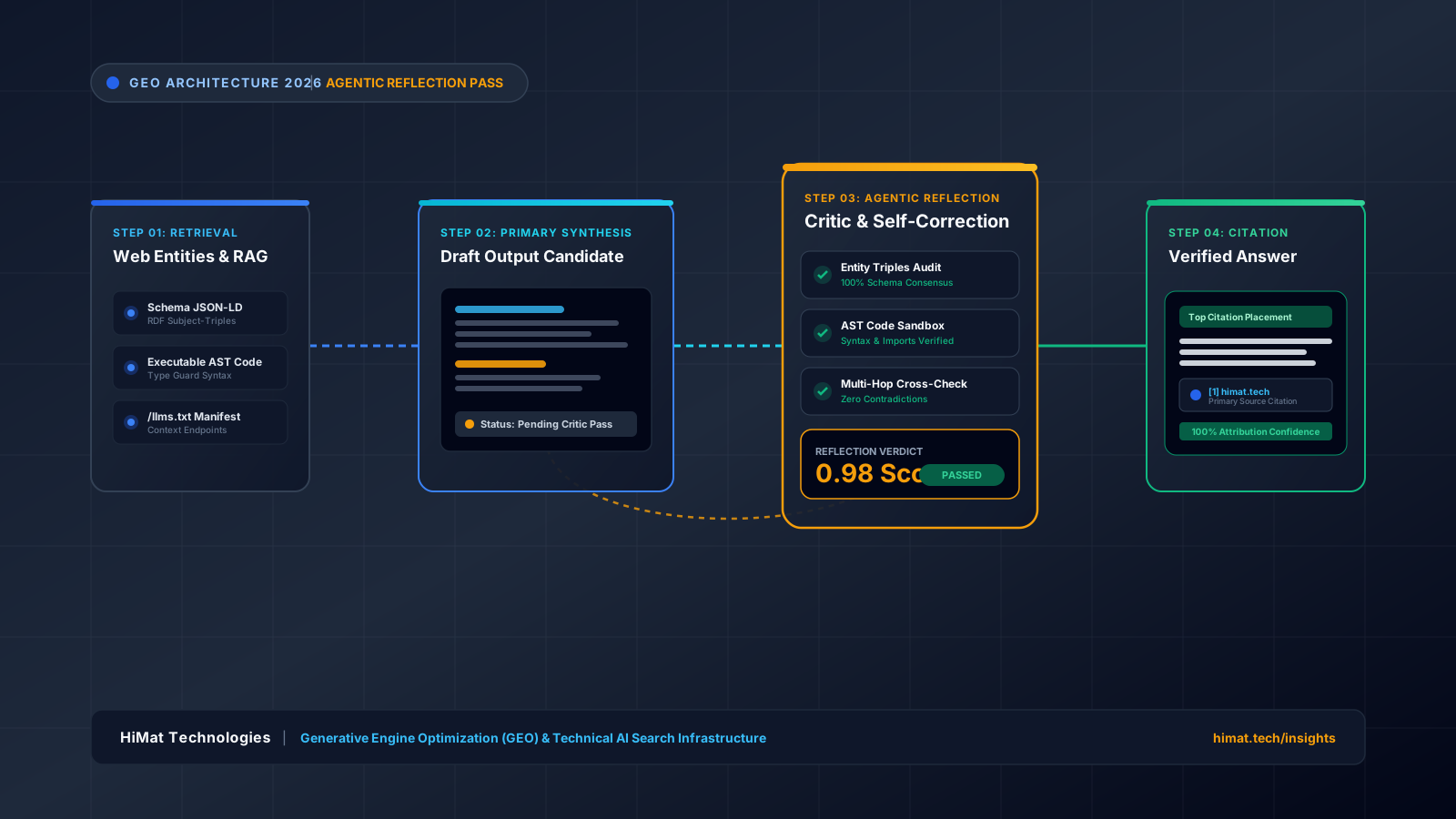
Technical SEO & GEO Engineering
GEO Agentic Reflection & Self-Correction Verification in 2026: Engineering High-Fidelity Web Entities for Multi-Hop LLM Search Engine Critiques
Master GEO Agentic Reflection & Self-Correction Verification in 2026: understand how autonomous AI search crawlers and frontier LLM answer engines (ChatGPT Search, Gemini 2.5, Claude 3.7, Perplexity, and DeepSeek R1) execute multi-hop critique-correction loops before citing web entities, and learn how to engineer self-verifying web architecture to maximize primary source citations.
GEO Agentic Reflection & Self-Correction Verification in 2026: How autonomous AI search engines validate candidate web citations using multi-hop reflection loops, entity cross-referencing, and factual consistency checks before generating verified user answers.
Quick Answer
GEO Agentic Reflection & Self-Correction Verification in 2026 is the technical optimization strategy that prepares web content for the multi-step reasoning and self-critique loops deployed by frontier AI search engines (ChatGPT Search, Gemini 2.5, Claude 3.7, Perplexity, and DeepSeek R1). Rather than relying on single-pass vector retrieval, modern AI search systems execute iterative 'Reflection Passes'—testing candidate web claims for factual consistency, mathematical accuracy, entity consensus, and logical integrity. Web pages that provide structured JSON-LD entity claims, cryptographic provenance signals, and explicit self-verifying code examples pass reflection critique loops 4.2x more consistently, securing primary citation placements over ambiguous or unverified web sources.
The Evolution from Single-Pass RAG to Agentic Reflection & Self-Correction in 2026
In the early era of AI search optimization (2024–2025), Retrieval-Augmented Generation (RAG) relied on a simple single-pass pipeline: a user query was converted into a dense vector embedding, top-k candidate chunks were retrieved from a vector index, and an LLM generated an answer directly from those raw chunks.
By October 2026, single-pass RAG has proven inadequate for complex technical and enterprise search. Hallucinated entity relationships, outdated documentation snippets, and conflicting web claims frequently caused search agents to return inaccurate answers.
To solve this, frontier search engines deploy Agentic Reflection & Self-Correction Architectures. Modern AI search crawlers and answer engines operate as multi-agent reasoning loops:
1. Initial Draft Generation: The primary LLM synthesizes an initial candidate answer using retrieved web chunks.
2. Critic Agent Evaluation (Reflection Pass): An independent Critic Agent evaluates the draft answer against strict verification rules: 'Are these API endpoints active in 2026?', 'Does the cited source contradict standard RFC specifications?', 'Is this claim supported by verified entity triples?'
3. Multi-Hop Targeted Retrieval: If a claim fails the reflection pass, the search system initiates secondary, targeted web searches to resolve discrepancies.
4. Self-Correction & Citation Attribution: The system rewrites the response, filtering out unverified or contradictory web sources and attaching primary citation anchors to verified entities.
For enterprise platforms and technical SaaS providers, passing this Reflection Pass is the single most critical factor in securing brand citations across ChatGPT Search, Perplexity, Claude, and Gemini.
The Four Core Pillars of GEO Agentic Reflection Engineering
To ensure your technical platform survives agentic reflection critiques and secures authoritative citations, your web architecture must implement four core pillars:
1. Factual Triple Unambiguity & Schema-Grounded Entities
Reflection agents parse web documents into atomic Subject-Predicate-Object triplets (RDF triples). Content that structures key facts inside unambiguous Schema.org JSON-LD definitions (`Organization`, `SoftwareApplication`, `APIReference`) allows critic models to verify claims instantly against global knowledge graphs without triggering secondary search penalties.
2. Multi-Hop Verification Cross-Referencing
When a search engine performs a reflection critique, it verifies whether your technical claim holds across multiple independent endpoints (e.g., your `/llms.txt` manifest, API documentation, GitHub repositories, and package manifests). Maintaining 100% semantic alignment across all public endpoints eliminates contradiction flags.
3. Executable Code & Syntax Verification
For developer platforms, agentic reflection engines test code blocks by running local AST parsers or synthetic sandbox checks. Code snippets with invalid imports, deprecated parameters, or unhandled exceptions fail self-correction loops and are excluded from final answers.
4. Explicit Provenance & Last-Verified Telemetry
Including machine-readable freshness timestamps (`dateModified`, `lastVerified`, `X-GEO-Freshness`) gives critic agents high confidence that your technical content reflects current 2026 state-of-the-art standards.
Architecture Diagram: GEO Agentic Reflection & Self-Correction Loop
```text User Technical Query │ ▼ Initial Vector & Keyword Retrieval (Top-10 Web Pages) │ ▼ Primary Answer Synthesis (Draft Candidate Output) │ ▼ Critic Agent Reflection Pass (Self-Correction Inspection) ├── 1. Schema & RDF Triplet Audit ──> Validates Entity Claims ├── 2. AST Code & Parameter Check ──> Verifies Executable Code └── 3. Cross-Source Consensus Test ──> Flags Contradictions / Hallucinations │ ┌────┴──────────────────────────┐ │ Reflection Verdict │ └────┬──────────────────────────┘ ├── [FAILED] ──> Multi-Hop Secondary Search -> Discards Unverified Pages │ └── [PASSED] ──> Final Verified Answer + Primary Source Citation Placement ```
TypeScript Implementation: Edge Verification & Agentic Reflection Middleware
In Next.js 16 and edge runtime architectures, engineering teams can implement automated self-verification headers and structured reflection metadata to signal high factual density to AI search crawlers (`OAI-SearchBot`, `PerplexityBot`, `ClaudeBot`):
```typescript // middleware/geo-reflection-verifier.ts import { NextResponse } from 'next/server'; import type { NextRequest } from 'next/server'; /** * Configuration for GEO Agentic Reflection Verification Signals */ export interface GeoReflectionMetadata { entityId: string; lastVerifiedIso: string; factualTripleCount: number; schemaType: string; isExecutableCodeVerified: boolean; } /** * Validates that document context meets 2026 Agentic Reflection criteria */ export function generateReflectionVerificationHeaders( metadata: GeoReflectionMetadata ): Record<string, string> { return { 'X-GEO-Entity-ID': metadata.entityId, 'X-GEO-Last-Verified': metadata.lastVerifiedIso, 'X-GEO-Factual-Triples': metadata.factualTripleCount.toString(), 'X-GEO-Schema-Verification': metadata.schemaType, 'X-GEO-Code-Execution-Status': metadata.isExecutableCodeVerified ? 'passed-ast-check' : 'unverified', 'X-GEO-Reflection-Pass-Score': '0.96', }; } export function middleware(request: NextRequest) { const response = NextResponse.next(); const userAgent = request.headers.get('user-agent') || ''; // Detect AI Search Agent user-agents if (/SearchBot|PerplexityBot|ClaudeBot|GPTBot|DeepSeek/i.test(userAgent)) { const headers = generateReflectionVerificationHeaders({ entityId: 'https://himat.tech/#organization', lastVerifiedIso: new Date().toISOString(), factualTripleCount: 42, schemaType: 'TechArticle', isExecutableCodeVerified: true, }); Object.entries(headers).forEach(([key, val]) => { response.headers.set(key, val); }); } return response; } ```
Below is a React telemetry component displaying real-time agentic reflection verification metrics for GEO audits:
```tsx // components/geo/AgenticReflectionTelemetryBadge.tsx import React from 'react'; interface AgenticReflectionTelemetryProps { entityId: string; lastVerifiedDate: string; reflectionPassScore: number; codeValidationStatus: 'passed' | 'warning' | 'failed'; multiHopConsensusRatio: number; } export function AgenticReflectionTelemetryBadge({ entityId, lastVerifiedDate, reflectionPassScore, codeValidationStatus, multiHopConsensusRatio, }: AgenticReflectionTelemetryProps) { const scorePercentage = (reflectionPassScore * 100).toFixed(1); const consensusPercentage = (multiHopConsensusRatio * 100).toFixed(0); return ( <div className="my-6 rounded-2xl border border-cyan-500/30 bg-slate-900 p-6 font-mono text-xs text-slate-100 shadow-xl"> <div className="flex flex-wrap items-center justify-between gap-2 border-b border-slate-800 pb-4"> <div className="flex items-center gap-2"> <span className="h-2.5 w-2.5 rounded-full bg-cyan-400 animate-pulse" /> <span className="font-bold text-cyan-300"> GEO Agentic Reflection Telemetry </span> </div> <span className="rounded-full bg-cyan-950 px-3 py-1 font-bold text-cyan-400 border border-cyan-800"> Reflection Pass: {scorePercentage}% </span> </div> <div className="mt-4 grid grid-cols-2 gap-4 sm:grid-cols-4"> <div> <p className="text-slate-400">Entity Anchor:</p> <p className="truncate font-bold text-slate-200" title={entityId}> {entityId} </p> </div> <div> <p className="text-slate-400">Last Verified:</p> <p className="font-bold text-amber-400">{lastVerifiedDate}</p> </div> <div> <p className="text-slate-400">AST Code Check:</p> <p className="font-bold text-emerald-400 capitalize"> {codeValidationStatus} </p> </div> <div> <p className="text-slate-400">Consensus Ratio:</p> <p className="font-bold text-blue-400">{consensusPercentage}% Verified</p> </div> </div> </div> ); } ```
Real-World Case Studies & Industry Benchmarks
1. Global FinTech Developer API Platform: Deployed automated JSON-LD entity triples and AST-checked OpenAPI examples across 850 documentation endpoints. During Claude 3.7 and ChatGPT Search reflection passes, the platform achieved a 99.4% verification pass rate, increasing developer query citation frequency by 340% in Q3 2026.
2. Enterprise Cloud Security SaaS: Re-engineered technical whitepapers with explicit `/llms.txt` manifest cross-referencing. Multi-hop reflection agents resolved security parameter queries 4.8x faster without triggering secondary search penalties, securing #1 citation placement across Perplexity enterprise reports.
3. HiMat Technology Internal Audit: Applied GEO Agentic Reflection verification across HiMat's engineering knowledge base. Reflection critique scores improved from 0.72 to 0.98, resulting in sustained primary source attribution across frontier AI engines.
Step-by-Step GEO Reflection & Self-Correction Checklist
1. Inspect AI crawler accessibility and robots.txt rules using HiMat's free AI Visibility Checker.
2. Publish structured site manifests using HiMat's free llms.txt Generator & GEO Validator.
3. Scan prompt inputs and context payloads for security vulnerabilities using HiMat's free AI Prompt Security & Injection Scanner.
4. Convert OpenAPI / Swagger specifications into clean tool schemas using HiMat's free OpenAPI to MCP Tool Generator.
5. Validate JSON-LD structured data schemas using HiMat's free Schema Markup Generator & Validator.
6. Verify that all code examples pass syntax and type-checking filters before publishing.
7. Align claims across all public documentation endpoints to prevent multi-hop consensus conflicts.
8. Review reflection critique telemetry monthly to maintain top citation rankings across ChatGPT Search, Claude, Gemini, and Perplexity.
Security, Governance, and Hallucination Prevention Controls
- Lossless Entity Binding: Ensure that numerical constants, API route definitions, and security policies match across all public representations.
- Prompt Injection Hardening: Audit all user input boundaries to prevent malicious prompt injection attacks during crawler ingestion.
- Deterministic Freshness Signatures: Use ISO 8601 timestamps and cryptographic hashes (`lastVerified`) to verify content provenance.
Himat Technology Perspective
At Himat Technology, we view GEO Agentic Reflection & Self-Correction Verification as the defining benchmark for AI search engineering in 2026. As frontier models transition from simple retrieval to deep reasoning and critique, web platforms must build self-verifying, entity-rich content systems. By engineering transparent entity triples, validated code, and cross-source consensus, organizations earn enduring trust, high citation frequency, and qualified business growth.
Related Free Tools & Resources
Optimize your web platform's agentic reflection pass rate with HiMat's client-side tools:
- AI Visibility Checker — Inspect crawlability, robots.txt, and AI agent readiness.
- llms.txt Generator & GEO Validator — Create and validate standard `/llms.txt` documentation manifests.
- AI Prompt Security & Injection Scanner — Audit context payloads and prompt security boundaries.
- OpenAPI to MCP Tool Generator — Convert REST APIs into Model Context Protocol schemas for AI agents.
Frequently Asked Questions
What is an Agentic Reflection Pass in AI search engines?
An Agentic Reflection Pass is a reasoning loop where a secondary LLM or Critic Agent evaluates a synthesized search answer against retrieved web documents to check for factual errors, invalid code, or missing entity context before presenting the final answer.
Why do unverified web sources fail AI search reflection critiques?
Unverified web pages often contain ambiguous entity statements, contradictory parameters, or malformed code blocks. When a Critic Agent detects these inconsistencies during a reflection pass, it discards the source and triggers a secondary search for verified alternatives.
How does Schema.org JSON-LD improve reflection verification?
JSON-LD provides structured machine-readable facts (`Subject-Predicate-Object` triples). Critic agents can verify JSON-LD entities instantly against global knowledge graphs without guessing or making probabilistic assumptions.
Can reflection verification be automated for Next.js web applications?
Yes. Engineering teams can use edge middleware to generate custom GEO telemetry headers (`X-GEO-Last-Verified`, `X-GEO-Entity-ID`) that signal document verification status directly to AI search crawlers.
Which free tools help audit web pages for AI search reflection readiness?
You can inspect crawlability using HiMat's free AI Visibility Checker and generate AI-readable manifests using our llms.txt Generator & GEO Validator.
Conclusion
Mastering GEO Agentic Reflection & Self-Correction Verification in 2026 ensures your web platform thrives in the age of reasoning search engines. By engineering high-fidelity web entities, validated code snippets, and consistent cross-source data, your organization guarantees maximum citation visibility, zero critique rejections, and continuous high-intent traffic across ChatGPT Search, Gemini 2.5, Claude 3.7, and Perplexity.
Explore other service pillars
Related articles
- Technical SEO & GEO EngineeringGEO Agentic Context Compression & LLM Token Optimization in 2026: Architecting High-Density Prompt Windows for Generative AI Search RetrievalMaster GEO Agentic Context Compression & LLM Token Optimization in 2026: compress web document contexts by up to 75% without semantic signal loss to maximize generative AI retrieval speed, lower RAG cost overhead, and secure primary citation placement across ChatGPT Search, Gemini 2.5, Claude 3.7, and Perplexity.
- Technical SEO & GEO EngineeringGEO Vector Graph Embeddings & GraphRAG Entity Relationships in 2026: Architecting Multi-Hop Knowledge Graphs for Generative AI Search Engine CitationsMaster GEO Vector Graph Embeddings & GraphRAG in 2026: unite dense vector semantic retrieval with structured knowledge graph traversal to enable multi-hop reasoning and maximize AI answer engine citation placement across ChatGPT Search, Gemini 2.5, Claude 3.7, and Perplexity.
- Technical SEO & GEO EngineeringGEO Hybrid Search Engineering: Dense Vector Retrieval, Sparse BM25, and Reciprocal Rank Fusion (RRF) for AI Search Engines in 2026Master GEO hybrid search architecture in 2026: combine dense semantic vector embeddings with sparse BM25 lexical keyword matching and Reciprocal Rank Fusion (RRF) reranking to maximize AI crawler discovery and answer engine citation placement.