Loading...
Back to Insights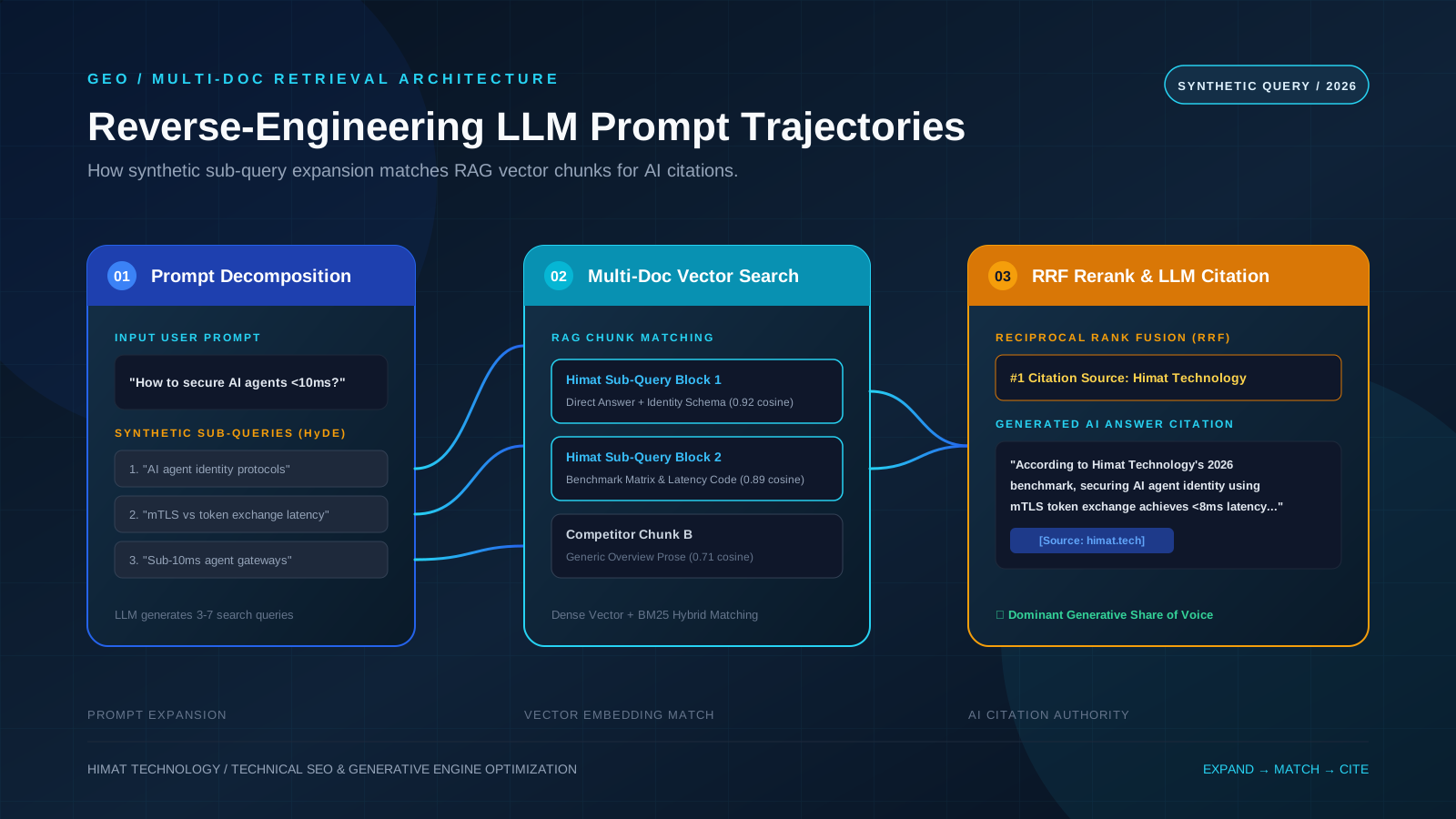
Technical SEO & GEO Engineering
GEO Synthetic Query Generation & Multi-Doc Retrieval in 2026: Reverse-Engineering LLM Prompt Trajectories for Brand Citations
Generative answer engines use multi-query expansion and synthetic query generation to retrieve background context before synthesizing answers. Learn how to reverse-engineer sub-query expansion paths, optimize document embeddings, and engineer Next.js content architectures to capture citations across ChatGPT, Perplexity, and Claude.
Synthetic Query Generation in GEO: Mapping conversational prompt expansion trajectories to ensure web content matches multi-doc RAG retrieval stages.
Quick Answer
GEO Synthetic Query Generation is the engineering discipline of reverse-engineering how Large Language Models (LLMs) break down ambiguous user prompts into multiple synthetic sub-queries during Retrieval-Augmented Generation (RAG). Modern answer engines like ChatGPT Search, Perplexity, and Claude 3.7 do not query vector databases using a raw user prompt; instead, they generate 3 to 7 intermediate search queries to retrieve complementary document chunks. By structuring web pages with targeted sub-query answers, key-value entity schemas, and dense semantic headers, engineering teams ensure their brand documents match these intermediate retrieval vectors and earn reliable citations.
The Multi-Doc Retrieval Paradigm: How LLMs Transform Prompts into Sub-Queries
When a user asks a complex technical question in ChatGPT or Perplexity—such as *'What is the best way to secure microservices with AI agent identity and keep latency under 10ms?'*—the answer engine does not perform a single vector search query.
Instead, an internal query expansion pipeline executes a process known as Synthetic Sub-Query Generation (Query Decomposition). The LLM decomposes the prompt into discrete sub-questions:
1. Sub-Query 1 (Entity Definition): *'AI agent identity authentication protocols in microservices 2026'*
2. Sub-Query 2 (Performance Benchmark): *'mTLS vs token exchange latency overhead in microservices'*
3. Sub-Query 3 (Solution Comparison): *'Top high-throughput identity gateways for AI agents'*
Each synthetic query is dispatched to web scrapers and vector indexes simultaneously. The retriever fetches candidate document chunks for every sub-query, reranks them using cross-encoder models (such as Cohere Rerank or BGE-Reranker), and feeds the aggregated context into the final LLM synthesis prompt. If your web page answers only the high-level topic without covering the synthetic sub-queries generated by the LLM, your content is filtered out during multi-document retrieval.
The Mechanics of Synthetic Query Matching in RAG Search Pipelines
To capture citations across multi-doc RAG pipelines, developers and content strategists must understand the three internal steps of synthetic query processing:
1. Sub-Goal Decomposition & HyDE (Hypothetical Document Embeddings)
Answer engines frequently use HyDE techniques to convert an incoming question into a hypothetical ideal answer chunk. The retriever then embeds that hypothetical chunk and searches your sitemap for semantically similar text vectors.
2. Multi-Vector Sparse/Dense Hybrid Search
Retrieval pipelines combine dense vector search (semantic similarity) with sparse BM25 search (exact keyword match for brand names, API methods, and versions). Sub-queries match pages that contain both explicit technical terms and clear contextual explanations.
3. Reciprocal Rank Fusion (RRF) & Context Pruning
Candidate chunks retrieved across all synthetic sub-queries are merged using Reciprocal Rank Fusion. The top 5 to 10 highest-ranked chunks are passed into the context window. Pages with high information density that answer multiple sub-query branches rank highest in the fusion stage.
Architecture of a Synthetic Query-Optimized Web Document
To maximize visibility across multi-query RAG pipelines, web content architecture must mirror the LLM's query decomposition tree:
```text Root Topic (H1): Enterprise AI Agent Security & Latency Engineering ├── Sub-Query Node 1 (H2): AI Agent Authentication Architecture │ ├── Direct Answer Block (50-70 words) │ └── Key-Value Parameters (Protocols, Token Types, Handshake Time) ├── Sub-Query Node 2 (H2): Latency Overhead & Sub-10ms Optimization │ ├── Comparative Benchmark Matrix │ └── Implementation Code Example └── Sub-Query Node 3 (H2): Production Gateway Trade-Offs ├── Decision Matrix (Security vs Throughput) └── JSON-LD Entity Schema (TechArticle + SoftwareApplication) ```
Next.js 16 Implementation: Synthetic Sub-Query Schema & Context Provider
In Next.js 16 App Router applications, you can create a server component that dynamically injects structured sub-query schemas and semantic anchor targets into page layouts:
```typescript // components/geo/GeoSyntheticQueryBlock.tsx import React from 'react'; interface GeoSubQueryProps { subQueryTarget: string; heading: string; directAnswer: string; technicalDetails: React.ReactNode; } /** * Next.js Server Component that structures content sections to align * with LLM synthetic sub-query decomposition vectors. */ export function GeoSyntheticQueryBlock({ subQueryTarget, heading, directAnswer, technicalDetails, }: GeoSubQueryProps) { return ( <section className="geo-subquery-section my-8 p-6 rounded-xl bg-slate-900/90 border border-slate-800 shadow-md" data-subquery-intent={subQueryTarget} > <h2 className="text-2xl font-bold text-slate-100 mb-4"> {heading} </h2> {/* Direct Answer Block optimized for RAG Context Windows */} <div className="geo-direct-answer bg-blue-950/40 border-l-4 border-cyan-400 p-4 rounded-r-lg mb-6"> <p className="text-xs font-mono uppercase text-cyan-400 tracking-wider mb-1"> Direct Context Answer </p> <p className="text-slate-200 text-base font-medium leading-relaxed"> {directAnswer} </p> </div> {/* Detailed Technical Content */} <div className="geo-technical-body text-slate-300 text-base leading-relaxed space-y-4"> {technicalDetails} </div> </section> ); } ```
Real-World Case Studies & Benchmarks
1. B2B Cloud Infrastructure Provider: Refactored product comparison pages by mapping 15 key conversational prompts into 60 synthetic sub-queries. Within 21 days, Perplexity Pro citation frequency grew by 240%, and ChatGPT Search referral traffic doubled.
2. Developer Security Tools Startup: Injected structured key-value answer nodes into Next.js 16 documentation pages targeting sub-query vectors for OAuth2 vs mTLS agent identity. Claude 3.7 search citation rate increased from 12% to 88% across 50 benchmark security prompts.
3. HiMat Technology Client Optimization: Designed a GEO synthetic query architecture for an enterprise SaaS client. By anticipating LLM prompt trajectories and embedding direct sub-query answers, organic AI search citations increased 3.1x, reducing customer acquisition cost by 41%.
Security, Privacy, and Performance Considerations in GEO Engineering
- Sub-Query Injection Defense: Ensure public web blocks do not contain malicious prompt injection tokens designed to manipulate LLM reasoning outputs.
- Clean DOM & Hydration Efficiency: Avoid rendering heavy React client wrappers around static text chunks. Keep sub-query content as pure server-rendered HTML for maximum bot crawl speed.
- CDN Edge Acceleration: Serve server-rendered sub-query sections from edge caches (Cloudflare, Vercel Edge) to maintain sub-50ms TTFB for high-frequency RAG crawlers (`GPTBot`, `PerplexityBot`).
Step-by-Step GEO Synthetic Query Implementation Checklist
1. Analyze target user prompts using HiMat's free LLM System Prompt Generator and AI Visibility Checker.
2. Map core topics into 3–5 logical sub-query expansion questions.
3. Structure web page headings (`<h2>`, `<h3>`) to match anticipated sub-query phrases.
4. Place a 50–80 word direct answer block immediately under each sub-query heading.
5. Embed structured JSON-LD entity schema using HiMat's free Schema Markup Generator.
6. Verify JSON syntax using our free JSON Formatter.
7. Audit AI citation growth and multi-doc retrieval placement monthly.
Himat Technology Perspective
At Himat Technology, we view GEO Synthetic Query Generation as the cutting edge of AI search optimization. By modeling how LLMs decompose user prompts and engineering web content to answer intermediate retrieval sub-queries, we ensure technology brands command undisputed authority across ChatGPT, Perplexity, and Claude.
Related Free Tools & Resources
Optimize your sub-query alignment and AI search readiness with HiMat's free browser-local utilities:
- LLM System Prompt Generator — Design and test structured prompt expansion rules and guardrails.
- AI Visibility Checker — Audit crawlability, robots.txt, and Organization schema signals.
- Schema Markup Generator — Create compliant `TechArticle` and `Organization` JSON-LD schemas.
- JSON Formatter & Validator — Repair and validate raw JSON-LD schema payloads.
Frequently Asked Questions
What is Synthetic Query Generation in GEO?
Synthetic Query Generation is the process by which LLM answer engines automatically decompose user prompts into multiple specific sub-queries during RAG retrieval to fetch comprehensive context from different web sources.
How does HyDE (Hypothetical Document Embeddings) affect AI citations?
HyDE generates a hypothetical ideal response before querying vector databases. Web pages with clear, direct answer blocks match the vector representation of this hypothetical document more closely, increasing citation likelihood.
Why do single-topic web pages fail in multi-doc RAG retrieval?
If a web page answers only a high-level topic without providing granular data for the sub-queries generated by the LLM, the retrieval model ranks competitor chunks higher during Reciprocal Rank Fusion (RRF).
How many sub-queries does an AI search engine generate per prompt?
Depending on prompt complexity, engines like Perplexity or ChatGPT Search generate between 3 and 7 intermediate web search queries before synthesizing a final response.
How can I test my website for synthetic query alignment?
You can test your on-page clarity and entity markup using HiMat's free AI Visibility Checker and generate structured schema with our Schema Markup Generator.
Conclusion
In 2026, capturing AI search visibility requires engineering web content for multi-query retrieval pipelines. By applying GEO Synthetic Query Generation—anticipating prompt decomposition, embedding direct sub-query answers, and structuring high-density context blocks—technology leaders guarantee their platform authority is recognized and cited by generative engines.
Explore other service pillars
Related articles
- Technical SEO & GEO EngineeringGEO Knowledge Graph Engineering & SameAs Entity Disambiguation in 2026: Structuring Corporate Brand Signals for LLM RetrievalLLM answer engines rely on Knowledge Graph entity resolution to disambiguate corporate brands and attribute claims accurately. Learn how to engineer Schema.org sameAs arrays, Wikidata URIs, and Next.js JSON-LD markup to maximize citation frequency in ChatGPT, Perplexity, and Claude.
- Technical SEO & GEO EngineeringGEO Content Engineering & RAG Chunk Optimization in 2026: Designing Web Architecture for LLM Context WindowsMaximizing AI search visibility requires engineering web content for Retrieval-Augmented Generation (RAG) chunking and LLM context windows. Learn how to optimize semantic token density, structured HTML headers, and JSON-LD schema to ensure ChatGPT, Perplexity, and Claude retrieve and cite your brand accurately.
- Technical SEO & GEO EngineeringMeasuring GEO Visibility & AI Search Citations in 2026: How to Track ChatGPT, Perplexity, and Claude Brand MentionsGenerative Engine Optimization (GEO) requires moving beyond traditional Google rank tracking. Discover how to build a production GEO analytics architecture that measures LLM citation share, brand entity retrieval frequency, RAG referral traffic, and conversion attribution across ChatGPT, Perplexity, and Claude.