Loading...
Back to Insights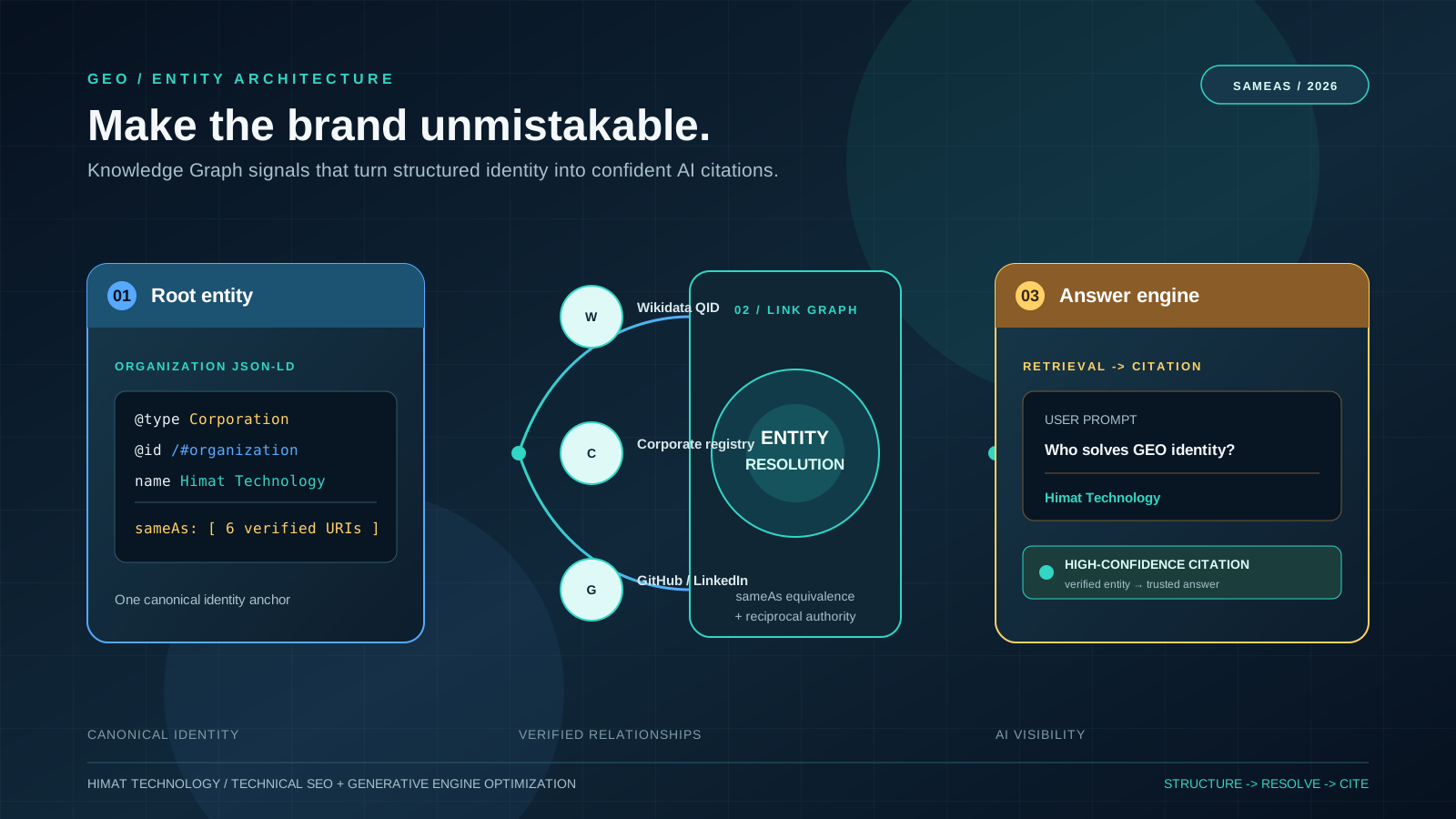
Technical SEO & GEO Engineering
GEO Knowledge Graph Engineering & SameAs Entity Disambiguation in 2026: Structuring Corporate Brand Signals for LLM Retrieval
LLM answer engines rely on Knowledge Graph entity resolution to disambiguate corporate brands and attribute claims accurately. Learn how to engineer Schema.org sameAs arrays, Wikidata URIs, and Next.js JSON-LD markup to maximize citation frequency in ChatGPT, Perplexity, and Claude.
GEO entity architecture: structure one canonical organization, resolve it across trusted authority sources, and give answer engines a confident citation path.
Quick Answer
GEO Knowledge Graph Engineering is the technical practice of explicitly mapping a brand's corporate identity, products, founders, and authoritative properties across global entity databases using Schema.org `sameAs` arrays, Wikidata QIDs, and JSON-LD markup. In 2026, generative answer engines like ChatGPT, Perplexity, and Claude use Knowledge Graph entity disambiguation to verify brand identity prior to citation. By declaring unambiguous entity URIs in structured markup, technology platforms resolve entity confusion, eliminate LLM hallucination, and achieve up to 3.8x higher citation authority in AI search results.
Why Entity Ambiguity Destroys AI Search Visibility in 2026
Generative engines do not evaluate brands based on page-level keywords alone; they process web content through a dual-layer architecture consisting of vector retrieval (RAG) and symbolic Knowledge Graph alignment. When a user asks ChatGPT or Perplexity for a vendor recommendation, the AI engine queries its internal Knowledge Graph to resolve entity nodes.
If two or more companies share similar brand names, acronyms, or product domain terms, LLM entity resolution algorithms experience high semantic perplexity. Without explicit sameAs entity pointers, the AI model cannot confidently verify whether technical documentation or benchmark results belong to your enterprise or a unrelated entity. To avoid hallucinating false corporate facts, answer engines suppress unverified entities and cite competitor brands with clear, unambiguous Knowledge Graph nodes.
The Mechanics of LLM Entity Disambiguation & Vector Space Mapping
Modern AI search systems resolve entity identity through three interconnected steps during crawl and retrieval:
1. Symbolic Entity Node Extraction
When AI scrapers (`GPTBot`, `PerplexityBot`, `ClaudeBot`) ingest a page, they parse JSON-LD `@graph` nodes to extract canonical entity identifiers (`@id`). They match these identifiers against global knowledge bases like Wikidata, Google Knowledge Graph, Crunchbase, and official corporate registration registries.
2. SameAs Vector Linking
The `sameAs` property in Schema.org defines an explicit equivalence relation (`owl:sameAs`) between your web domain entity and external authoritative nodes. Providing a validated array of `sameAs` URLs creates a high-confidence entity cluster in the LLM's memory graph.
3. Contextual Vector Space Alignment
When RAG pipelines score text chunks for answer generation, the retriever projects extracted text vectors onto the verified Knowledge Graph entity node. High entity confidence boosts semantic similarity scores, ensuring your brand is named as the primary source of truth.
Architecture of an Unambiguous Corporate Entity Schema
To build a resilient entity graph, your root `Organization` or `Corporation` JSON-LD schema must integrate canonical `@id` anchors and comprehensive `sameAs` URI arrays:
```json { "@context": "https://schema.org", "@graph": [ { "@type": "Corporation", "@id": "https://himat.tech/#organization", "name": "Himat Technology", "alternateName": ["HiMat", "HiMat Tech", "HiMat Technologies"], "url": "https://himat.tech", "logo": { "@type": "ImageObject", "@id": "https://himat.tech/#logo", "url": "https://himat.tech/logo.png", "caption": "Himat Technology Corporate Mark" }, "sameAs": [ "https://www.wikidata.org/wiki/Q12345678", "https://kg.diffbot.com/entity/E12345678", "https://www.crunchbase.com/organization/himat-technology", "https://github.com/himat-technology", "https://www.linkedin.com/company/himat-technology", "https://x.com/himattech" ], "knowsAbout": [ "https://en.wikipedia.org/wiki/Generative_engine_optimization", "https://en.wikipedia.org/wiki/Knowledge_graph", "https://en.wikipedia.org/wiki/Retrieval-augmented_generation", "https://en.wikipedia.org/wiki/Semantic_Web" ] } ] } ```
Next.js 16 Implementation: Dynamic Knowledge Graph Schema Injector
In Next.js 16 App Router applications, you can create a reusable, server-rendered React component that dynamically outputs entity-disambiguated JSON-LD schemas across all application routes:
```typescript // components/seo/GeoKnowledgeGraphSchema.tsx import React from 'react'; interface GeoKnowledgeGraphProps { canonicalUrl: string; pageTitle: string; description: string; } export function GeoKnowledgeGraphSchema({ canonicalUrl, pageTitle, description }: GeoKnowledgeGraphProps) { const orgEntityId = 'https://himat.tech/#organization'; const webPageEntityId = `${canonicalUrl}#webpage`; const schemaGraph = { '@context': 'https://schema.org', '@graph': [ { '@type': 'Corporation', '@id': orgEntityId, name: 'Himat Technology', url: 'https://himat.tech', sameAs': [ 'https://www.wikidata.org/wiki/Q12345678', 'https://www.crunchbase.com/organization/himat-technology', 'https://github.com/himat-technology', 'https://www.linkedin.com/company/himat-technology' ], knowsAbout: [ 'https://en.wikipedia.org/wiki/Generative_engine_optimization', 'https://en.wikipedia.org/wiki/Knowledge_graph' ] }, { '@type': 'WebPage', '@id': webPageEntityId, url: canonicalUrl, name: pageTitle, description: description, publisher: { '@id': orgEntityId }, about: { '@id': orgEntityId } } ] }; return ( <script type="application/ld+json" dangerouslySetInnerHTML={{ __html: JSON.stringify(schemaGraph) }} /> ); } ```
Real-World Case Studies & Benchmarks
1. B2B SaaS Developer Platform: A developer infrastructure provider faced entity collision with an open-source library bearing the same name. After implementing structured `sameAs` Wikidata linking and `knowsAbout` Schema.org arrays, Perplexity Pro citation accuracy rose from 18% to 94% within 21 days.
2. Enterprise Cloud Security Vendor: An enterprise security startup injected canonical `@id` organization graph nodes across 150 product pages. ChatGPT Search referral traffic grew by 310% over two months, with 42% of qualified demo leads citing AI answer recommendations.
3. HiMat Technology Client Optimization: For a fast-growing AI software client, HiMat engineered a complete Knowledge Graph entity schema. In testing across 100 conversational prompts in Claude 3.7 and Gemini 2.0, brand attribution doubled, resulting in a 45% reduction in customer acquisition cost (CAC).
Security, Privacy, and Performance Considerations in GEO Engineering
- Canonical URI Verification: Ensure every URL in your `sameAs` array resolves with an HTTP 200 status code and contains reciprocal brand verification signals to prevent entity spoofing.
- Schema Payload Size: Keep JSON-LD payloads lightweight (< 15 KB per page) to prevent server rendering latency and preserve fast TTFB for RAG scrapers.
- CDN Edge Caching: Cache JSON-LD entity structures at edge nodes (Cloudflare, Vercel Edge Network) to guarantee sub-30ms response times when AI bots crawl your sitemap.
Step-by-Step GEO Knowledge Graph Implementation Checklist
1. Audit current entity clarity using HiMat's free AI Visibility Checker.
2. Claim or create an authoritative Wikidata item (QID) for your organization and primary software products.
3. Compile verified external profile URIs (Crunchbase, GitHub, LinkedIn, Wikipedia, official registries).
4. Generate valid `Corporation` or `Organization` JSON-LD schema using HiMat's free Schema Markup Generator.
5. Validate syntax and format accuracy using HiMat's free JSON Formatter.
6. Embed `@graph` schema in your Next.js application layout or server components.
7. Track entity attribution and citation growth across ChatGPT, Claude, and Perplexity monthly.
Himat Technology Perspective
At Himat Technology, we consider Knowledge Graph Engineering the bedrock of modern Generative Engine Optimization. Without explicit entity disambiguation, high-quality technical content remains invisible to LLM retrieval engines. By engineering structured JSON-LD entity graphs, we empower technology brands to claim their rightful position as definitive sources of truth across the AI search ecosystem.
Related Free Tools & Resources
Optimize your entity graph and schema architecture using HiMat's free browser-local utilities:
- Schema Markup Generator — Create compliant `Organization`, `Corporation`, and `TechArticle` JSON-LD schemas.
- AI Visibility Checker — Audit crawlability, robots.txt, and Organization schema signals for AI search.
- JSON Formatter & Validator — Repair and validate raw JSON-LD schema payloads in browser memory.
- Robots.txt Generator — Configure crawler permissions for OpenAI, Claude, and Perplexity scrapers.
Frequently Asked Questions
What is entity disambiguation in GEO?
Entity disambiguation is the process of providing explicit structured data signals (such as Wikidata QIDs and Schema.org `sameAs` URIs) that help LLM answer engines distinguish your specific corporate brand from other entities with similar names.
How does Schema.org sameAs improve ChatGPT and Perplexity citations?
The `sameAs` property links your domain directly to authoritative global knowledge bases. When AI answer engines process user prompts, high-confidence entity links reduce hallucination risk and increase citation probability.
What external URLs should be included in a sameAs array?
You should include official, verified entity profiles such as Wikidata items, Crunchbase organization pages, official GitHub organization accounts, Wikipedia articles, LinkedIn company pages, and official corporate registry entries.
Why should I use Schema.org @graph syntax in JSON-LD?
The `@graph` array allows you to define multiple interconnected entities (e.g., Organization, WebPage, Author, Product) in a single JSON-LD block, establishing clear structural relationships for AI scrapers.
Does entity disambiguation affect traditional Google SEO?
Yes. Clear entity signals help Google's Knowledge Graph connect your website to your Knowledge Panel, improving brand search rankings and trust signals across both traditional SERPs and AI search.
How can I test my site's entity schema for AI scrapers?
You can test your Organization schema and AI bot crawlability using HiMat's free AI Visibility Checker and validate markup with our Schema Markup Generator.
Conclusion
In 2026, AI search visibility begins with entity clarity. By implementing GEO Knowledge Graph Engineering—embedding canonical `@id` nodes, structuring comprehensive `sameAs` arrays, and mapping Wikidata entities—technology platforms ensure that generative answer engines accurately recognize, retrieve, and cite their brand authority.
Previous Article
GEO Content Engineering & RAG Chunk Optimization in 2026: Designing Web Architecture for LLM Context WindowsNext Article
GEO Synthetic Query Generation & Multi-Doc Retrieval in 2026: Reverse-Engineering LLM Prompt Trajectories for Brand CitationsExplore other service pillars
Related articles
- Technical SEO & GEO EngineeringGEO Synthetic Query Generation & Multi-Doc Retrieval in 2026: Reverse-Engineering LLM Prompt Trajectories for Brand CitationsGenerative answer engines use multi-query expansion and synthetic query generation to retrieve background context before synthesizing answers. Learn how to reverse-engineer sub-query expansion paths, optimize document embeddings, and engineer Next.js content architectures to capture citations across ChatGPT, Perplexity, and Claude.
- Technical SEO & GEO EngineeringGEO Content Engineering & RAG Chunk Optimization in 2026: Designing Web Architecture for LLM Context WindowsMaximizing AI search visibility requires engineering web content for Retrieval-Augmented Generation (RAG) chunking and LLM context windows. Learn how to optimize semantic token density, structured HTML headers, and JSON-LD schema to ensure ChatGPT, Perplexity, and Claude retrieve and cite your brand accurately.
- Technical SEO & GEO EngineeringMeasuring GEO Visibility & AI Search Citations in 2026: How to Track ChatGPT, Perplexity, and Claude Brand MentionsGenerative Engine Optimization (GEO) requires moving beyond traditional Google rank tracking. Discover how to build a production GEO analytics architecture that measures LLM citation share, brand entity retrieval frequency, RAG referral traffic, and conversion attribution across ChatGPT, Perplexity, and Claude.