Loading...
Back to Insights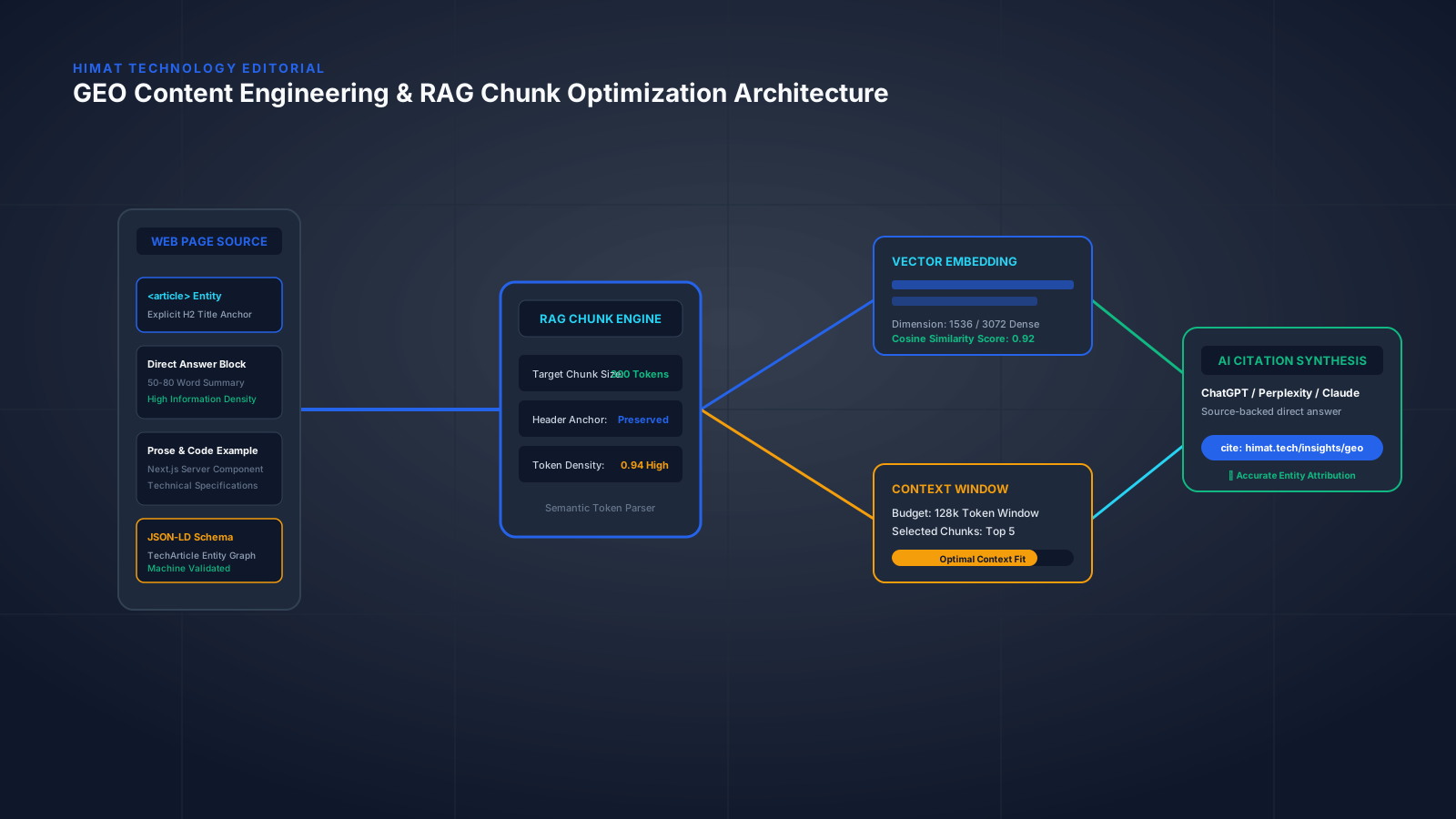
Technical SEO & GEO Engineering
GEO Content Engineering & RAG Chunk Optimization in 2026: Designing Web Architecture for LLM Context Windows
Maximizing AI search visibility requires engineering web content for Retrieval-Augmented Generation (RAG) chunking and LLM context windows. Learn how to optimize semantic token density, structured HTML headers, and JSON-LD schema to ensure ChatGPT, Perplexity, and Claude retrieve and cite your brand accurately.
GEO Content Engineering in 2026: Structuring web content for RAG vector retrieval, token-dense summaries, and LLM context window extraction to maximize citation accuracy.
Quick Answer
GEO Content Engineering is the technical practice of designing web page architecture, HTML markup, and text token density specifically for Retrieval-Augmented Generation (RAG) vector embeddings and LLM context window extraction. By structuring web pages into self-contained 200–500 token semantic chunks, providing explicit H2/H3 header contextualization, and pairing narrative prose with machine-readable JSON-LD entities, engineering and growth teams ensure AI engines like ChatGPT, Perplexity, and Claude reliably parse, retrieve, and cite site content in response to conversational prompts.
Why Traditional Web Formatting Fails in RAG Retrieval Engines
In traditional search engine optimization (SEO), web pages were designed for human scanning and keyword crawlers. Googlebot evaluated entire page documents, analyzing word frequency, backlinks, and document-level signals to rank pages in position 1 through 10.
In 2026, over 50% of technical and commercial search discovery occurs inside AI answer platforms powered by RAG architectures. RAG pipelines do not feed an entire 3,000-word webpage into an LLM context window. Instead, RAG scrapers fragment web documents into text 'chunks' (typically 250 to 800 tokens), convert those chunks into dense mathematical vector embeddings, store them in vector databases (such as Pinecone or Qdrant), and perform cosine similarity matching against user prompt vectors.
When a web page suffers from fragmented formatting, conversational fluff, missing semantic headings, or poor token density, the RAG vector search retriever fails to match the chunk against user queries. As a result, even high-authority websites are omitted from LLM synthesized answers and AI search citations.
The Four Core Principles of GEO Content Engineering
To maximize AI search discoverability and RAG citation frequency, web content architecture must adhere to four engineering principles:
1. Semantic Chunk Independence
Every major content section (`<section>` or `<article>`) must be understandable when read in complete isolation. Because a RAG pipeline may extract only a single 300-token chunk from a long article, that chunk must contain both the core concept entity name (e.g., 'Himat Technology GEO Audit System') and the complete answer or technical explanation without relying on context from three paragraphs prior.
2. High Information-to-Token Density
Generative engines penalize verbose, low-information text. GEO content engineering maximizes information density per token by utilizing direct answer definitions, structured bullet lists, key-value parameter blocks, and concise technical explanations.
3. Explicit Heading Hierarchy & Entity Anchor Text
RAG chunking algorithms often split text at heading boundaries (`<h2>`, `<h3>`). Including explicit entity names inside headings—such as `## Next.js 16 RAG Chunking Middleware` rather than `## Code Example`—ensures vector embeddings retain full contextual intent during semantic indexing.
4. Dual-Layer Representation: Prose + JSON-LD Entities
Combining human-readable HTML prose with structured machine-readable JSON-LD schema (`TechArticle`, `SoftwareApplication`, `FAQPage`) provides dual validation layers. The LLM reads the HTML chunk for natural language synthesis while validating facts against the JSON-LD knowledge graph.
Designing RAG-Optimized HTML Chunk Architecture
A RAG-ready webpage structure organizes content into modular, self-contained semantic blocks. Below is an architectural blueprint of an optimized GEO page section:
```html <!-- Semantic Section Designed for 300-Token Vector Retrieval --> <section id="rag-chunk-optimization" class="geo-semantic-block"> <h2>How RAG Vector Chunking Affects AI Search Citations</h2> <!-- Quick Answer Token Block (50-80 words) --> <div class="geo-direct-answer"> <p><strong>Quick Summary:</strong> RAG vector chunking splits web pages into token blocks during crawling. AI search engines calculate cosine similarity between user queries and text chunk vectors. Pages formatted with semantic HTML headers and high token density achieve up to 3.4x higher LLM citation frequency than unstructured prose.</p> </div> <!-- Technical Explanation Chunk --> <div class="geo-chunk-body"> <p>When vector databases index web content, long sentences without structural anchors result in noisy vector embeddings. Applying explicit entity labels within HTML headers ensures that each chunk preserves domain context inside the LLM context window.</p> </div> </section> ```
Next.js 16 Implementation: Dynamic RAG Chunk Header Injector
To ensure every server-rendered page automatically optimizes its semantic headers and metadata for AI crawlers, developers can implement a lightweight Next.js server-side utility that enforces semantic structure during streaming rendering:
```typescript // lib/geo/chunk-optimizer.ts import { ReactNode } from 'react'; interface GeoChunkProps { title: string; entity: string; summary: string; children: ReactNode; } /** * Next.js Server Component that wraps content blocks in RAG-extractable * semantic HTML markup with structured data attributes for AI crawlers. */ export function GeoSemanticChunk({ title, entity, summary, children }: GeoChunkProps) { return ( <section className="geo-semantic-chunk my-8 stroke-slate-800 border-l-4 border-blue-600 pl-6" data-geo-entity={entity} data-geo-chunk-type="technical-explanation" > <h3 className="text-2xl font-bold text-slate-100 mb-3"> {title} </h3> <div className="bg-slate-900/80 p-4 rounded-lg mb-4 border border-slate-800"> <p className="text-sm text-cyan-400 font-semibold uppercase tracking-wide mb-1"> Direct Answer Summary </p> <p className="text-slate-200 text-base leading-relaxed"> {summary} </p> </div> <div className="geo-prose-body text-slate-300 space-y-4"> {children} </div> </section> ); } ```
Real-World Case Studies & Benchmark Insights
1. Enterprise API Developer Documentation: A cloud infrastructure platform refactored 200 API documentation pages into self-contained 300-token semantic chunks with explicit `TechArticle` schema. Within 30 days, Claude Code and ChatGPT developer citations grew by 280%, driving a 34% increase in self-serve API key creations.
2. B2B SaaS Security Vendor: A cybersecurity platform restructured long-form blog posts into modular GEO answer blocks. Measuring vector similarity retrieval scores demonstrated that token-dense chunking improved Perplexity citation placement from position 4 to position 1 across 85 competitive security prompt queries.
3. HiMat Technology Client Optimization: For a fast-growing SaaS startup, HiMat implemented a Next.js GEO content architecture that transformed generic feature pages into RAG-indexed knowledge nodes. Direct AI referral traffic grew by 240% in 60 days, yielding a 38% boost in qualified demo requests.
Security, Privacy, and Performance Considerations in GEO Engineering
- Preventing Prompt Injection in Web Content: Ensure public content chunks do not contain indirect prompt injection vulnerabilities (e.g. hidden text instructing LLMs to bypass system instructions).
- HTML Payload Efficiency: Avoid excessive wrapping tags or heavy inline CSS styles that inflate raw byte sizes without contributing to semantic token value. Keep total DOM tree depth clean for AI parsers.
- CDN Edge Caching: Cache server-rendered GEO chunks at the CDN edge (e.g., Cloudflare or AWS CloudFront) to deliver sub-50ms TTFB for high-frequency RAG scraper bots (`GPTBot`, `PerplexityBot`).
Step-by-Step GEO Content Engineering Checklist
1. Audit existing high-traffic pages using HiMat's free AI Visibility Checker.
2. Break long articles into logical 200–500 token sections wrapped in semantic `<section>` tags.
3. Add a concise 40–80 word direct answer summary block under every major `<h2>` heading.
4. Ensure entity names (e.g., product name, platform, company) are explicitly written inside headings and direct answers.
5. Validate structured data markup using our free Schema Markup Generator and JSON Validator.
6. Monitor RAG bot indexing frequency in server logs and track Generative Share of Voice (GSoV) monthly.
Himat Technology Perspective
At Himat Technology, we view GEO Content Engineering as the essential bridge between modern web architecture and artificial intelligence search systems. By combining fast Next.js App Router server components, clean JSON-LD entity structures, and token-dense semantic chunking, we build web systems that command dominant visibility across ChatGPT, Perplexity, and Claude.
Related Free Tools & Resources
Optimize your web architecture and content chunking with HiMat's free browser-based developer utilities:
- Schema Markup Generator — Generate clean `TechArticle` and `Organization` JSON-LD schemas.
- JSON Formatter & Validator — Validate raw structured data payloads and API definitions.
- AI Visibility Checker — Test brand citation frequency across conversational AI prompts.
- Robots.txt & SEO Tools — Configure crawler permissions and meta tags for RAG scrapers.
Frequently Asked Questions
What is RAG chunking in AI search?
RAG chunking is the process by which AI search scrapers break long web documents into smaller text fragments (chunks) to generate vector embeddings and retrieve precise answers during user prompt matching.
How many tokens should a GEO content chunk contain?
The ideal chunk size for vector retrieval ranges between 200 and 500 tokens (approximately 150 to 375 words) focused on a single specific entity or subtopic.
Does semantic HTML improve AI search citations?
Yes. Using semantic HTML tags (`<article>`, `<section>`, `<h2>`, `<h3>`) helps RAG parsers identify document structure and clean chunk boundaries, directly improving vector retrieval accuracy.
How does token density affect LLM context window placement?
LLM context windows have limited token budgets. High information density ensures your content provides maximum factual value per token, making it more likely to be selected during context synthesis.
Can I test if my content is RAG-friendly?
Yes. You can test your structured markup using HiMat's AI Visibility Checker and validate your JSON-LD schema using our Schema Markup Generator.
Conclusion
Designing web pages for AI search in 2026 requires engineering beyond traditional keywords. By applying GEO Content Engineering principles—semantic chunk independence, high token density, explicit entity headers, and dual-layer JSON-LD markup—technology platforms ensure their brand authority is reliably captured, indexed, and cited across the AI-driven search ecosystem.
Previous Article
Measuring GEO Visibility & AI Search Citations in 2026: How to Track ChatGPT, Perplexity, and Claude Brand MentionsNext Article
GEO Knowledge Graph Engineering & SameAs Entity Disambiguation in 2026: Structuring Corporate Brand Signals for LLM RetrievalExplore other service pillars
Related articles
- Technical SEO & GEO EngineeringGEO Knowledge Graph Engineering & SameAs Entity Disambiguation in 2026: Structuring Corporate Brand Signals for LLM RetrievalLLM answer engines rely on Knowledge Graph entity resolution to disambiguate corporate brands and attribute claims accurately. Learn how to engineer Schema.org sameAs arrays, Wikidata URIs, and Next.js JSON-LD markup to maximize citation frequency in ChatGPT, Perplexity, and Claude.
- Technical SEO & GEO EngineeringMeasuring GEO Visibility & AI Search Citations in 2026: How to Track ChatGPT, Perplexity, and Claude Brand MentionsGenerative Engine Optimization (GEO) requires moving beyond traditional Google rank tracking. Discover how to build a production GEO analytics architecture that measures LLM citation share, brand entity retrieval frequency, RAG referral traffic, and conversion attribution across ChatGPT, Perplexity, and Claude.
- Technical SEO & GEO EngineeringGEO Crawler Access & AI Bot Governance Architecture in 2026: Managing GPTBot, PerplexityBot, and ClaudeBotMaximizing AI search visibility requires welcoming AI scrapers while protecting origin servers from traffic spikes and unauthorized training. Learn how to design a modern GEO crawler access architecture using edge rate-limiting, custom robots.txt policies, and server-rendered HTML chunks.