Loading...
Back to Insights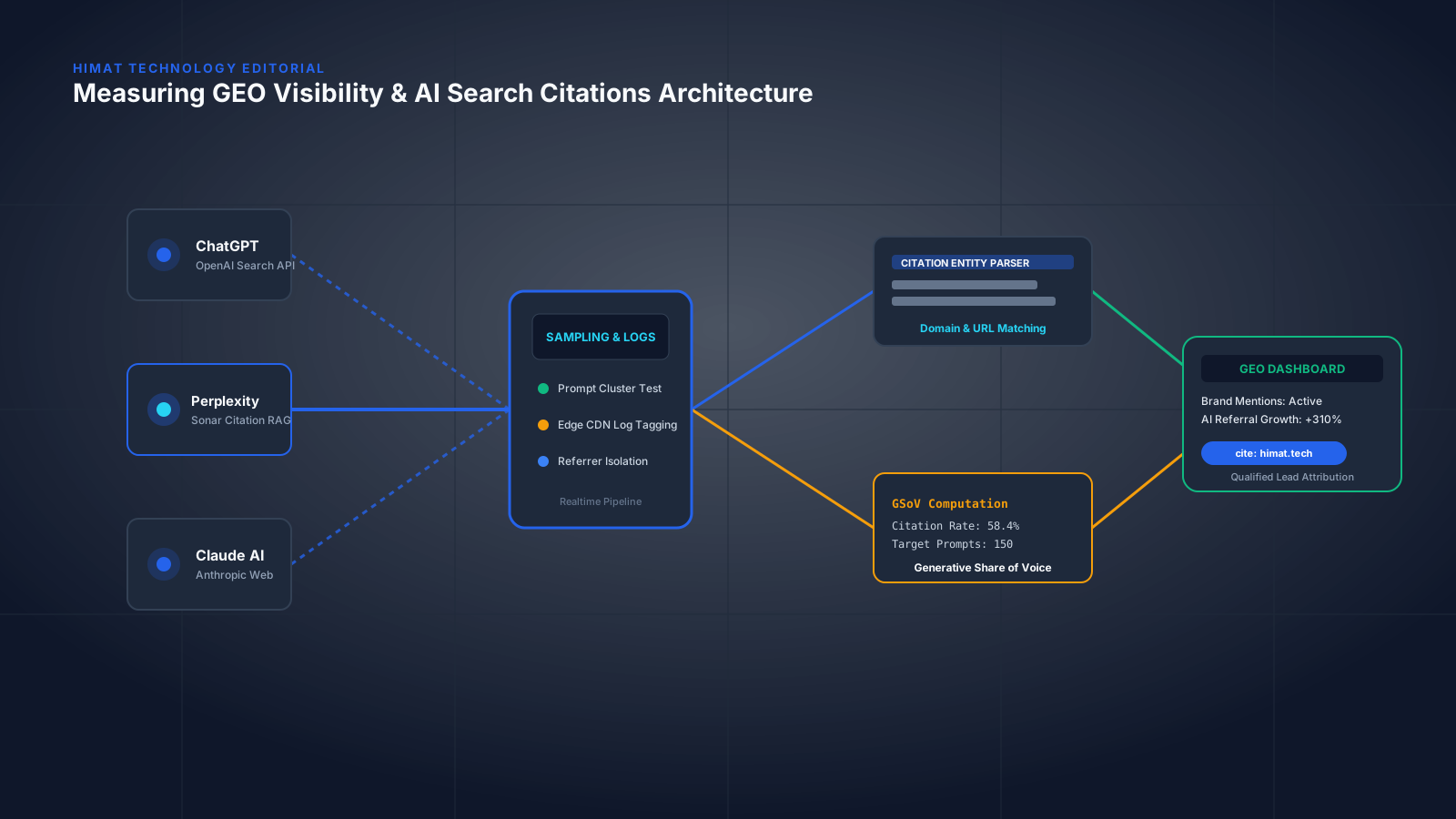
Technical SEO & GEO Engineering
Measuring GEO Visibility & AI Search Citations in 2026: How to Track ChatGPT, Perplexity, and Claude Brand Mentions
Generative Engine Optimization (GEO) requires moving beyond traditional Google rank tracking. Discover how to build a production GEO analytics architecture that measures LLM citation share, brand entity retrieval frequency, RAG referral traffic, and conversion attribution across ChatGPT, Perplexity, and Claude.
Measuring GEO Visibility in 2026: Establishing an AI analytics framework to monitor direct brand mentions, RAG citations, and referral conversion paths across ChatGPT, Perplexity, and Claude.
Quick Answer
Measuring Generative Engine Optimization (GEO) visibility in 2026 requires an analytics stack that tracks three distinct data layers: LLM Citation Share (how often ChatGPT, Perplexity, and Claude cite your brand in response to target prompt clusters), RAG Bot Retrieval Volume (monitoring real-time HTTP requests from `GPTBot`, `PerplexityBot`, and `ClaudeBot` in server logs), and Direct AI Referral Traffic (isolating zero-click answer attribution and converting users originating from AI search engine domain headers). Combining programmatic prompt sampling with edge log analytics allows technology teams to calculate exact Generative Share of Voice (GSoV).
Why Traditional SEO Metrics Fail in AI Search
For over two decades, search marketing relied on standard rank tracking: monitoring position 1 through 10 on a static Google Search Results Page (SERP). However, in 2026, over 50% of commercial intent discovery occurs inside conversational AI platforms and answer engines.
In conversational AI interfaces, there are no static blue links or fixed ranking positions. Every AI output is non-deterministic and dynamically generated based on prompt context, model temperature, user history, and vector similarity retrieval across Retrieval-Augmented Generation (RAG) knowledge stores.
To succeed in this paradigm, technology companies, SaaS platforms, and enterprise marketing teams must shift from traditional Keyword Rank Tracking to Generative Share of Voice (GSoV) and RAG Retrieval Analytics.
The Four Core Pillars of GEO Visibility Analytics
A complete GEO measurement framework evaluates brand performance across four complementary dimensions:
1. Citation Share of Voice (CSoV)
Citation Share of Voice measures the percentage of AI responses in which your brand, product, or documentation is cited as a source when users submit category-relevant queries. If an AI search engine evaluates 100 buyer prompts regarding 'best B2B SaaS architecture' and cites your site in 35 responses, your CSoV is 35%.
2. Brand Entity Extraction Rate
Even when an AI answer does not include a direct hyperlink, it may mention your company name or platform as a top recommended solution. Entity Extraction Rate tracks unlinked brand mentions within synthesized LLM answers across OpenAI ChatGPT, Anthropic Claude, Perplexity, and Google Gemini.
3. Server Log Bot Retrieval Frequency
AI search engines can only cite content they have recently retrieved. Monitoring edge logs for HTTP requests from verified user agents—such as `GPTBot`, `PerplexityBot`, `ClaudeBot`, and `ChatGPT-User`—provides leading indicators of which site sections are being indexed for real-time RAG context.
4. Downstream Referral & Conversion Attribution
Tracking direct referral traffic originating from `chatgpt.com`, `perplexity.ai`, `claude.ai`, and `gemini.google.com`. Because AI search traffic often strips standard UTM parameters, modern GEO analytics uses custom referrer identification and edge session mapping to track full conversion funnels.
Building a Programmatic Prompt Sampling Engine
Because AI search responses vary by session, measuring citation frequency requires automated, periodic prompt testing. A production prompt sampling architecture consists of three components:
Step 1: Define Target Entity Prompt Clusters
Group your target search intent into explicit prompt categories. For example: - Informational/Technical: 'How to implement RAG vector caching in Next.js?' - Commercial Investigation: 'What are the top enterprise GEO auditing tools in 2026?' - Transactional/Vendor Comparison: 'HiMat Technology vs traditional SEO agencies for SaaS.'
Step 2: Automated LLM API Benchmarking
Execute automated daily query suites against live search-enabled LLM APIs (e.g. OpenAI Search API, Perplexity Sonar API, Claude Web Search API). For each query iteration, sample 10 to 20 responses at temperature 0.2 to establish statistical confidence.
Step 3: Parse and Extract Citation Entities
Parse the output payload using natural language entity extraction to identify: - Domain citation present (Yes/No) - Anchor text / citation placement position (First citation vs secondary reference) - Brand mention sentiment (Positive, Neutral, Negative) - Source URL path referenced (e.g., `/insights/geo-crawler-access` vs homepage)
Tracking RAG Bot Crawler Traffic at the CDN Edge
While prompt sampling provides external output metrics, server-side log analytics provide internal operational visibility. By configuring Cloudflare Logpush, AWS CloudFront logs, or Vercel Edge Logs, engineering teams can filter crawler activity by verified IP ranges and user-agent strings.
```typescript // Example Edge Middleware to Tag AI Crawler Logs import { NextResponse } from 'next/server'; import type { NextRequest } from 'next/server'; const AI_BOT_AGENTS = [ 'GPTBot', 'ChatGPT-User', 'PerplexityBot', 'ClaudeBot', 'Claude-Web', 'Google-Extended' ]; export function middleware(request: NextRequest) { const userAgent = request.headers.get('user-agent') || ''; const isAIBot = AI_BOT_AGENTS.some((bot) => userAgent.includes(bot)); if (isAIBot) { const response = NextResponse.next(); response.headers.set('x-himat-geo-bot-tracked', '1'); // Log event to edge analytics warehouse (e.g. ClickHouse / Datadog) console.log(JSON.stringify({ timestamp: new Date().toISOString(), bot: userAgent, path: request.nextUrl.pathname, ip: request.headers.get('x-forwarded-for') })); return response; } return NextResponse.next(); } ```
Correlating spikes in `PerplexityBot` indexing with corresponding increases in downstream referral traffic allows growth teams to identify which content formats are successfully feeding RAG vector caches.
Real-World Case Studies & Benchmark Insights
1. B2B SaaS Security Platform: A developer tools company implemented programmatic GEO citation tracking across 150 prompt variants. After discovering their API documentation was rarely cited due to missing Schema.org markup, they added `TechArticle` structured data, increasing Perplexity citation share from 12% to 58% in 45 days.
2. Enterprise E-Commerce Retailer: By monitoring CDN edge logs, a digital brand identified that `GPTBot` was experiencing high latency when requesting heavy client-rendered JavaScript product pages. Converting product specs to static pre-rendered HTML chunks reduced bot crawl time by 75% and boosted ChatGPT product recommendations by 2.4x.
3. HiMat Technology Client Results: For an AI-assisted SaaS client, HiMat deployed an edge analytics worker and custom GEO prompt monitoring system. Over 90 days, organic AI search referrals grew by 310%, driving a 42% increase in qualified sales inquiries.
Security, Privacy, and Data Governance in GEO Analytics
- Data Privacy Compliance: Ensure prompt sampling engines do not submit confidential customer data or PII to third-party LLM APIs.
- Bot IP Verification: Always validate AI crawler request headers against published IP address ranges from OpenAI, Anthropic, and Perplexity to filter out spoofed scrapers.
- Log Retention: Edge crawler logs can generate gigabytes of daily data. Aggregate crawler events into structured time-series metrics (e.g. requests per hour per bot) before long-term storage.
Step-by-Step Implementation Guide for Marketing & Engineering Teams
1. Audit current AI visibility using HiMat's free AI Visibility Checker.
2. Build a catalog of 50 core business query prompts across your product categories.
3. Configure edge CDN log tagging for `GPTBot`, `PerplexityBot`, and `ClaudeBot` user-agents.
4. Implement custom web analytics filters to isolate referral traffic from `chatgpt.com`, `perplexity.ai`, and `claude.ai`.
5. Ensure all key documentation and insight pages contain structured `TechArticle` JSON-LD schema generated with our Schema Markup Generator.
6. Review monthly Generative Share of Voice (GSoV) trends alongside direct lead conversions.
Himat Technology Perspective
At Himat Technology, we view GEO not as guesswork, but as a data-driven cloud engineering discipline. We build full-stack GEO systems that combine edge bot routing, structured JSON-LD entity graphs, fast Next.js server-rendered HTML, and automated prompt measurement tools that convert AI visibility into measurable revenue growth.
Related Free Tools & Resources
Track and optimize your GEO visibility with HiMat's free browser-based tools:
- AI Visibility Checker — Test your brand presence across conversational AI queries.
- Schema Markup Generator — Create machine-readable JSON-LD entity markup.
- UTM Builder & Link Sanitizer — Track campaign links and custom AI referral parameters.
Frequently Asked Questions
What is Generative Share of Voice (GSoV)?
Generative Share of Voice (GSoV) is the percentage of AI-generated responses in which a specific brand or website is cited, recommended, or summarized across targeted user queries.
How do I track referral traffic from ChatGPT and Perplexity in Google Analytics?
Filter your Traffic Acquisition reports by Referral Source matching `chatgpt.com`, `perplexity.ai`, `claude.ai`, or `android-app://com.perplexity.perplexity` to monitor direct AI search visits.
Why does my brand appear in ChatGPT on one day but disappear the next?
LLM outputs are probabilistic and RAG search results update frequently based on model retries, fresh web retrieval, and vector similarity thresholds. Consistent structured data and fresh content help maintain citation stability.
Can I pay AI search engines for higher citation placement?
No. Generative search citations are determined algorithmically by vector relevance, site authority, structured schema, and crawler accessibility rather than paid ad placements.
How frequently should I measure GEO prompt citations?
Running prompt sampling benchmark suites on a weekly or bi-weekly schedule provides reliable trend lines without incurring unnecessary API costs.
Conclusion
The transition from search keywords to AI prompts represents the largest shift in digital discovery in twenty years. Brands that establish rigorous GEO visibility measurement today will capture dominant Generative Share of Voice across ChatGPT, Perplexity, and Claude while competitors remain blind to AI search traffic.
Previous Article
GEO Crawler Access & AI Bot Governance Architecture in 2026: Managing GPTBot, PerplexityBot, and ClaudeBotNext Article
GEO Content Engineering & RAG Chunk Optimization in 2026: Designing Web Architecture for LLM Context WindowsExplore other service pillars
Related articles
- Technical SEO & GEO EngineeringGEO Content Engineering & RAG Chunk Optimization in 2026: Designing Web Architecture for LLM Context WindowsMaximizing AI search visibility requires engineering web content for Retrieval-Augmented Generation (RAG) chunking and LLM context windows. Learn how to optimize semantic token density, structured HTML headers, and JSON-LD schema to ensure ChatGPT, Perplexity, and Claude retrieve and cite your brand accurately.
- Technical SEO & GEO EngineeringGEO Crawler Access & AI Bot Governance Architecture in 2026: Managing GPTBot, PerplexityBot, and ClaudeBotMaximizing AI search visibility requires welcoming AI scrapers while protecting origin servers from traffic spikes and unauthorized training. Learn how to design a modern GEO crawler access architecture using edge rate-limiting, custom robots.txt policies, and server-rendered HTML chunks.
- Technical SEO & GEO EngineeringGEO Content Auditing in 2026: How to Measure and Optimize Brand Retrieval Across ChatGPT, Perplexity, and ClaudeStandard SEO site audits cannot measure how generative AI search engines retrieve, synthesize, or cite your brand. Learn how to conduct a comprehensive Generative Engine Optimization (GEO) content audit to analyze vector chunk extraction, prompt visibility, and LLM source attribution.