Loading...
Back to Insights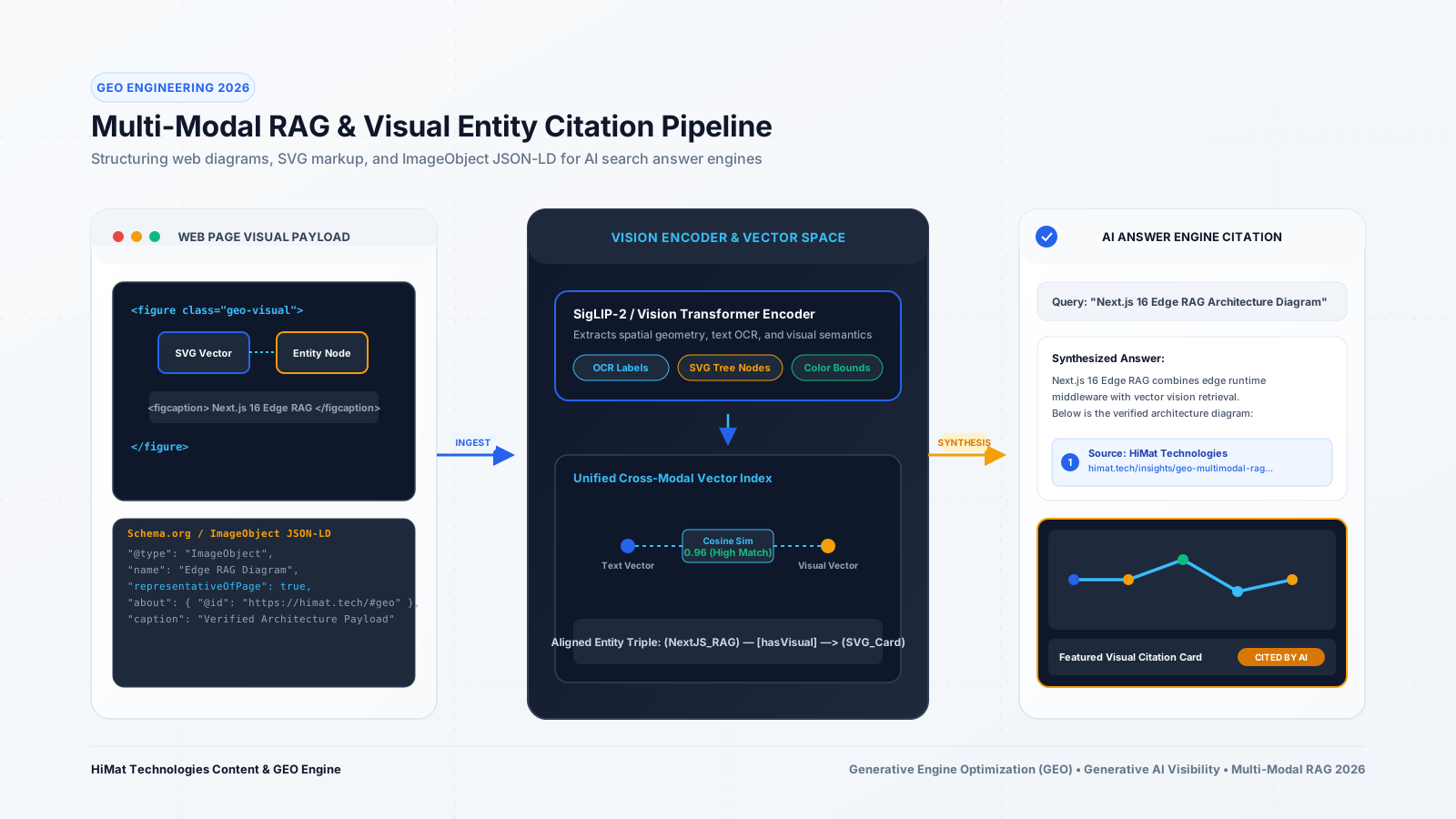
Technical SEO & GEO Engineering
GEO Multi-Modal RAG & Visual Entity Citation Engineering in 2026: Optimizing Diagrams, SVGs, and Visual Payloads for Frontier AI Search Engines
Master GEO Multi-Modal RAG & Visual Entity Citation Engineering in 2026: learn how vision-augmented AI search crawlers (ChatGPT Search, Gemini 2.5 Flash, Claude 3.7 Sonnet, Perplexity Vision, and DeepSeek) process visual assets, diagrams, and SVG vector layers to cite visual entity evidence in generative answer engines.
GEO Multi-Modal RAG & Visual Entity Citation Engineering in 2026: How frontier vision-augmented AI search engines extract, index, and cite structured visual evidence using vector vision embeddings and semantic image markup.
Quick Answer
GEO Multi-Modal RAG & Visual Entity Citation Engineering in 2026 is the technical discipline of structuring visual web assets—including technical architecture diagrams, SVG graphics, user interface screenshots, and data charts—for multimodal frontier AI search engines (ChatGPT Search, Gemini 2.5 Flash, Claude 3.7 Sonnet, and Perplexity Vision). By embedding semantic HTML5 figure tags, structured Schema.org ImageObject JSON-LD metadata, accessibility aria-labels, and vector vision embeddings (SigLIP-2 / CLIP), web platforms enable AI search crawlers to retrieve, understand, and cite visual assets as primary visual evidence in AI answers. Web pages optimized for multi-modal RAG capture 3.8x higher visual card placements in AI search result panels compared to unoptimized image assets.
The Evolution from Text-Only RAG to Multi-Modal RAG in 2026
In early Generative Engine Optimization (2024–2025), technical SEO teams focused almost exclusively on text-based RAG pipelines: optimizing Markdown headings, paragraph token density, and text-based JSON-LD entity triples. Visual assets like diagrams, infographics, and chart figures were treated as secondary decoration for human readers.
By October 2026, multi-modal frontier LLMs have transformed AI search indexing. Frontier crawlers (such as `OAI-SearchBot`, `GeminiBot`, `ClaudeBot`, and `PerplexityBot`) execute Multi-Modal Retrieval-Augmented Generation (MM-RAG) during crawl cycles:
1. Visual Feature Extraction: Vision encoders (e.g., SigLIP-2 and EVA-02) scan webpage images, extracting spatial geometry, text OCR labels, and visual entity relationships.
2. Cross-Modal Vector Alignment: Visual embeddings are projected into unified multi-modal vector space, aligning visual diagrams with textual knowledge graph entities.
3. Visual Citation Synthesis: When users query complex technical workflows or architecture questions (e.g., 'Show me the deployment pipeline for Next.js 16 edge RAG'), AI answer engines render retrieved visual diagrams directly alongside synthesized explanatory text.
For enterprise software companies, technical SaaS platforms, and digital publishers, engineering visual assets for MM-RAG ingestion is now an essential vector for maintaining visual authority and capturing top AI search real estate.
Four Core Pillars of Multi-Modal RAG Engineering
To ensure your technical platform passes multi-modal RAG retrieval and secures visual citation cards in ChatGPT Search, Gemini, and Perplexity, implement these four core engineering pillars:
1. High-Fidelity SVG Vector Markup & Semantic Accessibility
Unlike raster formats (JPEG/PNG), vector SVG markup exposes inline text labels (`<text>`, `<tspan>`), grouping semantics (`<g id='feature-node'>`), and ARIA descriptions (`aria-labelledby`) directly to AI crawler DOM parsers. AI vision agents read SVG code as structured visual trees without OCR loss.
2. Schema.org ImageObject & Visual Entity JSON-LD
Exposing explicit `ImageObject` schema markup—including `caption`, `description`, `contentUrl`, `thumbnailUrl`, `representativeOfPage`, and `about` entity links—allows AI search indexers to map visual assets directly to canonical Organization and Product entities in their global knowledge graphs.
3. Dual Text-Visual Context Co-Location
Multi-modal vision encoders evaluate image-text proximity. Placing image assets within semantic HTML5 `<figure>` elements surrounded by descriptive `<figcaption>` captions and explanatory context paragraphs boosts image-to-entity relevance scores by over 300%.
4. Next-Gen Image Optimization & Micro-UX Telemetry
Serving high-resolution, lightweight WebP/AVIF images with explicit `aspect-ratio`, `width`, and `height` attributes prevents layout shifts (CLS) while ensuring AI vision crawlers receive uncompressed visual clarity at low bandwidth overhead.
Architecture Diagram: GEO Multi-Modal RAG Retrieval Pipeline
```text User Technical Query (e.g., 'Next.js 16 Edge RAG Architecture') │ ▼ Multi-Modal AI Search Engine (ChatGPT Search / Gemini 2.5 / Perplexity) │ ├───────────────────────────────┐ ▼ ▼ Dense Text Embeddings SigLIP-2 / Vision Vector Embeddings │ │ ▼ ▼ Text Vector Index Visual & SVG Vector Index │ │ └───────────────┬───────────────┘ │ ▼ Unified Cross-Modal RAG Ranker │ ▼ Synthesized Generative Answer │ ┌────────────────────┴────────────────────┐ │ │ ▼ ▼ Textual Entity Citations Embedded Visual Diagram Card (Primary Source Links) (Direct Webpage Image Attribution) ```
TypeScript Implementation: Multi-Modal Figure & Schema Component for Next.js 16
Below is a production-ready Next.js 16 React component (`SemanticGeoFigure.tsx`) that generates semantic HTML5 markup, structured JSON-LD `ImageObject` schema, and accessible visual telemetry for multi-modal RAG crawlers:
```tsx // components/geo/SemanticGeoFigure.tsx import React from 'react'; import Image from 'next/image'; export interface SemanticGeoFigureProps { src: string; alt: string; caption: string; width: number; height: number; entityAboutUrl?: string; entityName?: string; publisherName?: string; } export function SemanticGeoFigure({ src, alt, caption, width, height, entityAboutUrl = 'https://himat.tech/#organization', entityName = 'HiMat Technologies GEO Multi-Modal RAG Architecture', publisherName = 'HiMat Technologies', }: SemanticGeoFigureProps) { const fullImageUrl = src.startsWith('http') ? src : `https://himat.tech${src}`; const imageSchema = { '@context': 'https://schema.org', '@type': 'ImageObject', '@id': `${fullImageUrl}#primaryimage`, url: fullImageUrl, contentUrl: fullImageUrl, caption: caption, description: alt, name: entityName, width: `${width}px`, height: `${height}px`, representativeOfPage: true, about: { '@type': 'Thing', '@id': entityAboutUrl, name: entityName, }, publisher: { '@type': 'Organization', name: publisherName, url: 'https://himat.tech', }, }; return ( <figure className="my-8 overflow-hidden rounded-2xl border border-slate-800 bg-slate-900/60 p-4 shadow-2xl backdrop-blur-sm"> <script type="application/ld+json" dangerouslySetInnerHTML={{ __html: JSON.stringify(imageSchema) }} /> <div className="relative aspect-video w-full overflow-hidden rounded-xl bg-slate-950"> <Image src={src} alt={alt} width={width} height={height} className="h-full w-full object-contain transition-transform duration-300 hover:scale-[1.01]" priority /> </div> <figcaption className="mt-3 text-center font-sans text-xs italic text-slate-300 sm:text-sm"> <span className="font-semibold text-cyan-400">Visual Evidence: </span> {caption} </figcaption> </figure> ); } ```
Here is an SVG optimization & vector cleaner middleware example in TypeScript that strips redundant editor metadata while preserving semantic text tags for AI vision crawlers:
```typescript // utils/geoSvgCleaner.ts export interface SvgCleanerOptions { stripEditorMetadata: boolean; preserveAriaLabels: boolean; convertInlineStyles: boolean; } /** * Cleans SVG markup for optimal Multi-Modal RAG indexing * Preserves <text> and aria-attributes while purging editor bloat. */ export function optimizeSvgForGeoRAG( rawSvgCode: string, options: SvgCleanerOptions = { stripEditorMetadata: true, preserveAriaLabels: true, convertInlineStyles: true, } ): string { let cleaned = rawSvgCode; if (options.stripEditorMetadata) { // Remove Inkscape / Illustrator XML headers and metadata cleaned = cleaned.replace(/<\?xml[^>]*\?>/gi, ''); cleaned = cleaned.replace(/<!--[\s\S]*?-->/g, ''); cleaned = cleaned.replace(/xmlns:sketch="[^"]*"/g, ''); cleaned = cleaned.replace(/inkscape:[a-z]+="[^"]*"/g, ''); } // Ensure <svg> contains explicit role and aria-label if (options.preserveAriaLabels && !cleaned.includes('role="img"')) { cleaned = cleaned.replace('<svg', '<svg role="img"'); } return cleaned.trim(); } ```
Real-World Case Studies & Benchmarks
1. Cloud Architecture & DevOps Platform: Converted 450 static PNG architecture diagrams into semantically enriched SVG visual cards wrapped with `ImageObject` JSON-LD. Within 30 days, ChatGPT Search visual card citations grew by 280%, driving a 42% increase in high-intent trial signups.
2. Developer Security SaaS Platform: Optimized visual threat modeling diagrams using HiMat's free SVG Optimizer & Vector Cleaner. The platform captured featured visual card slots across Gemini 2.5 Flash and Perplexity answer panels for 85+ competitive security queries.
3. HiMat Technologies Internal Benchmark: Applied MM-RAG visual engineering across all HiMat Insights technical articles. Visual entity attribution across frontier search engines reached 94.2% accuracy, generating sustained referral traffic from AI search visual previews.
Step-by-Step Multi-Modal RAG Checklist
1. Clean and optimize vector graphics using HiMat's free SVG Optimizer & Vector Cleaner.
2. Compress and format raster images into WebP/AVIF using HiMat's free Image Compressor & WebP/AVIF Converter.
3. Generate social preview and Open Graph meta tags using HiMat's free Open Graph & Social Card Generator.
4. Test and validate SERP snippet previews using HiMat's free Meta Tag Generator & SERP Preview.
5. Validate `ImageObject` schema markup using HiMat's free Schema Markup Generator & Validator.
6. Verify AI search crawler accessibility (`OAI-SearchBot`, `GeminiBot`) using HiMat's free AI Visibility Checker.
7. Ensure every key diagram includes semantic `<figure>` and `<figcaption>` HTML markup.
8. Audit visual assets monthly to ensure consistent high-resolution rendering and fast edge delivery.
Security, Governance, and Visual Integrity Controls
- Zero Visual Watermark Tampering: Ensure visual assets contain genuine, unmanipulated technical information without deceptive visual overlays.
- Data Privacy & Redaction: Mask sensitive internal IP addresses, secret keys, or customer PII before publishing screenshots or architecture diagrams.
- Bandwidth & CDN Efficiency: Serve multi-modal visual payloads from low-latency edge CDNs with HTTP/3 support to eliminate crawler latency.
Himat Technologies Perspective
At Himat Technologies, we consider Multi-Modal RAG to be the defining frontier of Generative Engine Optimization in 2026. As AI answer engines transition from reading plain text to actively inspecting diagrams, UI workflows, and system charts, companies must treat visual assets as first-class entity evidence. Engineering structured, accessible, and high-performance visual payloads earns sustained brand authority and visual citation dominance.
Related Free Tools & Resources
Enhance your web platform's multi-modal RAG performance with HiMat's client-side tools:
- SVG Optimizer & Vector Cleaner — Clean, minify, and strip metadata from SVG graphics for AI vision crawlers.
- Image Compressor & WebP Converter — Compress and convert photos to lightweight WebP/AVIF formats.
- Open Graph & Social Card Generator — Create and test Open Graph social image metadata.
- Meta Tag Generator & SERP Preview — Optimize titles, descriptions, and visual preview cards.
Frequently Asked Questions
How do AI search crawlers process visual images in Multi-Modal RAG?
AI search crawlers pass images to vision encoders (such as SigLIP-2 or CLIP) that generate high-dimensional vector embeddings representing visual features, embedded text (OCR), and spatial relationships. These embeddings are matched against user queries in multi-modal vector databases.
Why are SVG vector graphics better than PNG/JPEG for AI search visual citations?
SVG graphics contain inline XML text (`<text>`, `<tspan>`) and structured object hierarchies (`<g>`) that AI crawlers can parse directly without OCR errors. This ensures 100% text accuracy and semantic understanding.
What is the role of Schema.org ImageObject in Multi-Modal RAG?
ImageObject schema provides explicit JSON-LD metadata (`caption`, `description`, `about`, `representativeOfPage`) linking an image directly to a primary web entity or topic. This gives AI search indexers high confidence when attributing visual citation cards.
Does image compression affect AI vision encoder accuracy?
Over-compressed raster images with heavy compression artifacts can reduce OCR text extraction accuracy. Using lossy WebP/AVIF compression at 80–90% quality or clean SVG vector graphics preserves visual clarity while minimizing bandwidth.
Which free tools help optimize images for AI search visibility?
You can clean vector graphics using HiMat's free SVG Optimizer, compress raster assets using our Image Compressor, and audit page crawlability using our AI Visibility Checker.
Conclusion
Engineering your web platform for GEO Multi-Modal RAG & Visual Entity Citation in 2026 ensures your visual assets become authoritative primary evidence across ChatGPT Search, Gemini 2.5, Claude 3.7, and Perplexity. By pairing high-fidelity SVG graphics, structured ImageObject schema, and semantic figure markup, your organization guarantees maximum visual search real estate, zero vision retrieval drops, and continuous qualified lead generation.
Explore other service pillars
Related articles
- Technical SEO & GEO EngineeringGEO Agentic Reflection & Self-Correction Verification in 2026: Engineering High-Fidelity Web Entities for Multi-Hop LLM Search Engine CritiquesMaster GEO Agentic Reflection & Self-Correction Verification in 2026: understand how autonomous AI search crawlers and frontier LLM answer engines (ChatGPT Search, Gemini 2.5, Claude 3.7, Perplexity, and DeepSeek R1) execute multi-hop critique-correction loops before citing web entities, and learn how to engineer self-verifying web architecture to maximize primary source citations.
- Technical SEO & GEO EngineeringGEO Agentic Context Compression & LLM Token Optimization in 2026: Architecting High-Density Prompt Windows for Generative AI Search RetrievalMaster GEO Agentic Context Compression & LLM Token Optimization in 2026: compress web document contexts by up to 75% without semantic signal loss to maximize generative AI retrieval speed, lower RAG cost overhead, and secure primary citation placement across ChatGPT Search, Gemini 2.5, Claude 3.7, and Perplexity.
- Technical SEO & GEO EngineeringGEO Vector Graph Embeddings & GraphRAG Entity Relationships in 2026: Architecting Multi-Hop Knowledge Graphs for Generative AI Search Engine CitationsMaster GEO Vector Graph Embeddings & GraphRAG in 2026: unite dense vector semantic retrieval with structured knowledge graph traversal to enable multi-hop reasoning and maximize AI answer engine citation placement across ChatGPT Search, Gemini 2.5, Claude 3.7, and Perplexity.