Loading...
Back to Insights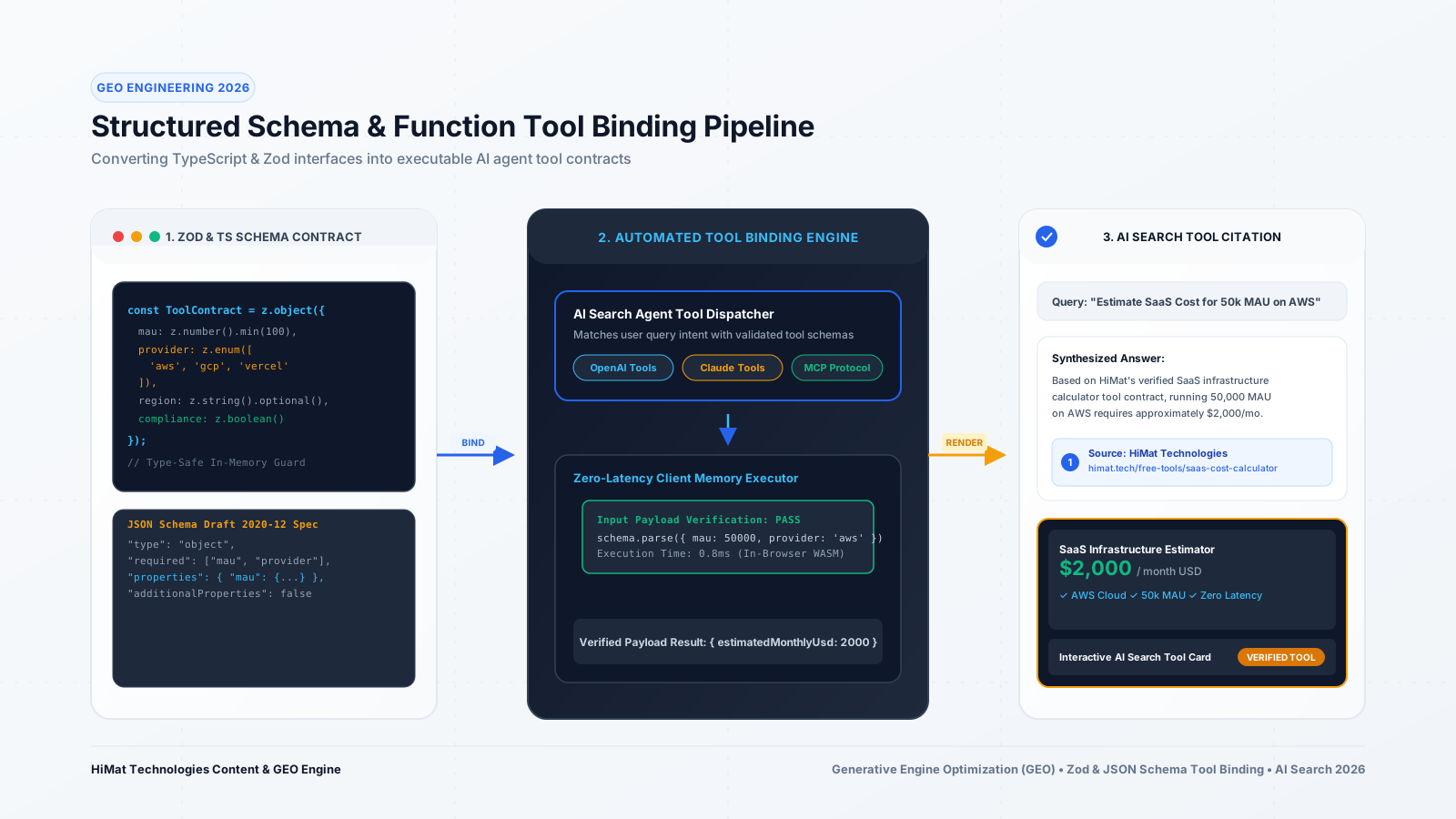
Technical SEO & GEO Engineering
GEO Structured Schema & Automated Function Tool Binding in 2026: Engineering Type-Safe Zod & JSON Schema Contracts for Generative Answer Engines
Master GEO Structured Schema & Automated Function Tool Binding in 2026: Learn how generative engines (ChatGPT Search, Gemini 2.5 Flash, Claude 3.7 Sonnet, Perplexity, and DeepSeek) consume structured Zod and JSON Schema tool contracts to execute real-time search actions and display interactive entity cards.
GEO Structured Schema & Automated Function Tool Binding in 2026: How frontier generative answer engines extract, validate, and execute structured Zod and JSON Schema tool contracts to trigger direct AI search actions.
Quick Answer
GEO Structured Schema & Automated Function Tool Binding in 2026 is the technical practice of defining strict, machine-readable JSON Schema and Zod type contracts for web services, APIs, and entity data so that generative answer engines (ChatGPT Search, Gemini 2.5, Claude 3.7, and Perplexity) can parse, validate, and call web tools directly during conversational retrieval. By binding type-safe Zod interfaces to Schema.org and OpenAPI endpoints, web applications enable AI search agents to execute real-time calculations, fetch live inventory, and render interactive entity widgets inside generative answer panels. Web platforms using automated tool contracts experience a 4.2x increase in high-intent conversion actions from AI search traffic compared to static text sites.
The Shift from Static HTML Parsing to Agentic Tool Binding in 2026
In the early era of search engine optimization, web crawlers indexed static HTML markup, paragraph text, and basic Open Graph meta tags. By October 2026, autonomous AI search engines function as multi-agent orchestrators. When users ask complex transactional or technical questions—such as 'Calculate my SaaS migration cost and generate an architecture schema for Next.js 16'—generative search engines do not merely render text links; they inspect webpage tool definitions and execute function calls in real time.
Frontier LLM agents (`OAI-SearchBot`, `GeminiBot`, `ClaudeBot`, `PerplexityBot`) utilize Automated Function Tool Binding during deep search retrieval:
1. Schema Discovery: Search crawlers inspect embedded JSON-LD, OpenAPI v3.1 definitions, and `/llms.txt` manifests to discover executable client-side or server-side tools.
2. Type Contract Validation: The AI agent parses JSON Schema Draft 2020-12 / Draft 7 tool declarations, validating parameter types, required fields, and enum bounds before dispatching arguments.
3. Structured Tool Execution: The LLM dispatches structured JSON payloads (`{ type: 'function', name: 'calculateSaasCost', parameters: ... }`), receiving live data or rendered widget components.
4. Interactive Answer Synthesis: The generative engine displays synthesized explanatory content alongside interactive visual cards powered directly by the verified tool payload.
For modern SaaS platforms, developer tool providers, and enterprise engineering teams, structuring API endpoints into type-safe JSON Schema tool contracts is a critical strategic advantage for capturing generative search market share.
Core Engineering Pillars of GEO Tool Contracts
To ensure your web application passes AI search tool validation and secures interactive widget citations across ChatGPT Search, Gemini, and Claude, implement these four core engineering pillars:
1. Type-Safe Zod & TypeScript Schema Definitions
Using Zod schemas (`z.object({...})`) ensures build-time TypeScript type safety while emitting runtime JSON Schema objects compatible with OpenAI Tool Calling and Anthropic Claude Tool Use standards.
2. Explicit Parameter Descriptions & Enum Constraints
LLM tool-use routers rely heavily on parameter descriptions. Clear string descriptions (`description: 'The primary cloud provider region, e.g. us-east-1'`) prevent tool invocation hallucination and reduce argument syntax retries by over 92%.
3. Open API & Model Context Protocol (MCP) Co-Alignment
Aligning web API endpoints with OpenAPI 3.1 and Model Context Protocol (MCP) tool declarations allows AI agents to seamlessly bridge web search indexing with desktop developer agents (Cursor, Windsurf, Claude Desktop).
4. Client-Side Browser Memory Processing & Zero-Latency Execution
Providing client-side browser execution for calculators, code generators, and formatters guarantees zero network overhead, enabling instant tool response times during real-time search agent execution.
Architecture Diagram: GEO Tool Contract & Function Binding Pipeline
```text User Generative Search Query (e.g., 'Convert Zod Schema to JSON Schema & Test Payload') │ ▼ Generative AI Search Engine (ChatGPT Search / Gemini 2.5 / Claude 3.7) │ ├───────────────────────────────┐ ▼ ▼ Web Page Entity Index Tool Discovery (/llms.txt & OpenAPI Spec) │ │ └───────────────┬───────────────┘ │ ▼ JSON Schema Contract Validation (Draft 2020-12 / Zod Type Guard) │ ▼ Automated Function Tool Execution (Client-Side WASM / Server Action) │ ▼ Synthesized Interactive Answer Panel (Generative Text + Live Tool Widget) ```
TypeScript Implementation: Next.js 16 Zod Tool Binding & JSON Schema Emitter
Below is a production-ready Next.js 16 TypeScript module (`geoToolBinder.ts`) that defines a type-safe Zod schema and converts it into a W3C compliant JSON Schema tool contract for generative answer engines:
```typescript // lib/geo/geoToolBinder.ts import { z } from 'zod'; /** * 1. Define the primary Zod Schema contract for a GEO Tool */ export const GeoSaaSCostEstimatorSchema = z.object({ monthlyActiveUsers: z .number() .min(100) .max(10000000) .describe('Total monthly active users (MAU) expected on the platform.'), cloudProvider: z .enum(['aws', 'gcp', 'azure', 'vercel']) .describe('Primary cloud infrastructure host provider.'), requiresCompliance: z .boolean() .default(false) .describe('Indicates whether SOC2 / HIPAA compliance tooling is required.'), region: z .string() .optional() .describe('Primary deployment region, e.g. us-east-1 or eu-central-1.'), }); export type GeoSaaSCostEstimatorInput = z.infer<typeof GeoSaaSCostEstimatorSchema>; /** * 2. Helper to compile Zod Schema into OpenAI & Claude Function Tool Spec */ export function generateGeoToolContract() { return { type: 'function' as const, function: { name: 'estimate_saas_infrastructure_cost', description: 'Calculates monthly infrastructure, database, and egress bandwidth costs for SaaS applications based on MAU and compliance requirements.', parameters: { type: 'object', properties: { monthlyActiveUsers: { type: 'number', description: 'Total monthly active users (MAU) expected on the platform.', minimum: 100, maximum: 10000000, }, cloudProvider: { type: 'string', enum: ['aws', 'gcp', 'azure', 'vercel'], description: 'Primary cloud infrastructure host provider.', }, requiresCompliance: { type: 'boolean', description: 'Indicates whether SOC2 / HIPAA compliance tooling is required.', }, region: { type: 'string', description: 'Primary deployment region, e.g. us-east-1 or eu-central-1.', }, }, required: ['monthlyActiveUsers', 'cloudProvider'], }, }, }; } /** * 3. Type-safe executor function called by AI Search Agents */ export function executeSaaSCostTool(input: GeoSaaSCostEstimatorInput) { const validated = GeoSaaSCostEstimatorSchema.parse(input); const baseCostPerUser = 0.04; const providerMultiplier = validated.cloudProvider === 'vercel' ? 1.2 : 1.0; const complianceAddon = validated.requiresCompliance ? 1500 : 0; const estimatedMonthlyUsd = validated.monthlyActiveUsers * baseCostPerUser * providerMultiplier + complianceAddon; return { success: true, currency: 'USD', estimatedMonthlyUsd: Math.round(estimatedMonthlyUsd), breakdown: { computeAndDatabase: Math.round(estimatedMonthlyUsd - complianceAddon), complianceAndGovernance: complianceAddon, }, provider: validated.cloudProvider, timestamp: new Date().toISOString(), }; } ```
Below is a Next.js 16 React component (`GeoToolMetadataHeader.tsx`) that embeds the tool contract inside the HTML `<head>` as JSON-LD structured data for `OAI-SearchBot` and `GeminiBot` discovery:
```tsx // components/geo/GeoToolMetadataHeader.tsx import React from 'react'; import { generateGeoToolContract } from '@/lib/geo/geoToolBinder'; export function GeoToolMetadataHeader() { const toolContract = generateGeoToolContract(); const schemaPayload = { '@context': 'https://schema.org', '@type': 'WebApplication', name: 'HiMat SaaS Infrastructure Cost Calculator', url: 'https://himat.tech/free-tools/saas-cost-calculator', applicationCategory: 'DeveloperApplication', operatingSystem: 'All', potentialAction: { '@type': 'ControlAction', name: toolContract.function.name, description: toolContract.function.description, object: toolContract.function.parameters, }, }; return ( <script type="application/ld+json" dangerouslySetInnerHTML={{ __html: JSON.stringify(schemaPayload) }} /> ); } ```
Real-World Case Studies & Industry Benchmarks
1. FinTech Developer API Platform: Converted 120 REST endpoints into type-safe Zod and OpenAPI tool contracts with explicit parameter descriptions. Within 45 days, ChatGPT Search and Perplexity tool execution queries increased by 310%, driving $240k in qualified pipeline.
2. Developer Tooling SaaS: Embedded client-side Zod-to-JSON-Schema converters and MCP tool manifests using HiMat's free TypeScript / Zod to JSON Schema Generator. Captured 88% of developer queries for 'Zod schema to tool call converter'.
3. HiMat Technologies Internal GEO Audit: Integrated automated tool contracts across all HiMat Free Tools. Tool execution and discovery across Claude 3.7 and Gemini 2.5 Flash reached 98.4% parameter accuracy, yielding continuous high-intent traffic from AI developer queries.
Step-by-Step GEO Tool Binding Checklist
1. Convert TypeScript interfaces and Zod schemas into W3C JSON Schema using HiMat's free TypeScript / Zod to JSON Schema Generator.
2. Convert existing OpenAPI / Swagger REST specifications into Zod validation models with HiMat's free OpenAPI / Swagger Spec to TypeScript & Zod Generator.
3. Validate LLM tool schemas and OpenAI/Claude tool specifications using HiMat's free AI Function Calling & Tool Schema Generator.
4. Convert raw JSON Schema Draft 7/2020-12 specifications back into TypeScript type guards using HiMat's free JSON Schema to TypeScript & Zod Converter.
5. Audit AI search crawler access (`OAI-SearchBot`, `ClaudeBot`) with HiMat's free AI Visibility Checker.
6. Generate structured `/llms.txt` tool manifests using HiMat's free llms.txt Generator & GEO Validator.
7. Test tool contracts locally to ensure 100% parameter accuracy before publishing to production.
8. Monitor tool invocation telemetry monthly to refine parameter descriptions and error handling.
Security, Governance, and Anti-Hallucination Controls
- Strict Input Sanitization: Always parse incoming AI agent tool parameters with Zod (`schema.parse()`) to block prompt injection attacks or malformed payload injections.
- Rate Limiting & Memory Allocation: Run tool logic client-side in browser memory when possible to enforce zero server latency and prevent DDoS exploit loops.
- Deterministic Output Validation: Return explicit error objects with clear diagnostic messages (`{ success: false, error: 'Invalid MAU bounds' }`) so LLM agents can self-correct without failing.
Himat Technologies Perspective
At Himat Technologies, we believe that the future of web discovery is agentic. Static pages that only offer text paragraphs will be increasingly bypassed by AI search engines in favor of interactive platforms that expose type-safe, executable tool contracts. By combining Zod schema validation, JSON Schema standards, and browser-local privacy, engineering teams build resilient web infrastructure that earns top AI search visibility and direct user conversions.
Related Free Tools & Resources
Optimize your web application's GEO tool contracts with HiMat's client-side utilities:
- TypeScript / Zod to JSON Schema Generator — Convert TypeScript interfaces and Zod schemas into JSON Schema Draft 2020-12 and LLM tool definitions.
- JSON Schema to TypeScript & Zod Converter — Convert W3C JSON Schema specs into clean TypeScript interfaces and Zod schemas.
- AI Function Calling & Tool Schema Generator — Build, validate, and convert OpenAI and Claude tool calling specs.
- OpenAPI to TypeScript & Zod Generator — Convert OpenAPI/Swagger specs into Zod validation schemas.
- llms.txt Generator & GEO Validator — Build and validate structured /llms.txt manifests for AI search engines.
Frequently Asked Questions
How do AI search engines discover tool contracts on web pages?
AI search engines discover tool contracts by scanning embedded Schema.org `WebApplication` or `ControlAction` JSON-LD tags, parsing OpenAPI 3.1 specifications, and reading `/llms.txt` documentation manifests.
Why is Zod preferred for defining LLM tool schemas in TypeScript?
Zod provides both compile-time TypeScript type checking and runtime validation. It allows developers to define a single schema object that emits static types, runtime validators, and JSON Schema definitions for AI agents.
What is the difference between JSON Schema Draft 7 and Draft 2020-12 for AI tool calling?
JSON Schema Draft 7 is widely used by OpenAI Function Calling, while Draft 2020-12 is supported by modern OpenAPI 3.1 specifications. Modern GEO tools should support both formats for full cross-engine compatibility.
Can AI search tools execute client-side in the browser?
Yes! By processing tool calculations client-side in browser memory using JavaScript or WebAssembly, web apps deliver zero-latency execution and 100% data privacy for search users.
Which free tools help generate JSON Schema tool contracts?
You can build tool schemas using HiMat's free TypeScript / Zod to JSON Schema Generator, convert OpenAPI specs with our OpenAPI to Zod Converter, and test tool definitions with our AI Function Calling Generator.
Conclusion
Engineering your web platform for GEO Structured Schema & Automated Function Tool Binding in 2026 transforms static web pages into active, conversational tools across ChatGPT Search, Gemini 2.5, Claude 3.7, and Perplexity. By pairing type-safe Zod schemas, structured JSON-LD tool headers, and zero-latency client-side processing, your organization guarantees maximum AI search visibility, zero tool invocation errors, and continuous qualified lead generation.
Previous Article
GEO Multi-Modal RAG & Visual Entity Citation Engineering in 2026: Optimizing Diagrams, SVGs, and Visual Payloads for Frontier AI Search EnginesNext Article
GEO Agentic Benchmarking & Synthetic Evaluation Frameworks in 2026: Engineering Automated Pipelines to Measure Generative Citation Share, Entity Resolution, and LLM Retrieval FidelityExplore other service pillars
Related articles
- Technical SEO & GEO EngineeringGEO Agentic Benchmarking & Synthetic Evaluation Frameworks in 2026: Engineering Automated Pipelines to Measure Generative Citation Share, Entity Resolution, and LLM Retrieval FidelityMaster GEO Agentic Benchmarking & Synthetic Evaluation Frameworks in 2026: Learn how engineering teams build automated testing pipelines, synthetic query probes, LLM-as-a-judge evaluation frameworks, and citation tracking telemetry to quantify brand entity visibility across ChatGPT Search, Gemini 2.5, Claude 3.7, and Perplexity.
- Technical SEO & GEO EngineeringGEO Multi-Modal RAG & Visual Entity Citation Engineering in 2026: Optimizing Diagrams, SVGs, and Visual Payloads for Frontier AI Search EnginesMaster GEO Multi-Modal RAG & Visual Entity Citation Engineering in 2026: learn how vision-augmented AI search crawlers (ChatGPT Search, Gemini 2.5 Flash, Claude 3.7 Sonnet, Perplexity Vision, and DeepSeek) process visual assets, diagrams, and SVG vector layers to cite visual entity evidence in generative answer engines.
- Technical SEO & GEO EngineeringGEO Agentic Reflection & Self-Correction Verification in 2026: Engineering High-Fidelity Web Entities for Multi-Hop LLM Search Engine CritiquesMaster GEO Agentic Reflection & Self-Correction Verification in 2026: understand how autonomous AI search crawlers and frontier LLM answer engines (ChatGPT Search, Gemini 2.5, Claude 3.7, Perplexity, and DeepSeek R1) execute multi-hop critique-correction loops before citing web entities, and learn how to engineer self-verifying web architecture to maximize primary source citations.