Loading...
Back to Insights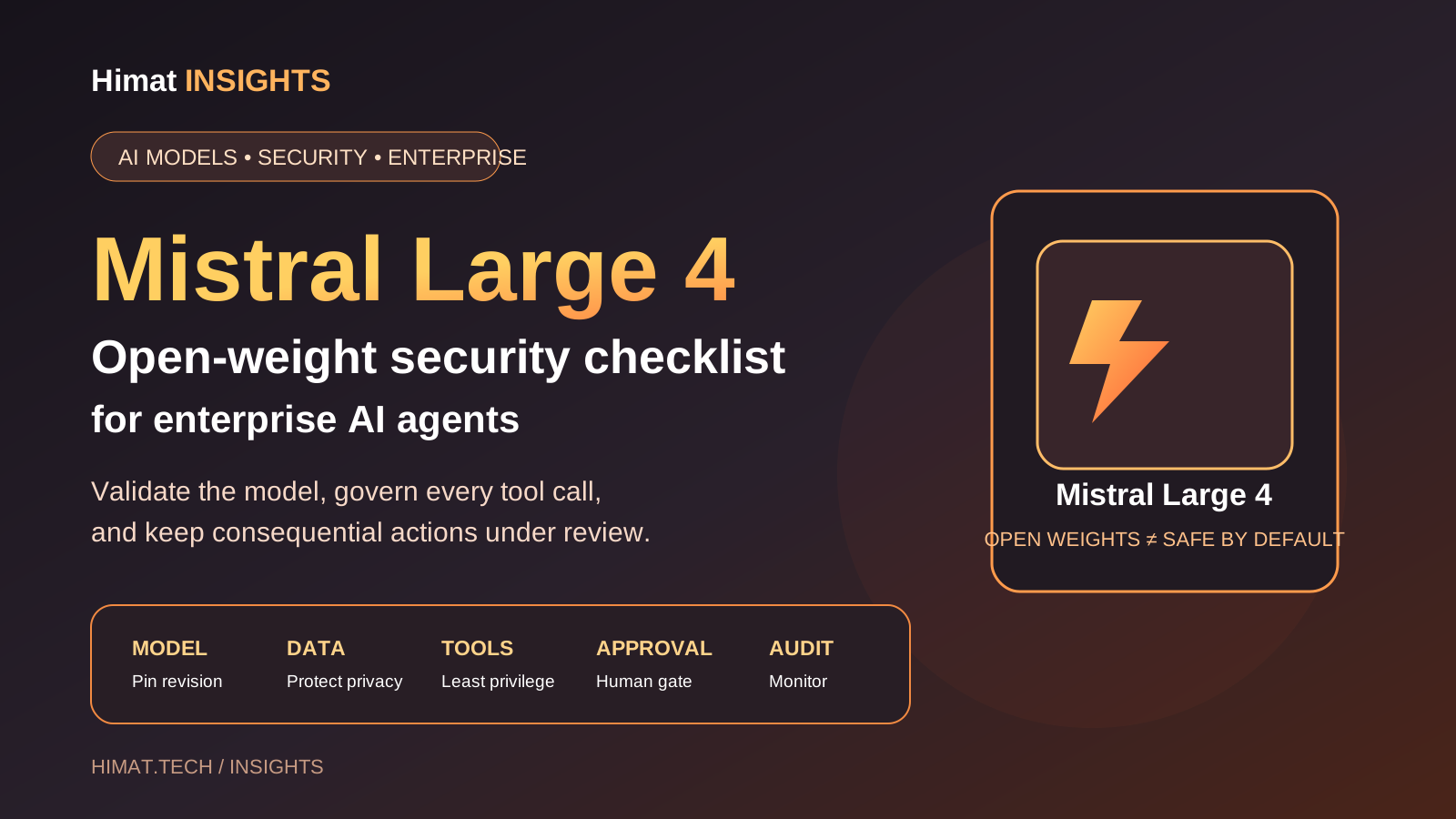
AI Engineering & Security
Mistral Large 4: Security Checklist for Enterprise AI Agents
Mistral Large 4’s weights are open. Learn how to test model quality, security, tool permissions, licensing, cost and production readiness before deployment.
A model release is only the start: validate the workload, controls, cost and failure modes before granting an AI agent access to production systems.
Quick Answer
Mistral released the improved Mistral Large 4 weights on October 29, 2026. The open-weight, multimodal model supports reasoning, coding and agentic workflows, but downloadable weights do not make an application production-safe. Before connecting it to enterprise systems, evaluate your own tasks, test prompt-injection and data-leakage risks, validate every tool call, review the license, measure real deployment cost, and keep consequential actions behind human approval.
What changed with Mistral Large 4?
Mistral previewed Large 4 on October 6 and released improved weights on October 29 after additional reinforcement learning. The company highlights coding, defensive-cybersecurity and reasoning-efficiency gains. See the October 29 release note for its description of the update.
Mistral reports 51% on the Artificial Analysis Cyber Index and a 96.6% average refusal rate on malicious cyber prompts. Treat these as vendor-reported evaluation results, not certification or proof that an application is secure. A refusal benchmark cannot test your retrieval layer, credentials, tools or deployment configuration.
Mistral also says live-traffic monitoring showed potential uplift for real attacks and that it was modifying guardrails. That disclosure makes application-level testing essential. Reuters covered the public release and its dual-use implications in its October 29 report.
What does open-weight mean — and what does it not mean?
Open-weight means the model parameters are available for download and deployment. It can improve control over where inference runs and how the model is adapted, but it does not prove that the training pipeline, serving stack or application is open, secure, compliant or cheap to operate.
Self-hosting reduces dependence on a third-party inference endpoint, but the organization takes on hardware, patching, access control, logging, backups and incident response. A private endpoint is not a security boundary if an agent still has excessive API permissions.
Review the Mistral Large 4 model card and its Mistral Ecosystem Open-Weight License. The modified MIT-style license permits broad use and modification, but operators of a Model-as-a-Service business need a separate commercial license. It includes exceptions for internal use and end-user products with embedded model features. This is a summary, not legal advice; have counsel review your distribution model.
Capabilities that matter to agent builders
The official model card describes a roughly 1T-parameter multimodal Mixture-of-Experts model with 49B active parameters per token (52B including embeddings and output layers). It supports a 1M context window, text and image input, low/medium/high reasoning effort, function calling and strict JSON Schema output.
Mistral recommends vLLM and documents SGLang, Transformers and llama.cpp support. Its vLLM example uses eight-way tensor parallelism on NVIDIA GPUs. This is an example, not a universal minimum: memory needs depend on precision, quantization, context, concurrency and runtime. Do not infer GPU requirements from active-parameter count alone.
A 1M context window does not mean every request should contain a million tokens. Large prompts can raise memory use, latency and cost while burying relevant evidence. Use retrieval and concise context assembly when they improve precision and preserve source references.
An eight-step checklist before production
1. Define one bounded workflow
Choose one bounded job—ticket classification, approved-document summaries, code-patch proposals or CRM drafts. Define inputs, expected output, stop condition and escalation path. Classify actions as read-only, draft-only or write-capable; do not start with an unrestricted agent.
2. Pin the model artifact and review its terms
Record the exact model revision, files, tokenizer, quantization, runtime and serving configuration. Pin versions instead of tracking a moving branch. Store the license with the deployment record and document whether the use is internal, embedded in a product or a model service.
3. Build an evaluation set from real work
Build representative tests from real work: normal, ambiguous, incomplete, multilingual, stale-source and conflicting-source cases, plus examples where the correct action is to stop. Define expected outcomes before comparing models. Synthetic cases can expand coverage, but domain owners should review labels. The free AI Evaluation Dataset Generator can help draft test pairs.
Score task completion, factual accuracy, groundedness, schema validity and unnecessary refusals. For retrieval answers, verify that each citation supports the claim and that missing evidence produces an explicit uncertainty response.
4. Test security at the application boundary
Test direct and retrieved-content prompt injection, sensitive-data disclosure, unsafe output handling, excessive agency and untrusted tool results. Include benign controls so the model is not rewarded for refusing everything. Use the OWASP GenAI LLM Top 10 2026 as a threat checklist and the NIST AI RMF to structure risk management.
For cyber workflows, test only authorized systems in isolated repositories with synthetic secrets. Verify findings and patches independently; never use the model’s explanation as the sole evidence that an action is safe.
5. Treat every tool call as untrusted input
Strict JSON constrains format, not authority. Validate arguments server-side, enforce a tool allowlist, check user permissions and reject unexpected fields. Add timeouts, rate limits, idempotency and error handling. If you use MCP, review filesystem access, shell and command permissions, tool schemas and exposed secrets with the free MCP Security & Permission Auditor.
6. Deploy to an isolated staging environment first
Use mock services or test tenants, synthetic data and credentials that cannot reach production. Separate read and write permissions. Test timeouts, retries, malformed responses and duplicate requests. Keep consequential writes in draft mode or behind explicit approval during the pilot.
7. Measure the cost of a completed task
Measure a successful end-to-end task, not just token price: include retries, tools, retrieval, queue time, GPU utilization, idle capacity, storage and human correction. Mistral’s model docs list $0.70/M input, $0.07/M cached input and $2.10/M output at review time; re-check before budgeting. HiMat’s cost calculator covers OpenAI, Anthropic, DeepSeek, Gemini and Groq/Llama, not Mistral Large 4. For self-hosting, add hardware, redundancy, power and operations.
Track task success, grounded-answer rate, invalid tool calls, policy violations, escalation, p95 latency, cost per completed task and human correction time. Set acceptance thresholds before testing and rerun the same suite after model, prompt or runtime changes.
8. Keep human approval, audit and rollback
Use least privilege, short-lived credentials, secret redaction and auditable model/policy versions. Require human approval for consequential writes until tests justify narrower controls. Define rollback for the model, prompt, retrieval index and tool configuration.
A safer reference architecture
Reference flow: user request → identity/policy gateway → permission-filtered retrieval → model → server-side schema and authorization checks → approval queue for consequential actions → business API → audit log. The model proposes; the application enforces.
For answer engines, attach source IDs, canonical URLs, timestamps and document versions to retrieved evidence. Measure citation precision and unsupported claims, not fluency alone. Clear entities, crawlable explanations, direct definitions and internal links help retrieval systems interpret content, but cannot guarantee AI citations.
What this means for GEO and enterprise AI search
GEO is not achieved by choosing a foundation model. It depends on whether useful information can be discovered, retrieved and attributed accurately. Give agents relevant, permission-checked evidence and preserve provenance; a citation is useful only when the source actually supports the claim.
For public sites, keep key facts in HTML, maintain accurate authorship and dates, and link relevant tools and services. For private RAG, enforce document permissions and versioning. In both cases, preserve provenance from source to answer.
Himat Technologies perspective
HiMat treats an AI agent as a bounded software workflow, not a chatbot with unrestricted credentials. We design task scope, tool allowlists, permission-aware retrieval, evaluations, failure handling and human approvals. Explore AI Agent Development, AI Software Development and RAG & AI Copilots.
Related reading: AI Agent Identity and Least-Privilege Security, GEO Context Governance, Deterministic Context Verification and Agentic Context Observability.
Frequently asked questions
Is Mistral Large 4 open-source?
Mistral calls it open-weight. Review the model license separately; the term does not mean every part of the training data, infrastructure or deployment system is open-source.
Can a company use Mistral Large 4 commercially?
Commercial use is permitted subject to the license. Model-as-a-Service operators need a separate commercial license; review the full terms for your distribution model.
Does a one-million-token context window remove the need for RAG?
No. Retrieval improves relevance, enforces document permissions and attaches source provenance; a large context window does not replace those controls.
Is Mistral Large 4 safe for cybersecurity agents?
No model is safe by default. Test authorized defensive tasks, prompt injection, tool permissions and patch quality in isolation with human review.
Can I run Mistral Large 4 on a single GPU?
Do not assume so from active-parameter count. Published serving examples use multi-GPU configurations; benchmark your exact precision, quantization, context, concurrency and runtime.
What should be measured before production?
Measure task success, groundedness, unsafe actions, policy violations, tool validity, p95 latency, cost per task, escalations and human corrections. Set thresholds before testing.
Sources and further reading
- Mistral: Mistral Large 4 (Le Chonk) is now open weight — October 29, 2026
- Mistral Large 4 official model card
- Mistral Large 4 API documentation and pricing
- Mistral Ecosystem Open-Weight License
- Reuters: Mistral AI publicly releases Large 4, targets cybersecurity users — October 29, 2026
- OWASP GenAI LLM Top 10 2026 — August 3, 2026
- NIST AI Risk Management Framework
Previous Article
GEO Agentic Context Observability & Real-Time OpenTelemetry Tracing in 2026: Engineering Distributed Context Spans, Semantic Drift Metrics, and Edge Trace Auditing for Frontier AI Search EnginesNext Article
Akamai Agent Sandbox: WebAssembly AI Execution GuideExplore other service pillars
Related articles
- AI Security & Agentic EngineeringAI Agent Identity in 2026: Why Least-Privilege Access Is Becoming the New Security PerimeterAI agents are moving from chat interfaces into APIs, SaaS tools, cloud platforms, and business workflows. Learn how to give agents their own identity, scoped permissions, short-lived credentials, delegation controls, and auditable actions without turning automation into an over-privileged security risk.
- Technical SEO & GEO EngineeringGEO Agentic Context Governance: A Practical Zero-Trust ArchitectureA practical guide to governing enterprise AI retrieval with identity-aware access, data minimization, redaction, source provenance, and audit trails, with implementation patterns and validation guidance.
- Technical SEO & GEO EngineeringGEO Agentic Context Verification & Deterministic Execution Audits in 2026: Engineering Cryptographic Model Context Proofs, Schema-Bound Retrieval Verification, and Zero-Hallucination Quorum Consensus for Enterprise AI Search EnginesMaster GEO Agentic Context Verification & Deterministic Execution Audits in 2026: Learn how enterprise engineering teams implement cryptographic model context proofs, Zod schema-bound retrieval verification, deterministic state hashing, and automated execution audits across ChatGPT Search, Gemini 2.5, Claude 3.7, and Perplexity.