Loading...
Back to Insights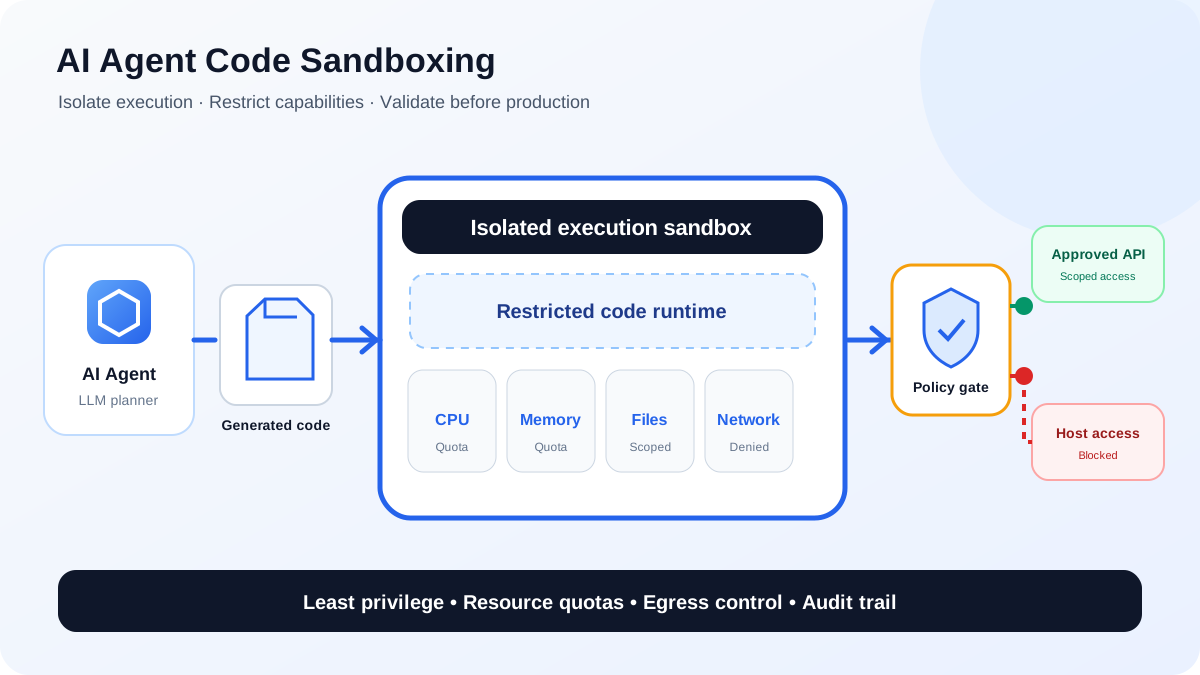
AI Infrastructure & Agent Runtime
Akamai Agent Sandbox: WebAssembly AI Execution Guide
Explore Akamai Agent Sandbox, its WebAssembly runtime, beta limits, developer fit, and a practical checklist for evaluating AI agent execution safely.
Akamai's preview makes agent code execution a managed runtime layer; application identity and business authorization remain separate responsibilities.
Quick Answer
Akamai Agent Sandbox is a managed execution environment for AI agents that uses a Spin/WebAssembly runtime to isolate code the agent generates. Akamai describes a nested JavaScript and Python execution layer, runtime-enforced limits, and outbound access blocked by default. It is currently offered through a beta/tech-preview access path, so developers should validate workload fit and preview terms before treating it as a production dependency.
Why this announcement matters
AI products are moving from answering questions to taking actions: generating code, running tests, transforming data, and invoking tools. The difficult part is not only selecting a capable model. A product also needs a place where untrusted code can run without inheriting the permissions of the application server or the user's workstation.
On October 27, 2026, Akamai announced Akamai Inference and Akamai Agent Sandbox as connected parts of an AI infrastructure offering. The announcement describes a managed inference service alongside an execution environment for agent-written code. The product page currently asks developers to request access to the Agent Sandbox tech preview. The distinction matters: the press release describes beta availability, while the product page is the current source for preview access and operational details.
Read the Akamai announcement and the Akamai Agent Sandbox product page before making a procurement or architecture decision.
What Akamai says the product does
The product overview describes an agent running in a Spin/WebAssembly environment. When the agent writes JavaScript or Python, that code executes in a more tightly restricted nested runtime. Akamai also describes resource limits and outbound network access blocked by default. The intent is to make code execution a managed boundary rather than an unrestricted child process on an application host.
The product page describes a short-step preview model: an intermittent agent completes a step, stops, and can be invoked again. It says each step is designed to complete in about a minute. Stateful components for agents that remain active for days or weeks are described as planned, not as a capability to assume in the current preview.
That makes the current fit question specific: does your workload consist of bounded execution steps, or does it depend on a long-lived process that retains state between actions?
How the execution model fits together
A useful mental model separates four responsibilities:
1. Inference: the model receives context and proposes the next action or code.
2. Agent runtime: the agent decides which bounded step to request and what inputs it needs.
3. Execution runtime: the sandbox runs generated code with the capabilities and resource limits supplied by the platform.
4. Application control plane: your product remains responsible for user identity, tenant policy, approvals, persistent business state, and access to production APIs.
The product's value is in managing the third layer and integrating it with inference. It does not remove the need for the fourth. If an agent can call a CRM, ticketing system, or database through an API outside the sandbox, that API still needs its own authorization checks.
What WebAssembly and Spin change
WebAssembly gives a host a controlled way to execute compiled modules. With WASI-style capability design, a module should receive only the filesystem, network, clock, or other host capabilities explicitly exposed to it. This differs from assuming a process can see the host environment and then trying to remove permissions after launch.
Spin provides an application framework for WebAssembly components. Akamai's use of Spin is relevant because it gives developers a component-oriented execution model while the managed service handles more of the runtime infrastructure. It does not mean every native binary, package, system call, or long-running workload will work unchanged. Compatibility must be tested against the languages and dependencies your agent actually uses.
The WASI security model explains capability-based access, the WebAssembly security overview describes module isolation, and the Spin documentation explains the component framework. The runtime and host imports still determine what a module can do.
Product capabilities and questions to validate
| Area | What current product information describes | What to verify in your own preview |
| --- | --- | --- |
| Execution model | Spin/WebAssembly agent environment with a nested JavaScript/Python runtime | Supported versions, package compatibility, native extensions and startup behavior |
| Network | Outbound access blocked by default for sandboxed code | Allowlist mechanism, DNS behavior, proxy support and private-network restrictions |
| Resources | Runtime-enforced execution limits | CPU, memory, disk, process, output-size and concurrency quotas |
| Duration | Intermittent steps; about one minute per step is described | Maximum step duration, retry behavior, cancellation and orchestration limits |
| State | Longer-lived stateful components are planned | What persists between steps, where state is stored and how it is isolated by tenant |
| Operations | Managed service integrated with Akamai Inference | Regions, logs, tracing, incident response, support, SLA, pricing and data-retention terms |
Treat the middle column as vendor-described product information, not an independent security certification. The final column is the due-diligence list for a proof of concept.
Which workloads look like a fit?
Short code tasks: a model writes a small transformation, calculation, or validation script and returns a bounded result.
Developer workflows: an agent runs a focused test, formatter, or repository analysis step without mounting a developer's full workstation or production credentials.
Document and data processing: generated code transforms an approved input file and writes a constrained output artifact.
Agent tool steps: an agent executes a small, repeatable computation between calls to trusted application APIs.
Workloads that depend on persistent background processes, long-running sessions, native system dependencies, large local datasets, or GPU-heavy execution need additional validation. Akamai's product page describes stateful support as planned, so do not design a critical long-lived workflow around that future capability.
Managed Agent Sandbox vs self-hosted alternatives
A managed product and a self-hosted runtime solve different operating problems. Akamai may reduce the work required to operate the execution platform and connect it to inference. Self-hosting can offer more control over versions, deployment topology, data paths, and integration, but your team then owns patching, isolation configuration, scheduling, observability, and incident response.
| Option | Main advantage | Main responsibility or trade-off |
| --- | --- | --- |
| Akamai Agent Sandbox | Managed execution environment connected to Akamai Inference | Preview access, product limits, vendor dependency and contract details must be assessed |
| Self-hosted Spin/WASI | Control over runtime, component versions and hosting topology | Your team operates the host, capability policy, lifecycle and monitoring |
| Hardened containers or gVisor | Broad Linux tool compatibility; gVisor adds a user-space kernel boundary | Kernel and runtime configuration, network policy, patching and compatibility remain your responsibility |
| Firecracker microVMs | Separate guest-kernel boundary for higher-risk workloads | KVM, image lifecycle, host hardening, boot overhead and operations |
gVisor's security model explains its user-space kernel approach. Firecracker's production host guidance describes the hardening expected around its KVM-based microVMs. These are alternatives to evaluate, not interchangeable implementations of Akamai's product.
Adoption checklist for a technical proof of concept
1. Choose one bounded workload. Use a small task with a clear input, expected output, and no irreversible side effects.
2. Confirm preview terms. Ask about access, regions, availability, pricing, support, data retention, and production-use restrictions.
3. Test real dependencies. Run the actual JavaScript or Python libraries, package versions, file formats, and input sizes used by the workflow.
4. Probe the boundary. Test attempted filesystem access outside the workspace, outbound requests, metadata endpoints, process spawning, resource exhaustion, and cross-tenant reads.
5. Measure the step lifecycle. Record startup time, execution time, retries, memory use, output size, failure modes, and the effect of the per-step duration model.
6. Keep business authority outside the runtime. Use your own identity and policy layer for CRM writes, payments, ticket changes, deployments, or other consequential actions.
7. Design the exit path. Keep task definitions, inputs, output schemas, and policy rules portable enough that you can move to a self-hosted runtime or another provider if preview terms or product limits change.
What the product does not replace
A sandbox can contain some consequences of generated code, but it does not make an agent trustworthy by itself. It does not automatically prevent prompt injection, decide whether a user may update a customer record, validate generated SQL, detect every malicious dependency, or approve a high-impact business action.
Keep model and tool permissions in your application control plane. Treat retrieved documents and tool responses as untrusted input. Validate outputs before consuming them. Require human approval for actions that are irreversible, financially material, or affect customer access. For broader incident lessons and general sandbox controls, see HiMat's existing AI Agent Sandboxing & Security analysis.
Where agent sandboxing fits in GEO and retrieval workflows
Generative Engine Optimization (GEO) focuses on helping answer systems discover, retrieve, understand, and attribute useful source material. An execution sandbox is not a ranking signal and does not make a page more likely to be cited. Its value is one layer downstream: a research or retrieval agent may fetch pages, parse untrusted markup, run generated transformations, or call tools to verify facts. Isolating that execution and denying outbound access by default can reduce the risk that hostile inputs or generated code affect the host or reach unintended services.
A safer workflow keeps source provenance and business authority outside the sandbox: (1) fetch a source and record its URL, publication date, and retrieval time in the trusted application; (2) parse or transform untrusted content inside the restricted runtime; (3) validate the output against a schema; (4) apply identity and policy checks before any tool call; and (5) pass the validated content and provenance to the synthesis layer. The sandbox protects execution; it does not replace source verification, editorial judgment, or access control. For the retrieval-policy layer, see GEO Agentic Context Governance.
HiMat Technologies perspective
For companies building internal copilots or autonomous workflow products, separate inference, execution, and business authority. A managed sandbox can be one execution option, but identity, tenant policy, tool authorization, approval, audit, and data lifecycle should remain explicit parts of the product design.
This is directly relevant to HiMat's AI Agent Development service and broader AI Software Development service. Select the runtime after workload testing, not from a feature list alone.
Related HiMat Technologies free tools
The MCP Security & Permission Auditor reviews recognizable MCP configuration risks such as broad filesystem roots, risky shell launches, unpinned package runners, plain-HTTP endpoints, wildcard approvals, and hard-coded credentials. It is a browser-local static checker; it does not certify a runtime sandbox.
The AI Evaluation Dataset Generator can help draft normal, adversarial, and unanswerable test cases for the proof of concept. Review generated cases and run them against the actual application and provider preview.
For related engineering context, read AI Agent Identity and Least-Privilege Access, Mistral Large 4: Security Checklist for Enterprise AI Agents, and GEO Agentic Context Governance.
Frequently asked questions
Is Akamai Agent Sandbox generally available?
Akamai's October 27 press release describes beta availability, while the current product page asks developers to request access to the Agent Sandbox tech preview. Confirm the current access path and contractual terms directly with Akamai before relying on it.
What runtime does Akamai Agent Sandbox use?
The product page describes a Spin/WebAssembly environment for the agent and a tighter nested JavaScript/Python runtime for code the agent writes. Verify language, package and native-extension compatibility with your own workload.
Can it run long-lived stateful agents?
The current product page describes intermittent execution steps and says stateful components for agents that remain active for days or weeks are planned. Treat long-running state as a future capability until the provider confirms availability.
Does blocking outbound network access make an agent secure?
No. It reduces one path for data exfiltration, but the application still needs authorization, tenant isolation, input and output validation, secret management, audit, and approval for consequential actions.
Should a team choose managed sandboxing or self-hosted WebAssembly?
Choose based on workload fit, access terms, control requirements, portability, latency, operations capacity, and total cost. A managed preview may accelerate evaluation; self-hosting offers more control but makes your team responsible for runtime operations and security.
Does Akamai Agent Sandbox replace Docker or microVMs?
Not automatically. It is a managed product with its own runtime model. Containers, gVisor, and microVMs are alternative isolation approaches with different compatibility and operational trade-offs. Compare them against the same threat model and workload tests.
Does sandboxing improve GEO visibility or AI citations?
No. A sandbox is an execution-security control, not a ranking or citation factor. It can make agents that collect, transform, and verify content safer, but discoverability still depends on accessible, accurate, well-structured sources and reliable provenance.
Conclusion
Akamai Agent Sandbox is worth evaluating because it makes isolated code execution a first-class part of an AI infrastructure offering. Its current preview model appears most relevant to bounded, intermittent agent tasks. Before adopting it, test the actual runtime, limits, data path, observability, and commercial terms—and keep identity, authorization, and production business actions under your own control.
Previous Article
Mistral Large 4: Security Checklist for Enterprise AI AgentsNext Article
Google Connected Apps: MCP Guide for Search & GeminiExplore other service pillars
Related articles
- AI Security & Agentic EngineeringAI Agent Identity in 2026: Why Least-Privilege Access Is Becoming the New Security PerimeterAI agents are moving from chat interfaces into APIs, SaaS tools, cloud platforms, and business workflows. Learn how to give agents their own identity, scoped permissions, short-lived credentials, delegation controls, and auditable actions without turning automation into an over-privileged security risk.
- AI Engineering & SecurityMistral Large 4: Security Checklist for Enterprise AI AgentsMistral Large 4’s weights are open. Learn how to test model quality, security, tool permissions, licensing, cost and production readiness before deployment.
- Technical SEO & GEO EngineeringGEO Agentic Context Governance: A Practical Zero-Trust ArchitectureA practical guide to governing enterprise AI retrieval with identity-aware access, data minimization, redaction, source provenance, and audit trails, with implementation patterns and validation guidance.